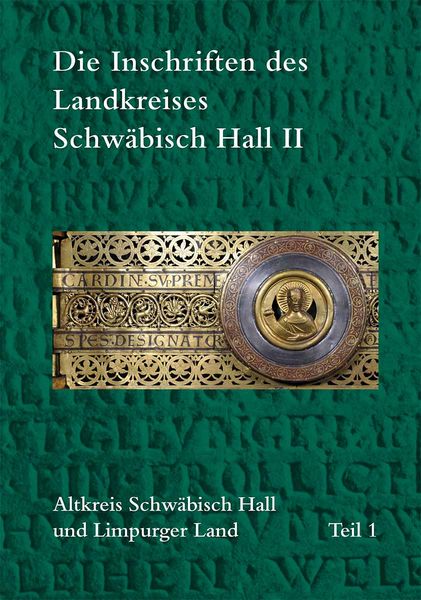
Die Inschriften des Landkreises Schwäbisch Hall II Altkreis Schwäbisch Hall und Limpurger Land
-
- Deutsch ausgewählt
279,99 €
inkl. gesetzl. MwSt.,
Beschreibung
Produktdetails
Einband
Gebundene Ausgabe
Erscheinungsdatum
05.04.2023
Verlag
Reichert, LSeitenzahl
2028
Maße (L/B/H)
1,5/20,2/28 cm
Gewicht
5730 g
Sprache
Deutsch
ISBN
978-3-7520-0680-3
Almost a fifth of the inscriptions were created before 1500, but the clear focus of the inscription tradition is the second half of the 16th and the first half of the 17th century. By far the largest part is made up of inscriptions commemorating the dead, with the unusually high number of wooden epitaphs being particularly noteworthy. In addition, a remarkably large number of late Gothic altar retables have survived the iconoclasm of the Reformation in churches and museums. The 86 bells in total also represent an extensive group.
By far the most important location with 909 inscriptions is the imperial city of Hall with impressive inscribed monuments of the city nobility and the self-confident citizens, primarily in and on the churches and on the Nikolai cemetery, but also on secular buildings in the old part of town. The diverse inscriptions offer rich material for genealogical and prosopographical research. This is followed by the Komburg collegiate church (monastery until 1488), which remained Catholic during the Reformation, with important tombs and furnishings, including antependium and chandelier from the Romanesque period. From the 14th to the 16th century, the Imperial Hereditary Butlers (Reichserbschenken) of Limpurg were buried there. Even before the residences of the Schenken family in Gaildorf, Obersontheim and Schloßschmiedelfeld, the Stöckenburg parish church stands out as a location of inscriptions.
Each inscribed monument is described in the catalogue, the texts are critically edited and translated if necessary. Where necessary, the script and content of the inscriptions are commented on. The introduction to the volume offers an evaluation of the entire material from various points of view. The main focus is on the inscription palaeography and the elaboration of workshop contexts. For example, the work of the stonemasons and sculptors Sem Schlör and Jakob Betzoldt, who lived in Hall, clearly gains contours through the present study. A comprehensive illustration section is used for illustration; 17 registers open up the material.
Using Schwäbisch Hall as an example, the edition enriches the overall picture of epigraphic tradition in imperial cities. In addition, it offers extensive material on the complex of issues relating to the relationship between the city and the surrounding area and prepares the inscriptions for further philological, historical, art and architectural history research.
Ein neues Kapitel für Ihre Bücher
Ein neues Kapitel für Ihre Bücher
Schenken Sie Ihren alten Schätzen ein zweites Leben: Einfach Barcode scannen, Versandetikett ausdrucken, Bücher verschicken und Thalia Geschenkkarte erhalten.
Jetzt verkaufenKundinnen und Kunden meinen
Verfassen Sie die erste Bewertung zu diesem Artikel
Helfen Sie anderen Kund*innen durch Ihre Meinung
Kurze Frage zu unserer Seite
Vielen Dank für Ihr Feedback
Wir nutzen Ihr Feedback, um unsere Produktseiten zu verbessern. Bitte haben Sie Verständnis, dass wir Ihnen keine Rückmeldung geben können. Falls Sie Kontakt mit uns aufnehmen möchten, können Sie sich aber gerne an unseren Kund*innenservice wenden.
zum Kundenservice