Produktbild: Educational Innovation in Economics and Business
- 14%

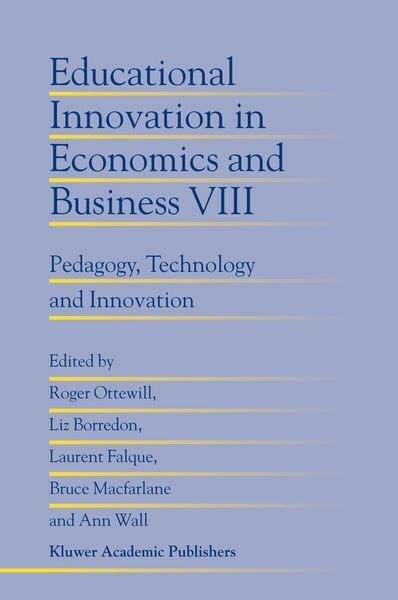
Educational Innovation in Economics and Business Pedagogy, Technology and Innovation

14% sparen

137,99 € UVP 160,49 €

inkl. gesetzl. MwSt., Versandkostenfrei


Beschreibung

Produktdetails

ISBN

978-1-4020-1787-2

Auflage

2004 edition

Erscheinungsdatum

31.12.2003

Einband

Gebundene Ausgabe

Herausgeber

Roger Ottewill + weitere

Verlag

Springer Netherland

Seitenzahl

401

Maße (L/B/H)

25,1/16,1/1,2 cm

Gewicht

898 g

Sprache

Englisch

Beschreibung

Produktdetails

ISBN

978-1-4020-1787-2

Auflage

2004 edition

Erscheinungsdatum

31.12.2003

Einband

Gebundene Ausgabe

Herausgeber

Verlag

Springer Netherland

Seitenzahl

401

Maße (L/B/H)

25,1/16,1/1,2 cm

Gewicht

898 g

Sprache

Englisch

Herstelleradresse

Libri GmbH
Europaallee 1
36244 Bad Hersfeld
DE

Email: gpsr@libri.de

Kundinnen und Kunden meinen

0 Bewertungen

Informationen zu Bewertungen

Zur Abgabe einer Bewertung ist eine Anmeldung im Konto notwendig. Die Authentizität der Bewertungen wird von uns nicht überprüft. Wir behalten uns vor, Bewertungstexte, die unseren Richtlinien widersprechen, entsprechend zu kürzen oder zu löschen.

Die Bewertungen sind nach Format, Anzahl Sterne und Datum sortiert.

Verfassen Sie die erste Bewertung zu diesem Artikel

Helfen Sie anderen Kund*innen durch Ihre Meinung

Kundinnen und Kunden meinen

0 Bewertungen filtern

Weitere Artikel finden Sie in

  • Produktbild: Educational Innovation in Economics and Business
  • Contributors. Acknowledgements. Editors. Preface. I: The Business Context. How E-Learning Businesses Meet Client and End-User Needs: Analysing the Collaborative Contexts; D. Russell, D. Calvey, M. Banks. Business Process, Experience and Memory: Educational Approaches and Technology Tools for a Global Workforce; D.M. Cardhidi, D.J. McCarthy. II: Challenges for the Academy. From High Level Clarity to Ground Level Confusion: Exactly Where Do IT-Mediated Education Policies Fit? S.D. Reeve, S.H. Flowers. Moving a University toward On-line Learning: Opportunities, Challenges and Technologies; D. Parker, A. Gemino. Linking Pedagogical Innovation and Information Technology to Enhance Business Education; S. Vasquez Bronfman. The Experience of Self-Organized Learning through the Use of Learning Plans for Knowledge Management; V. Lee Looi Chng, S. Coombes. III: Team and Collaborative Learning. Using Student Consulting Team Assignments as a Vehicle to Teach a Systems Development Course; S. Merchant. Using Team Learning in the Classroom: Experiences and Lessons; L.F. Christ, M.Y. Christ, A.S. Grahama, M.K. McCuddy, W.L. Pirie. Using Team Learning in the Classroom: Meeting the Challenge of Evaluating Students' Work; M.K. McCuddy, W.L. Pirie. International Management: Early Experience in Multicultural Virtual Team Interaction; K. Morse. IV: Problem Based Learning. PRAXIS: A Practice-Based Instructional System in the First Year of an Industrial Engineering Program; W.M. van Woerden, N.J. Smit. Using the Web for Problem-Based Learning; N.J. Smit, M. van Riemsdijk, J. van der Veen. Effects of Problem-Based Learning in Business Education: A Comparison between a PBL and a Conventional Educational Approach; P. van den Bossche, M. Segers,D. Gijbels, F. Dochy. Learning about Teaching Information Systems in a Problem-Based Curriculum: an Exploratory Study of the Impact of Students' Individual Differences on their Conception and Perception of Problem Tasks; J. Nijhuis, M. Segers, W. Gijselaers. V: Distance and On Line Learning. The Use of a Virtual Learning Environment to Support Learners on Work-Based Learning Programs; L. Bird. Distance Learning: The Experience of Accounting at the University of Natal (Durban) South Africa; A.B. Lumby, A.D. Saville. Creating and Improving a 'Virtual Object' through Web-Mediated Discourse; G. Wells. Testing Social Information Processing Theories in Distance Education; W.B. Martz Jr., M.M. Shepherd. VI: Specific Applications of Learning Technology. Electronic Tutorial for Moral Reasoning in Business Education: A Technological Learning Tool to Facilitate Students' Moral Reasoning; M. Alemán Vargas. The Five Key Benefits of On-line Final Examinations (with Three Free Bonus Benefits); J.B. Williams. Assertion-Reason Assessment in Formative and Summative Tests: Results from Two Graduate Case Studies; L.B. Connelly. Exploring the Implications of Videoconferencing for Management Learning; V. Hodgson, M. Asensio. Index.