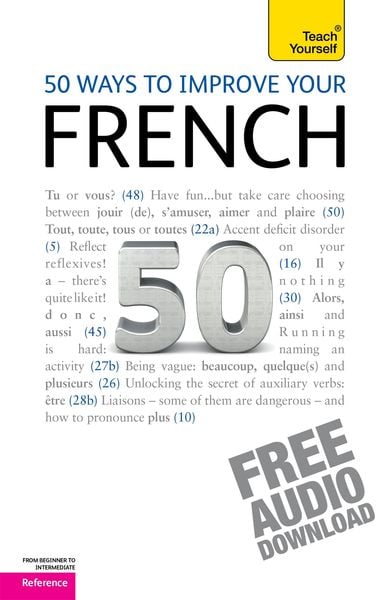
Produktbild: 50 Ways to Improve your French

50 Ways to Improve your French Teach Yourself

12,99 €

inkl. gesetzl. MwSt., Versandkostenfrei


Beschreibung

Produktdetails

ISBN

978-1-4441-1064-7

Erscheinungsdatum

27.08.2010

Sprachniveau

A1 + weitere

Einband

Taschenbuch

Verlag

Teach Yourself

Seitenzahl

160

Maße (L/B/H)

19,7/13/1,3 cm

Gewicht

163 g

Sprache

Englisch

Beschreibung

Produktdetails

ISBN

978-1-4441-1064-7

Erscheinungsdatum

27.08.2010

Sprachniveau

  • A1
  • A2
  • B1

Einband

Taschenbuch

Verlag

Teach Yourself

Seitenzahl

160

Maße (L/B/H)

19,7/13/1,3 cm

Gewicht

163 g

Sprache

Englisch

Herstelleradresse

Libri GmbH
Europaallee 1
36244 Bad Hersfeld
DE

Email: gpsr@libri.de

Noch keine Bewertungen vorhanden

Verfassen Sie die erste Bewertung zu diesem Artikel

Helfen Sie anderen Kundinnen und Kunden durch Ihre Meinung.

Kundinnen und Kunden meinen

Bewertungen (0)

Weitere Artikel finden Sie in

  • Produktbild: 50 Ways to Improve your French

    • : Meet the authors

    • : Only got 1 minute?

    • : Only got 5 minutes?

    • : Only got 10 minutes?

    • : How to use this book

    • : The 50 most common mistakes in French

    • : Sounding right

    • : 1 Vowel problems

    • : 2 Consonant problems

    • : 3 Silent endings and -ent

    • : 4 Numbers count

    • : 5 Accent deficit disorder

    • : 6 Capital letters can lead to capital errors

    • : 7 Mission impossible: how to pronounce words beginning with a vowel + n/m

    • : 8 Don’t get stressed about stress!

    • : 9 Contractions without (labour) pain) and the influence of the ‘h’ factor

    • : 10 Liaisons – some of them are dangerous – and how to pronounce plus

    • : Getting the structure right

    • : Getting the right word in the right place

    • : 11 Adjectives: you don’t have carte blanche!

    • : 12 Where do the ne and the pas belong? A negative viewpoint

    • : 13a Direct pronouns – get them sorted!

    • : 13b More possibilities with direct pronouns

    • : 14 Sort out your direct from your indirect pronouns!

    • : 15 Y and en, the pronouns for ‘there’ and ‘some of it’

    • : 16 Reflect on your reflexives!

    • : 17a Pronouns: subjective, emphatic and possessive

    • : 17b His or hers, mine or yours? Possessive adjectives and pronouns

    • : Nouns, adjectives and adverbs

    • : 18 Gender issues – very French!

    • : 19a Be articulate! The indefinite, definite and partitive articles

    • : 19b When to use un/une and le/la/les with days or parts of days

    • : 20 Agreement of adjectives: the French all agree on this!

    • : 21 How you do what you do – bon, bien, mauvais, mal, mieux, meilleur and pire

    • : 22 Tout, tous, toute and toutes: when and how to use them

    • : 23 C’est and il/elle est… Defining moments

    • : 24 You’re never alone with a plural!

    • : 25 Demonstrative adjectives: ‘this’, ‘these’ and ‘that’

    • : 26 Indefinite adjectives and adverbs: beaucoup, quelques, plusieurs…

    • : Verbs: what you do and when

    • : 27a The present participle: the ‘-ing’ thing (the ‘gerund’)

    • : 27b The present participle: naming an activity

    • : 28a Unlocking the secret of auxiliary verbs: avoir

    • : 28b Unlocking the secret of auxiliary verbs: être

    • : 29a Talking about time: depuis and ça fait…que

    • : 29b Talking about time: pour and pendant

    • : 30 Il y a – there’s nothing quite like it!

    • : 31 Set your past right! The perfect and imperfect tenses – which to use

    • : Prepositions

    • : 32 Prepositions: choosing the correct preposition

    • : 33 Prepositions: their presence or absence makes a difference!

    • : 34a Prepositions and places: towns and regions

    • : 34b Prepositions and places: countries and continents

    • : Weeding out unnecessary words and adding others

    • : 35 Verbs worth a closer look: attendre, chercher, aller and venir

    • : 36 How about ‘that’: que to express what you think, feel and believe

    • : Choosing the right words

    • : 37 Visiting places and people: who to bring and what to take

    • 38 Choose your verbs carefully! Connaître/savoir, entendre/écouter, voir/regarder,: laisser/quitter/partir and pouvoir/savoir

    • : 39a Qualifications and achievements: passing and taking exams

    • : 39b The workplace: interviews and meetings

    • : 40 Prendre, mettre and faire: how to deal with taking, putting (on), doing and making!

    • : 41 Etre or avoir (‘being’ or ‘having’)? How old are you and how do you feel?

    • : 42 Faire or faire faire?

    • : 43 Le temps: weather and time – taking the time to sort them out

    • : 44 Actuellement, normalement, eventuellement, réellement and proprement: beware these false friends

    • : 45 Alors, donc, aussi: saying ‘so, ‘thus’, ‘therefore’ and ‘also’

    • : 46 More false friends: they can let you down anytime, bigtime!

    • : 47 Use dictionaries carefully! Do not assume the first definition is the right one

    • : 48 Tu or vous?

    • : Adults only!

    • : 49 Watch these words!

    • : 50 Have fun…but take care choosing between jouir (de), s’amuser, aimer and plaire

    • : Glossary of grammatical terms

    • : Simplified sound system

    • : Index to grammar