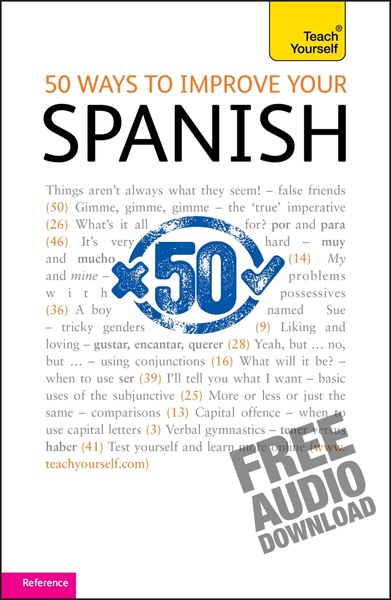
Produktbild: 50 Ways to Improve Your Spanish

50 Ways to Improve Your Spanish

14,99 €

inkl. gesetzl. MwSt., Versandkostenfrei


Beschreibung

Produktdetails

ISBN

978-1-4441-1594-9

Erscheinungsdatum

27.08.2010

Unterrichtsfächer

Spanisch

Schulformen

Erwachsenenbildung

Einband

Taschenbuch

Verlag

Teach Yourself

Seitenzahl

160

Maße (L/B/H)

19,6/13/1,5 cm

Gewicht

161 g

Sprache

Englisch

Beschreibung

Produktdetails

ISBN

978-1-4441-1594-9

Erscheinungsdatum

27.08.2010

Unterrichtsfächer

Spanisch

Schulformen

Erwachsenenbildung

Einband

Taschenbuch

Verlag

Teach Yourself

Seitenzahl

160

Maße (L/B/H)

19,6/13/1,5 cm

Gewicht

161 g

Sprache

Englisch

Herstelleradresse

Libri GmbH
Europaallee 1
36244 Bad Hersfeld
DE

Email: gpsr@libri.de

Noch keine Bewertungen vorhanden

Verfassen Sie die erste Bewertung zu diesem Artikel

Helfen Sie anderen Kundinnen und Kunden durch Ihre Meinung.

Kundinnen und Kunden meinen

Bewertungen (0)

Weitere Artikel finden Sie in

  • Produktbild: 50 Ways to Improve Your Spanish
    • : Meet the author
    • : Only got a minute?
    • : Only got 5 minutes?
    • : Only got 10 minutes?
    • : How to use this book
    • : Looking and sounding right
    • 1: Speling errers – Avoiding mistakes in spelling
    • 2a: It’s acute! – Using accents to mark stress
    • 2b: It’s acute! – Problems with accents
    • 3: Capital offence – When to use capital letters
    • 4a: Say it after me – Keeping vowels clear and simple
    • 4b: Say it after me – Concentrating on consonants
    • : Getting the structure right
    • : The right word in the right place
    • 5: Now how cow brown – Problems with word order
    • : Nouns, adjectives and adverbs
    • 6a: The cat sat on the mat – When to use the definite article
    • 6b: The cat sat on the mat – Further uses of the definite article
    • 7: What’s the form? – Forms of the articles
    • 8: ‘A’ or ‘an’ – Mistakes with the indefinite article
    • 9a: A boy named Sue – Tricky genders
    • 9b: A boy named Sue – More tips on gender
    • 10: Don’t agree to disagree! – Agreements
    • 11: Blurred picture – Common mistakes with adjectives
    • 12: A bit of this and that – Problems with demonstratives
    • 13: More or less or just the same – Comparisons
    • 14: It’s very hard – muy and mucho
    • 15: Softly softly – Easy does it with adverbs
    • : Conjunctions, questions and negatives
    • 16: Yeah, but… no, but… – Using conjunctions
    • 17: What was that? – Question words
    • 18: How long is a piece of string? – Tricky questions
    • 19: No means no! – Negative expressions
    • : Verbs and verb constructions
    • 20: Hey, you! – Which word for ‘you’?
    • 21a: Clear and present danger – Pitfalls in present-tense usage
    • 21b: Clear and present danger – Pitfalls in present-tense formation
    • 22: All in the past – Preterite and imperfect
    • 23a: Passive resistance – Replacing the passive with the reflexive
    • 23b: Passive resistance – Replacing the passive with impersonal se
    • 24: Coming and going – Use and misuse of the gerund
    • 25a: I’ll tell you what I want – Basic uses of the subjunctive
    • 25b: I’ll tell you what I want – Use and misuse of the subjunctive
    • 26a: Gimme, gimme, gimme – Simple commands and requests
    • 26b: Gimme, gimme, gimme – The ‘true’ imperative
    • 27a: All together now – Basic errors in joining verbs
    • 27b: All together now – Joining verbs with de and other prepositions
    • 28: Liking and loving – gustar, encantar, querer
    • 29: When I’m 64 – Looking into the future
    • 30: It all depends – Verbs with differing constructions
    • 31: What if? – Tenses with si
    • 32: I’m not so sure! – Problems with expressions of doubt
    • : Pronouns and possessives
    • 33: Only me! – Subject and prepositional pronouns
    • 34: Indirect or direct? – Object pronouns
    • 35a: You’re out of order! – Personal pronouns: which comes first?
    • 35b: You’re out of order! – Personal pronouns: before or after the verb?
    • 36: ‘My’ and ‘mine’ – Problems with possessives
    • : Numbers, dates and times
    • 37: Figure it out! – Problems with numbers
    • 38: When was that? – Days, dates and times
    • : Choosing the right words
    • 39a: What will it be? – When to use ser
    • 39b: What will it be? – When to use estar
    • 40: Being and having – Alternatives to ser/estar
    • 41a: Verbal gymnastics – jugar versus tocar
    • 41b: Verbal gymnastics – pensar versus creer
    • 42a: To have and to hold – tener versus haber
    • 42b: To have and to hold – hay, hay que and tener que
    • 43: Leave it out or I’ll quit! – Problems with leaving
    • 44: Getting the know-how – saber, conocer and poder
    • 45: Propositions about prepositions – en, a, de
    • 46: What’s it all for? – por and para
    • 47: The missing link – Unexpected uses of prepositions
    • 48: Up the ante – Mistakes with ‘before’ and ‘under’
    • 49: It’s behind you! – detrás, tras and después
    • 50: Things aren’t always what they seem! – False friends
    • : Glossary of grammatical terms
    • : Index