• Produktbild: Fun-Size Academic Writing for Serious Learning
  • Produktbild: Fun-Size Academic Writing for Serious Learning

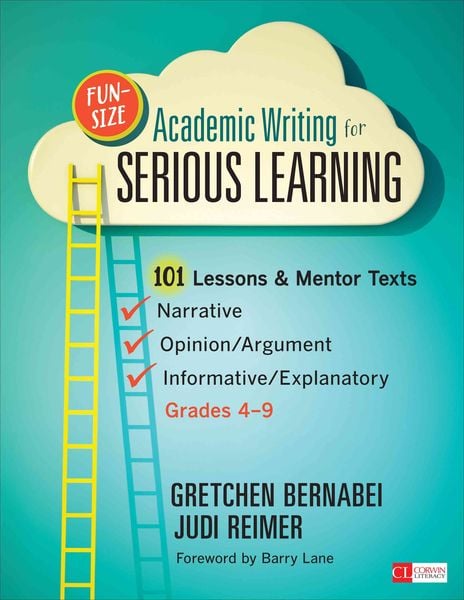
Fun-Size Academic Writing for Serious Learning 101 Lessons & Mentor Texts--Narrative, Opinion/Argument, & Informative/Explanatory, Grades 4-9

37,99 €

inkl. gesetzl. MwSt., Versandkostenfrei


Beschreibung

Produktdetails

ISBN

978-1-4522-6861-3

Erscheinungsdatum

06.08.2013

Einband

Taschenbuch

Verlag

Sage Publications

Seitenzahl

264

Maße (L/B/H)

28/21,6/1,4 cm

Gewicht

730 g

Sprache

Englisch

Beschreibung

Rezension

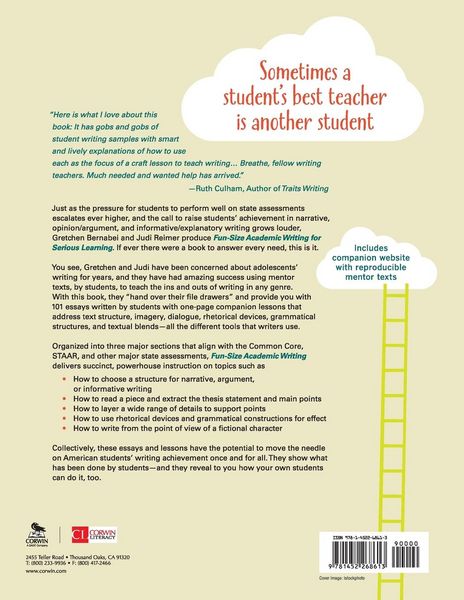
Here is what I love about this book:  It has gobs and gobs of student writing samples with smart and lively explanations of how to use each as the focus of a craft lesson to teach writing. The right models of student writing are the best mentor texts a teacher can find and with this book, you need look no further. . . . Breathe, fellow writing teachers.  Much needed and wanted help has arrived.

Ruth Culham, Author of Traits Writing

Zitat

"The good news is that the book you hold in your hand is a lifeline to real writing instruction. Based on careful observation of wonderfully varied student writing, grades 4-9, and organized around the genres of the Common Core Standards, Fun-Sized Academic Writing is the best book I know for giving students a fun-sized suit that fits their true voices as writers and thinkers."

Produktdetails

ISBN

978-1-4522-6861-3

Erscheinungsdatum

06.08.2013

Einband

Taschenbuch

Verlag

Sage Publications

Seitenzahl

264

Maße (L/B/H)

28/21,6/1,4 cm

Gewicht

730 g

Sprache

Englisch

Herstelleradresse

Libri GmbH
Europaallee 1
36244 Bad Hersfeld
DE

Email: Libri GmbH

Kundinnen und Kunden meinen

0 Bewertungen

Informationen zu Bewertungen

Zur Abgabe einer Bewertung ist eine Anmeldung im Konto notwendig. Die Authentizität der Bewertungen wird von uns nicht überprüft. Wir behalten uns vor, Bewertungstexte, die unseren Richtlinien widersprechen, entsprechend zu kürzen oder zu löschen.

Die Bewertungen sind nach Format, Anzahl Sterne und Datum sortiert.

Verfassen Sie die erste Bewertung zu diesem Artikel

Helfen Sie anderen Kund*innen durch Ihre Meinung

Kundinnen und Kunden meinen

0 Bewertungen filtern

  • Produktbild: Fun-Size Academic Writing for Serious Learning
  • Produktbild: Fun-Size Academic Writing for Serious Learning
  • Foreword by Barry Lane
    Acknowledgments
    Introduction
    Part I. Narrative
    1. Color It Up
    2. Sprinkling Writing With Humor
    3. Adding Movement and Sound to Animate a Piece
    4. Using Asides
    5. Combining Rhetorical Devices: Cataloguing and Repetition
    6. Using Literary Characters to Write Fiction
    7. Using Specific Language From a Special Setting
    8. Using Varied Sentence Openers to Create Rhythm and Flow
    9. Using Precise Language to Create Visual Snapshots
    10. Using Foreshadowing to Create Mood
    11. Building Suspense in a Narrative Through Questions and Answers
    12. Using Participles and Participial Phrases
    13. Using Variety When Introducing Narrator Thoughts
    14. Using Metaphor to Illuminate a Life Lesson
    15. Writing Observations
    16. Adding Rich Dialogue to a Narrative
    17. Writing From the Point of View of a Fictional Character
    18. Using Variations of "Said"
    19. Using Depth and Detail to "Explode" a Moment
    20. Showing How a Character Changes
    21. Using Introspection in a Memoir
    22. Using Onomatopoeia as an Organizational Device
    23. Using a Story to Illustrate a Life Lesson
    24. Combining Action and Back-Story
    25. Showing Conflicting Feelings in a Personal Narrative
    26. Fleshing Out a Kernel Essay With Dialogue
    27. Showing How a Character Makes an Important Decision
    28. Choosing Vivid Verbs
    29. Writing Dialogue With Inner Reactions
    30. Using Time Transitions: Flash Forward
    31. Using Absolutes as Sentence Fragments
    32. Using Time Transitions: Flashbacks
    33. Withholding and Revealing Information to Build Suspense
    34. Using Anadiplosis to Make a Truism Chain
    35. Using Enumeratio to Add Detail
    36. Layering Thinking and Dialogue
    37. Using Transitions to Develop a Conclusion
    38. Weaving Together Text From Different Genres
    Part II. Informative/Explanatory
    39. Sharing Culture Through Special Events
    40. Explaining a Historical Context
    41. Using Compound Predicates in a Series
    42. Analyzing Characters by Writing Letters Between Them
    43. Tracking a Changing Thought Process
    44. Responding to Literature: Questioning the Author (Part I)
    45. Responding to Literature: Questioning the Author (Part II)
    46. Conversing With an Imagined Listener
    47. Explaining a Concept From the Point of View of a Character
    48. Writing About Clues That Reveal a Situation
    49. Writing a Letter Using Second-Person Point of View
    50. Using Personification to Turn an Abstract Concept Into a Colorful Character
    51. Writing a Graphic Book Review
    52. Analyzing Literature: Focusing on Character Tension
    53. Responding to Literature: Characters Conversing About a Problem
    54. Analyzing Literature: Identifying Character Conflicts
    55. Analyzing Literature: Noticing an Author¿s Choices
    56. Recognizing and Illustrating an Important Theme
    57. Analyzing the Rhetorical Effects of Poetic Devices
    58. Analyzing a Movie
    59. Creating an "All About" Essay
    60. Giving Writing Vocal Qualities
    61. Using Opinions and Facts When Explaining Something New
    62. Defining an Important Concept
    63. Writing an Epistolary Essay
    64. Moving Between Concrete Details and Abstract Ideas
    65. Using Quotations to Support a Thesis in a Literary Essay
    66. Writing an Extended Apostrophe
    67. Multimedia Analysis of a Literary Theme
    Part III. Opinion/Argument
    68. Using Facts as Evidence
    69. Using Formal Versus Informal Language
    70. Writing a Script for a Public Service Announcement
    71. Examining Quotations
    72. Developing Sentence Variety
    73. Using Personal Experiences to Support Opinions
    74. Using Verbs and Adjectives to Back Up Opinions
    75. Making a Claim About a Historical Event
    76. Using Sensory Details
    77. Using Parentheses
    78. Naming and Renaming
    79. Using an Innovative Format
    80. Using Internal Citations
    81. Drawing Editorial Cartoons
    82. Knocking Down the Opposition
    83. Using Quirky Mental Images in an Argument
    84. Using Question and Answer to Frame an Argument
    85. Writing a Letter to Raise Awareness About a Social Problem
    86. Using Repetition (Anaphora) for Emphasis and Style
    87. Keeping an Argument From Sliding Into a Personal Narrative
    88. Creating a Poster for Persuasion
    89. Using Analogies to Show, Not Tell
    90. Anticipating and Overcoming Objections
    91. Anticipating a Reader¿s Objections
    92. Using Hyperbole for Effect
    93. Discovering a Problem, Proposing a Solution
    94. Weaving Information Into a Persuasive Argument
    95. Writing a Descriptive Lead
    96. Using Third-Person Examples in an Argument
    97. Using Opposites (Antithesis) to Make an Impact
    98. Revising an Argument for Length
    99. Using the Literary Present Tense to Present an Argument
    100. Making Inferences From Pictures
    101. Supporting an Argument With Expert Knowledge
    Appendixes
    Appendix A: 25 Ways to Use Great Student Essays
    Appendix B: Text Structures
    Appendix C: Lessons by Writing Trait and Level of Difficulty