• Produktbild: Computer Aided Systems Theory - EUROCAST '97
  • Produktbild: Computer Aided Systems Theory - EUROCAST '97
Band 1333

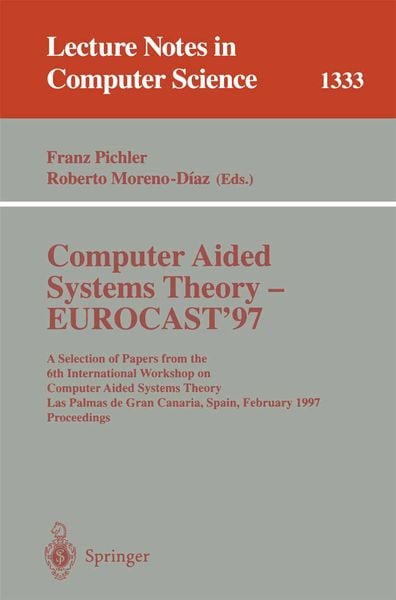
Computer Aided Systems Theory - EUROCAST '97 A Selection of Papers from the Sixth International Workshop on Computer Aided Systems Theory, Las Palmas de Gran Canaria, Spain, February 24-28, 1997, Proceedings

97,99 €

inkl. gesetzl. MwSt., Versandkostenfrei


Beschreibung

Produktdetails

Einband

Taschenbuch

Erscheinungsdatum

05.11.1997

Abbildungen

XII, 632 p.

Herausgeber

Franz Pichler + weitere

Verlag

Springer Berlin

Seitenzahl

632

Maße (L/B/H)

23,5/15,5/3,5 cm

Gewicht

961 g

Auflage

1997

Sprache

Englisch

ISBN

978-3-540-63811-7

Beschreibung

Produktdetails

Einband

Taschenbuch

Erscheinungsdatum

05.11.1997

Abbildungen

XII, 632 p.

Herausgeber

Verlag

Springer Berlin

Seitenzahl

632

Maße (L/B/H)

23,5/15,5/3,5 cm

Gewicht

961 g

Auflage

1997

Sprache

Englisch

ISBN

978-3-540-63811-7

Herstelleradresse

Springer-Verlag KG
Sachsenplatz 4-6
1201 Wien
AT

Email: GPSR Kontakt

Ein neues Kapitel für Ihre Bücher

Ein neues Kapitel für Ihre Bücher

Schenken Sie Ihren alten Schätzen ein zweites Leben und erhalten dafür eine Thalia Geschenkkarte.

Jetzt verkaufen
Jetzt verkaufen

Noch keine Bewertungen vorhanden

Verfassen Sie die erste Bewertung zu diesem Artikel

Helfen Sie anderen Kundinnen und Kunden durch Ihre Meinung.

Kundinnen und Kunden meinen

Bewertungen (0)

  • Produktbild: Computer Aided Systems Theory - EUROCAST '97
  • Produktbild: Computer Aided Systems Theory - EUROCAST '97
  • A system for designing parallel processor arrays.- On the role of architectures in systems engineering.- An approach to safety critical systems design.- Extensions and semantics of controller state diagrams for practical applications.- Design and implementation of an energy management system for an integrated iron and steel plant.- Representation and management of memory and decision in evolving software systems.- G E M — A generic engineering framework for mechanical engineering based upon meta models.- Formal representation and proof of the interpreted sequential machine model.- Modelling of concurrent and embedded systems.- A dense-time temporal logic with nice compositionality properties.- Introducing planning in discrete event systems.- Multirate control of a class of nonlinear systems.- Global structural approximate controllability of polynomial nonlinear systems.- Vectorized simulations of normal processes for first crossing-time problems.- An architecture for complex systems.- Model-based system design for engineering (T3SD) and general system logical theory.- Design of nonlinear lag-lead compensators by extended linearization using symbolic computation techniques.- A numerical computation for declarative expressions.- An automatic calculator with penrose diagrams.- Cognitive modeling for navigation of mobile robots using the sensory gradient concept.- Fuzzy traffic police for autonomous vehicles.- Object-oriented model of an open communication architecture for flexible manufacturing control.- A formal model for integrated system development.- Moving towards an agent-based engineering environment.- Experiencing modeling and development of an intelligent autonomous robot.- Modular control system for robotized cells and lines.- Latest developments in robotics.-Architectures for complex behaviour inspired in the nervous system.- Turing universality of neural nets (revisited).- Lifelong learning approach to intelligent agents modeling.- Role of qualitative reasoning in a multi-agent system.- Learning in multi-agent systems: Theoretical issues.- A computational model for visual size, location and movement.- Logic-algebraic method for a class of knowledge based systems.- Image compression by multilevel polynomial interpolation and wavelet texture coding.- Image enhancement using an optimum quantizer.- On the parametrization of algebraic discrete fourier transforms.- Learning visual ideals.- Multiple representation of complex intensity changes for image segmentation.- Design of ANN architectures for handling the temporal dimension in signal processing.- From sequential to distributed formal proofs.- Improvement in the computational efficiency in the analysis of signals by way of adaptive time frequency distributions.- Event based simulation of software development project planning.- Application of intelligent worldwide DSS to optimization problems.- System theoretical approach to control and synchronization of teleeducation in open distributed environment.- Multilevel approach to traffic control system.- A comparison of 4-GL development tools in the area of metadata and dynamic user interfaces.- Cryptographic permutations based on BOOT decompositions of walsh matrices.- PNtalk — a computerized tool for object oriented petri nets modelling.- System level design of microcontroller applications applications.