• Produktbild: Introduction to Coding Theory
  • Produktbild: Introduction to Coding Theory
Band 86 - 10%

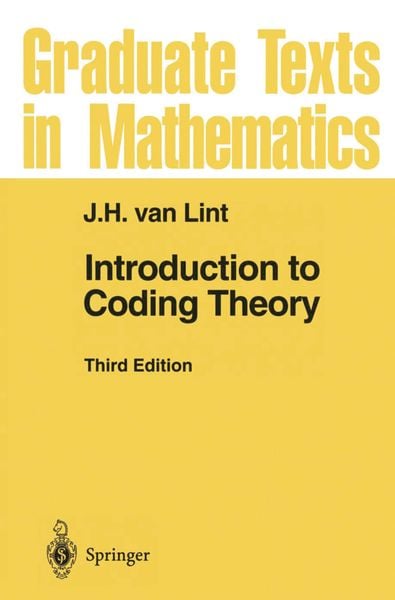
Introduction to Coding Theory

10% sparen

114,99 € UVP 128,39 €

inkl. gesetzl. MwSt., Versandkostenfrei


Beschreibung

Produktdetails

Einband

Gebundene Ausgabe

Erscheinungsdatum

15.12.1998

Verlag

Springer Berlin

Seitenzahl

234

Maße (L/B/H)

24,1/16/2 cm

Gewicht

547 g

Auflage

Third Edition 1999

Sprache

Englisch

ISBN

978-3-540-64133-9

Beschreibung

Produktdetails

Einband

Gebundene Ausgabe

Erscheinungsdatum

15.12.1998

Verlag

Springer Berlin

Seitenzahl

234

Maße (L/B/H)

24,1/16/2 cm

Gewicht

547 g

Auflage

Third Edition 1999

Sprache

Englisch

ISBN

978-3-540-64133-9

Herstelleradresse

Springer-Verlag KG
Sachsenplatz 4-6
1201 Wien
AT

Email: GPSR Kontakt

Ein neues Kapitel für Ihre Bücher

Ein neues Kapitel für Ihre Bücher

Schenken Sie Ihren alten Schätzen ein zweites Leben: Einfach Barcode scannen, Versandetikett ausdrucken, Bücher verschicken und Thalia Geschenkkarte erhalten.

Jetzt verkaufen
Jetzt verkaufen

Noch keine Bewertungen vorhanden

Verfassen Sie die erste Bewertung zu diesem Artikel

Helfen Sie anderen Kundinnen und Kunden durch Ihre Meinung.

Kundinnen und Kunden meinen

Bewertungen (0)

  • Produktbild: Introduction to Coding Theory
  • Produktbild: Introduction to Coding Theory
  • 1 Mathematical Background.- 1.1. Algebra.- 1.2. Krawtchouk Polynomials.- 1.3. Combinatorial Theory.- 1.4. Probability Theory.- 2 Shannon’s Theorem.- 2.1. Introduction.- 2.2. Shannon’s Theorem.- 2.3. On Coding Gain.- 2.4. Comments.- 2.5. Problems.- 3 Linear Codes.- 3.1. Block Codes.- 3.2. Linear Codes.- 3.3. Hamming Codes.- 3.4. Majority Logic Decoding.- 3.5. Weight Enumerators.- 3.6. The Lee Metric.- 3.7. Comments.- 3.8. Problems.- 4 Some Good Codes.- 4.1. Hadamard Codes and Generalizations.- 4.2. The Binary Golay Code.- 4.3. The Ternary Golay Code.- 4.4. Constructing Codes from Other Codes.- 4.5. Reed—Muller Codes.- 4.6. Kerdock Codes.- 4.7. Comments.- 4.8. Problems.- 5 Bounds on Codes.- 5.1. Introduction: The Gilbert Bound.- 5.2. Upper Bounds.- 5.3. The Linear Programming Bound.- 5.4. Comments.- 5.5. Problems.- 6 Cyclic Codes.- 6.1. Definitions.- 6.2. Generator Matrix and Check Polynomial.- 6.3. Zeros of a Cyclic Code.- 6.4. The Idempotent of a Cyclic Code.- 6.5. Other Representations of Cyclic Codes.- 6.6. BCH Codes.- 6.7. Decoding BCH Codes.- 6.8. Reed—Solomon Codes.- 6.9. Quadratic Residue Codes.- 6.10. Binary Cyclic Codes of Length 2n(n odd).- 6.11. Generalized Reed—Muller Codes.- 6.12. Comments.- 6.13. Problems.- 7 Perfect Codes and Uniformly Packed Codes.- 7.1. Lloyd’s Theorem.- 7.2. The Characteristic Polynomial of a Code.- 7.3. Uniformly Packed Codes.- 7.4. Examples of Uniformly Packed Codes.- 7.5. Nonexistence Theorems.- 7.6. Comments.- 7.7. Problems.- 8 Codes over ?4.- 8.1. Quaternary Codes.- 8.2. Binary Codes Derived from Codes over ?4.- 8.3. Galois Rings over ?4.- 8.4. Cyclic Codes over ?4.- 8.5. Problems.- 9 Goppa Codes.- 9.1. Motivation.- 9.2. Goppa Codes.- 9.3. The Minimum Distance of Goppa Codes.- 9.4. Asymptotic Behaviour of Goppa Codes.- 9.5. Decoding Goppa Codes.- 9.6. Generalized BCH Codes.- 9.7. Comments.- 9.8. Problems.- 10 Algebraic Geometry Codes.- 10.1. Introduction.- 10.2. Algebraic Curves.- 10.3. Divisors.- 10.4. Differentials on a Curve.- 10.5. The Riemann—Roch Theorem.- 10.6. Codes from Algebraic Curves.- 10.7. Some Geometric Codes.- 10.8. Improvement of the Gilbert—Varshamov Bound.- 10.9. Comments.- 10.10.Problems.- 11 Asymptotically Good Algebraic Codes.- 11.1. A Simple Nonconstructive Example.- 11.2. Justesen Codes.- 11.3. Comments.- 11.4. Problems.- 12 Arithmetic Codes.- 12.1. AN Codes.- 12.2. The Arithmetic and Modular Weight.- 12.3. Mandelbaum—Barrows Codes.- 12.4. Comments.- 12.5. Problems.- 13 Convolutional Codes.- 13.1. Introduction.- 13.2. Decoding of Convolutional Codes.- 13.3. An Analog of the Gilbert Bound for Some Convolutional Codes.- 13.4. Construction of Convolutional Codes from Cyclic Block Codes.- 13.5. Automorphisms of Convolutional Codes.- 13.6. Comments.- 13.7. Problems.- Hints and Solutions to Problems.- References.