• Produktbild: Point Defects in Semiconductors and Insulators
  • Produktbild: Point Defects in Semiconductors and Insulators
Band 51 - 12%

Point Defects in Semiconductors and Insulators Determination of Atomic and Electronic Structure from Paramagnetic Hyperfine Interactions

12% sparen

187,99 € UVP 213,99 €

inkl. gesetzl. MwSt., Versandkostenfrei


Beschreibung

Produktdetails

Einband

Gebundene Ausgabe

Erscheinungsdatum

22.01.2003

Abbildungen

XI, 492 p.

Herausgeber

Hans-Joachim Queisser

Verlag

Springer Berlin

Seitenzahl

492

Maße (L/B/H)

24,1/16/3,2 cm

Gewicht

922 g

Auflage

2003

Sprache

Englisch

ISBN

978-3-540-42695-0

Beschreibung

Produktdetails

Einband

Gebundene Ausgabe

Erscheinungsdatum

22.01.2003

Abbildungen

XI, 492 p.

Herausgeber

Hans-Joachim Queisser

Verlag

Springer Berlin

Seitenzahl

492

Maße (L/B/H)

24,1/16/3,2 cm

Gewicht

922 g

Auflage

2003

Sprache

Englisch

ISBN

978-3-540-42695-0

Herstelleradresse

Springer-Verlag KG
Sachsenplatz 4-6
1201 Wien
AT

Email: GPSR Kontakt

Ein neues Kapitel für Ihre Bücher

Ein neues Kapitel für Ihre Bücher

Schenken Sie Ihren alten Schätzen ein zweites Leben und erhalten dafür eine Thalia Geschenkkarte.

Jetzt verkaufen
Jetzt verkaufen

Noch keine Bewertungen vorhanden

Verfassen Sie die erste Bewertung zu diesem Artikel

Helfen Sie anderen Kundinnen und Kunden durch Ihre Meinung.

Kundinnen und Kunden meinen

Bewertungen (0)

  • Produktbild: Point Defects in Semiconductors and Insulators
  • Produktbild: Point Defects in Semiconductors and Insulators
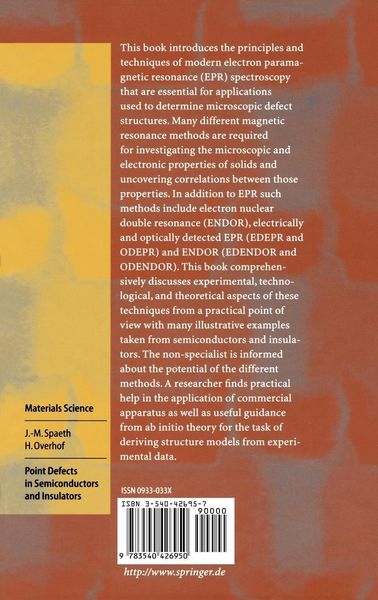
  • 1. Introduction.- 1.1 Structure of Point Defects.- 1.2 Basic Concepts of Defect Structure Determination by EPR.- 1.3 Superhyperfine and Electronic Structures of Defects in Solids.- 2. Fundamentals of Electron Paramagnetic Resonance.- 2.1 Magnetic Properties of Electrons and Nuclei.- 2.2 Electrons and Nuclei in an External Magnetic Field.- 2.3 Some Useful Relations for Angular Momentum Operators.- 2.4 Time Dependence of Angular Momentum Operators and Macroscopic Magnetization.- 2.5 Basic Magnetic Resonance Experiment.- 2.6 Spin-Lattice Relaxation.- 2.7 Rate Equations for a Two-Level System.- 2.8 Bloch Equations.- 2.9 Conventional Detection of Electron Paramagnetic Resonance and its Sensitivity.- 3. Electron Paramagnetic Resonance Spectra.- 3.1 Spin Hamiltonian.- 3.2 Electron Zeeman Interaction.- 3.3 g-Factor Splitting of EPR Spectra.- 3.4 Fine-Structure Splitting of EPR Spectra.- 3.5 Hyperfine Splitting of EPR Spectra.- 3.6 Superhyperfine Splitting of EPR Spectra.- 3.7 Inhomogeneous Line Widths of EPR Lines.- 4. Optical Detection of Electron Paramagnetic Resonance.- 4.1 Optical Transitions of Defects in Solids.- 4.2 Spectral Form of Optical Transitions of Defects in Solids.- 4.3 EPR Detected with Magnetic Circular Dichroism of Absorption Method.- 4.4 MCDA Excitation Spectra of ODEPR Lines (MCDA “Tagged” by EPR).- 4.5 Spatially Resolved MCDA and ODEPR Spectra.- 4.6 Measurement of Spin-Lattice Relaxation Time T1with MCDA Method.- 4.7 Determination of Spin State with MCDA Method.- 4.8 EPR of Ground and Excited States Detected with Optical Pumping.- 4.9 EPR Optically Detected in Donor-Acceptor Pair Recombination Luminescence.- 4.10 Optically Detected EPR of Triplet States.- 4.11 ODEPR of Trapped Excitons with MCDA Method.- 4.12 Sensitivity of ODEPR Measurements.- 4.13Structural Information from Forbidden Transitions in MCDA-EPR Spectra.- 4.14 Spatial Correlation Between Defects by Cross-Relaxation-Spectroscopy.- 4.15 High-Field ODEPR/ODENDOR.- 5. Electron Nuclear Double Resonance.- 5.1 The Resolution Problem, a Simple Model.- 5.2 Type of Information from EPR and NMR Spectra.- 5.3 Indirect Detection of NMR, Double Resonance.- 5.4 Examples of ENDOR Spectra.- 5.5 Relations Between EPR and ENDOR Spectra, ENDOR-Induced EPR.- 5.6 Electron Nuclear Nuclear Triple Resonance (Double ENDOR).- 5.7 Temperature Dependence and Photo-Excitation of ENDOR Spectra.- 5.8 Stochastic ENDOR.- 6. Analysis of ENDOR Spectra.- 6.1 Qualitative Analysis of ENDOR Spectra.- 6.2 Quantitative Analysis of ENDOR Spectra.- 7. Electrical Detection of Electron Paramagnetic Resonance.- 7.1 Experimental Methods to Detect EDEPR.- 7.2 Experimental Observation of EDEPR.- 7.3 The Donor-Acceptor Pair Recombination Model.- 7.4 On the Role of the Electron Irradiation for the Donor EPR in Silicon.- 7.5 Spatial Resolution and Low Frequency EDEPR.- 7.6 Electrical Detection of ENDOR.- 7.7 Concentration and Temperature Dependence of the EDEPR Signals.- 7.8 Further Spin-Dependent Recombination Models.- 8. Theoretical ab initio Calculations of Hyperfine Interactions.- 8.1 Electron States in Solids.- 8.2 Computational Methods for Deep Point Defects.- 8.3 Hyperfine Interactions.- 8.4 Deep Point Defects in Semiconductors and Insulators.- 8.5 Shallow Defects: The Effective Mass Approximation and Beyond.- 8.6 Conclusions.- 9. Experimental Aspects of Optically Detected EPR and ENDOR.- 9.1 Sensitivity Considerations.- 9.2 ODMR Spectrometers Monitoring Light Emission.- 9.3 ODMR Spectrometers Monitoring Magnetic Circular Properties of Absorption and Emission.- 9.4 Experimental Details of the Components of an MCDA/MCPE ODMR Spectrometer.- 9.5 High Frequency ODEPR/ODENDOR Cavities.- 9.6 High Pressure Photoluminescence-Detected EPR.- Appendices.- References.