• Produktbild: The Future of Human Resource Management
  • Produktbild: The Future of Human Resource Management

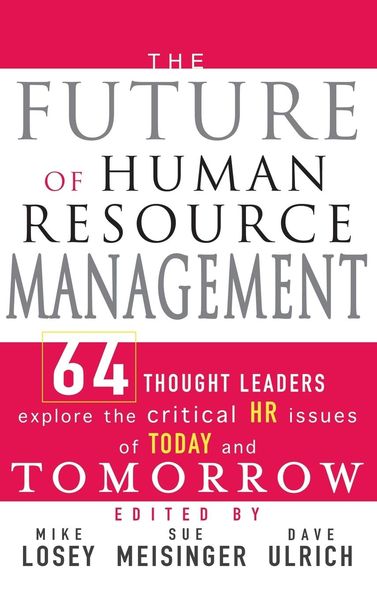
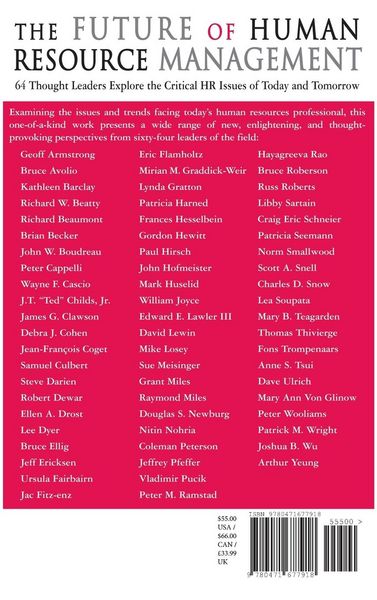
The Future of Human Resource Management 64 Thought Leaders Explore the Critical HR Issues of Today and Tomorrow

49,99 €

inkl. gesetzl. MwSt., Versandkostenfrei


Beschreibung

Produktdetails

Einband

Gebundene Ausgabe

Erscheinungsdatum

02.05.2005

Herausgeber

Mike Losey + weitere

Verlag

John Wiley & Sons Inc

Seitenzahl

448

Maße (L/B/H)

23,5/15,7/2,9 cm

Gewicht

800 g

Auflage

1. Auflage

Sprache

Englisch

ISBN

978-0-471-67791-8

Beschreibung

Rezension

"...this book is ideal for the busy practitioner and the book-weary student alike...a one-stop study guide to the most up-to-date HR thinking..." ( Personnel Today , 25 th October 2005)
"...This book provides a thought-provoking skim across the surface of HR..." ( Public Servant , 29 July 2005)

Produktdetails

Einband

Gebundene Ausgabe

Erscheinungsdatum

02.05.2005

Herausgeber

Verlag

John Wiley & Sons Inc

Seitenzahl

448

Maße (L/B/H)

23,5/15,7/2,9 cm

Gewicht

800 g

Auflage

1. Auflage

Sprache

Englisch

ISBN

978-0-471-67791-8

Herstelleradresse

Libri GmbH
Europaallee 1
36244 Bad Hersfeld
DE

Email: GPSR Kontakt

Ein neues Kapitel für Ihre Bücher

Ein neues Kapitel für Ihre Bücher

Schenken Sie Ihren alten Schätzen ein zweites Leben und erhalten dafür eine Thalia Geschenkkarte.

Jetzt verkaufen
Jetzt verkaufen

Noch keine Bewertungen vorhanden

Verfassen Sie die erste Bewertung zu diesem Artikel

Helfen Sie anderen Kundinnen und Kunden durch Ihre Meinung.

Kundinnen und Kunden meinen

Bewertungen (0)

Die Leseprobe wird geladen.
  • Produktbild: The Future of Human Resource Management
  • Produktbild: The Future of Human Resource Management
  • Introduction.
    The Future of Human Resources ( Michael R. Losey, Sue Meisinger, and Dave Ulrich ).

    Section I: Understanding and Managing People.

    Chapter 1: Will There Really Be a Labor Shortage? ( Peter Cappelli ).

    Chapter 2: The Motivator's Dilemma ( James G. Clawson and Douglas S. Newburg ).

    Chapter 3: Anticipating Change: Will There Be a Labor Shortage? ( Michael R. Losey ).

    Chapter 4: Get, Keep, Grow ( Coleman Peterson ).

    Chapter 5: The New Employment Relationship versus the Mutual Investment Approach: Implications for Human Resource Management ( Anne S. Tsui and Joshua B. Wu ).

    Section II: Invest in the Next Generation of Human Resource Professionalism.

    Chapter 6: The Future Human Resource Professional's Career Model ( Kathleen Barclay and Thomas Thivierge ).

    Chapter 7: Human Resource Education: A Career-Long Commitment ( Debra J. Cohen ).

    Chapter 8: Life after Outsourcing: Lessons Learned and the Role of Human Resources as a Strategic Business Partner ( Mirian M. Graddick-Weir ).

    Chapter 9: The Four Cs of the HR Profession: Being Competent, Curious, Courageous, and Caring about People ( Susan R. Meisinger ).

    Chapter 10: Differentiation through People-How Can HR Move beyond Business Partner? ( Geof f Armstrong ).

    Section III: Learn to Master and Play New Roles.

    Chapter 11: The Chief Integrative Leader: Moving to the Next Economy's HR Leader ( Bruce J. Avolio ).

    Chapter 12: From Business Partner to Driving Business Success: The Next Step in the Evolution of HR Management ( Wayne F. Cascio ).

    Chapter 13: Workforce Diversity: A Global HR Topic That Has Arrived ( J. T. (Ted) Childs Jr. ).

    Chapter 14: "Not Just Any Seat at the Table" ( Steve Darien ).

    Chapter 15: What Distinguishes the Outstanding HR Executives from the Others ( Bruce Ellig ).

    Chapter 16: Evolution and Revolution in the Twenty-First Century: Revolutionary New Rules for Organizations and Managing Human Resources ( Russ Roberts and Paul Hirsch ).

    Chapter 17: From Human Resources Management to Organizational Effectiveness ( Edward E. Lawler III ).

    Section IV: Discern, Create, and Adapt Culture to Business Conditions.

    Chapter 18: HR as a Strategic Partner: Culture Change as a Case Study ( Ursula F. Fairbairn ).

    Chapter 19: Changing Mental Models: HR's Most Important Task ( Jeffrey Pfeffer ).

    Chapter 20: Building a Market-Focused Culture ( Hayagreeva Rao and Robert D. Dewar ).

    Chapter 21: Branding from the Inside Out: HR's Role as Brand Builder ( Libby Sartain ).

    Chapter 22: The Winning Team: A Strategic Imperative ( Lea Soupata ).

    Section V: Rethink Organizations as Capabilities, Not Structures.

    Chapter 23: Workforce Strategy: A Missing Link in HR's Future Success ( Richard W. Beatty and Craig Eric Schneier ).

    Chapter 24: Connecting Strategy and HR: Establishing a New Logic of Partnership ( Gordon Hewitt ).

    Chapter 25: What Really Works? HR's Role in Building the 4+2 Organization ( William Joyce, Nitin Nohria, and Bruce Roberson ).

    Chapter 26: Human Resources' New ROI: Return on Intangibles ( Dave Ulrich and Norm Smallwood ).

    Chapter 27: In Pursuit of Marketplace Agility: Applying Precepts of Self-Organizing Systems to Optimize Human Resource Scalability ( Lee Dyer and Jeff Ericksen ).

    Chapter 28: Creating the Capability for Collaborative Entrepreneurship: HR's Role in the Development of a New Organizational Form ( Raymond E. Miles, Grant Miles, and Charles C. Snow ).

    Chapter 29: Partner or Guardian? HR's Challenge in Balancing Value and Values ( Patrick M. Wright and Scott A. Snell ).

    Section VI: See HR as a Decision Science and Bring Discipline to It.

    Chapter 30: Science Explodes Human Capital Mythology ( Jac Fitz-enz ).

    Chapter 31: Human Resource Accounting, Human Capital Management, and the Bottom Line ( Eric G. Flamholtz ).

    Chapter 32: Improving Human Resources' Analytical Literacy: Lessons from Moneyball ( Mark A. Huselid and Brian E. Becker ).