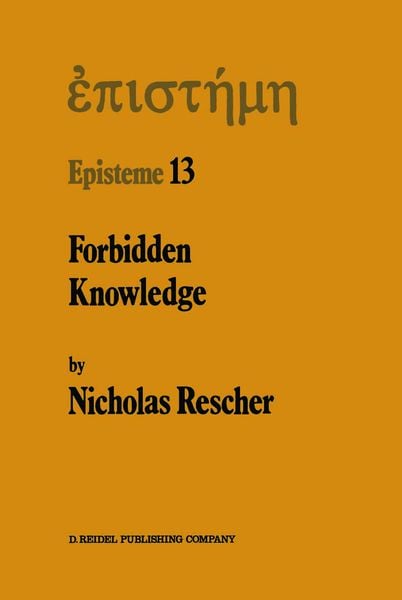
Produktbild: Forbidden Knowledge
Band 13 - 12%

Forbidden Knowledge And Other Essays on the Philosophy of Cognition

Aus der Reihe Episteme
12% sparen

93,99 € UVP 106,99 €

inkl. gesetzl. MwSt., Versandkostenfrei


Beschreibung

Produktdetails

Einband

Gebundene Ausgabe

Erscheinungsdatum

31.08.1987

Abbildungen

XIV, 154 p.

Verlag

Springer Netherland

Seitenzahl

154

Maße (L/B/H)

23,5/15,7/1,3 cm

Gewicht

411 g

Auflage

1987

Sprache

Englisch

ISBN

978-90-277-2410-6

Beschreibung

Produktdetails

Einband

Gebundene Ausgabe

Erscheinungsdatum

31.08.1987

Abbildungen

XIV, 154 p.

Verlag

Springer Netherland

Seitenzahl

154

Maße (L/B/H)

23,5/15,7/1,3 cm

Gewicht

411 g

Auflage

1987

Sprache

Englisch

ISBN

978-90-277-2410-6

Herstelleradresse

Springer-Verlag GmbH
Tiergartenstr. 17
69121 Heidelberg
DE

Email: ProductSafety@springernature.com

Ein neues Kapitel für Ihre Bücher

Ein neues Kapitel für Ihre Bücher

Schenken Sie Ihren alten Schätzen ein zweites Leben und erhalten dafür eine Thalia Geschenkkarte.

Jetzt verkaufen
Jetzt verkaufen

Noch keine Bewertungen vorhanden

Verfassen Sie die erste Bewertung zu diesem Artikel

Helfen Sie anderen Kundinnen und Kunden durch Ihre Meinung.

Kundinnen und Kunden meinen

Bewertungen (0)

  • Produktbild: Forbidden Knowledge
  • One/Forbidden Knowledge: Moral Limits of Scientific Research.- 1. A Range of Positions.- 2. Regulation vs. Laissez Faire.- 3. Moral Limits Pertain to Different Aspects of Knowledge.- 4. Can Knowledge as Such be Morally Inappropriate?.- 5. Knowledge is Only One Good among Others.- 6. The Enforcement of Morals.- 7. Coda.- Two/Truth as Ideal Coherence.- 1. The ‘Continuity Condition’ Relating a Criterion to the Definition of Truth.- 2. Truth as Ideal Coherence.- 3. Coherentism and Truth as Adequation.- 4. Postscript: The Gap Between the Real and the Ideal.- Three/Rationality and Consistency.- 1. Consistency: Initial Requisite or Ultimate Ideal?.- 2. Linearly Inferential vs. Dialectically Cyclic Reasoning.- 3. Ampliative vs. Reductive Reasoning.- 4. Two Very Different Sorts of Acceptability: Qualified vs. Outright Belief.- 5. Different Attitudes Towards Consistency.- 6. The Place of Dialectics in the Human Sciences.- 7. Must Inconsistency-Tolerance Be Motivated Epistemically?.- 8. Consistency as a Cognitive Ideal.- Four/An End to Science?.- 1. Is Scientific Discovery an Inherently Bounded Venture?.- 2. Nature Might Exhibit an Unending Complexity of Physical Constitution.- 3. Nature Might Exhibit an Unending Complexity of Lawful Comportment.- 4. The Phenomena of Nature Might Be Unendingly Diverse.- 5. The Basis for an Unending Prospect of Scientific Discovery Might Lie Wholly in the Character of Our Inquiry Processes.- 6. The Regulative Rationale for Supposing the Cognitive Inexhaustibility of Nature.- Five/On the Probabilistic Bearing of Testimony.- 1. Introduction.- 2. The Reliability of Sources.- 3.The Knowledgeability of Sources.- 4. Some Variations.- 5. A Survey of Probative Virtues.- 6. The Taxicab Problem.- 7. Hume and Laplace on Human Testimony.- 8. Laplace onTestimonial Chains.- 9. The Moral of the Story.- Six/The Limits of Probabilistic Epistemology.- 1. The Probabilist Program.- 2. Probability Is Not Enough.- Seven/The Threefold Way.- 1. The Three Levels.- 2. Some Examples.- 3. Man as a Creature of the Threefold Way.- 4. The Question of Legitimacy: The Utility of the Ideal.- Eight/Number Idolatry and Fallacies of Quantification.- Nine/Life’s Seasons: The Conceptual Phenomenology of Age-Periodization.- 1. The General Idea of a Life Cycle.- 2. The Rationale of Human Age-Periodization Phase Transitions.- 3. The Diversity of Age.- 4. The Conventionality of Phase Transition.- 5. Thought Experiments.- 6. The Upshot.- 7. Broader Vistas.- Ten/Philosophical Taxonomy as A Philosophical Issue.- 1. The Shape of Philosophy: Some Ancient Views.- 2. The Middle Ages and Early Modern Times.- 3. A Later Picture.- 4. Taxonomic Dynamics.- 5. The Post-Kantian Transformation.- 6. Taxonomic Proliferation.- 7. The Contemporary Situation.- 8. The Problem of Progress.- 9. The Dialectic of the Individual and the Community.- 10. Conclusion.- Eleven/Is Philosophy a Guide to Life?.- 1. Philosophy: The Problematic Guide.- 2. The Problem of ‘Applied Philosophy’: Only One’s Own Philosophy Can Provide Guidance.- 3. What Philosophy Per Se Can Contribute.- 4. Some Examples of ‘Applied Philosophy’ in the Public Domain.- 5. The Limited Utility of Methodological Applications.- 6. A Danger of ‘Applied Philosophy’.- Notes.- Index of Names.