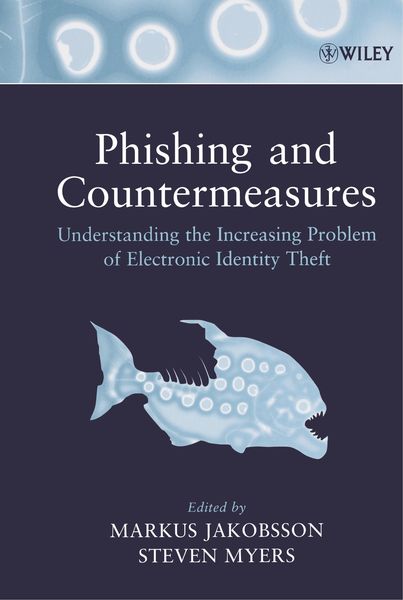
Phishing and Countermeasures Understanding the Increasing Problem of Electronic Identity Theft
146,99 €
inkl. gesetzl. MwSt.,
Beschreibung
Produktdetails
Einband
Gebundene Ausgabe
Erscheinungsdatum
01.11.2006
Abbildungen
w. figs.
Herausgeber
Steven Myers + weitereVerlag
John Wiley & SonsSeitenzahl
736
Maße (L/B/H)
24/16,1/4,4 cm
Gewicht
1258 g
Auflage
1. Auflage
Sprache
Englisch
ISBN
978-0-471-78245-2
--Directors of the International Financial Cryptography Association (IFCA)
Phishing attacks, or the practice of deceiving people into revealing sensitive data on a computer system, continue to mount. Here is the information you need to understand how phishing works, how to detect it, and how to prevent it.
Phishing and Countermeasures begins with a technical introduction to the problem, setting forth the tools and techniques that phishers use, along with current security technology and countermeasures that are used to thwart them. Readers are not only introduced to current techniques of phishing, but also to emerging and future threats and the countermeasures that will be needed to stop them. The potential and limitations of all countermeasures presented in the text are explored in detail. In spite of the fact that phishing attacks constantly evolve, much of the material in this book will remain valid, given that the book covers the general principles as much as actual instances of phishing.
While delving into a myriad of countermeasures and defense strategies, the authors also focus on the role of the user in preventing phishing attacks. The authors assert that countermeasures often fail not for technical reasons, but rather because users are unable or unwilling to use them. In response, the authors present a number of countermeasures that are simple for users to implement, or that can be activated without a user's direct participation. Moreover, the authors propose strategies for educating users. The text concludes with a discussion of how researchers and security professionals can ethically and legally perform phishing experiments to test the effectiveness of their defense strategies against the strength of current and future attacks.
Each chapter of the book features an extensive bibliography to help readers explore individual topics in greater depth. With phishing becoming an ever-growing threat, the strategies presented in this text are vital for technical managers, engineers, and security professionals tasked with protecting users from unwittingly giving out sensitive data. It is also recommended as a textbook for students in computer science and informatics.
Ein neues Kapitel für Ihre Bücher
Ein neues Kapitel für Ihre Bücher
Schenken Sie Ihren alten Schätzen ein zweites Leben und erhalten dafür eine Thalia Geschenkkarte.
Noch keine Bewertungen vorhanden
Verfassen Sie die erste Bewertung zu diesem Artikel
Helfen Sie anderen Kundinnen und Kunden durch Ihre Meinung.
Kurze Frage zu unserer Seite
Vielen Dank für Ihr Feedback
Wir nutzen Ihr Feedback, um unsere Produktseiten zu verbessern. Bitte haben Sie Verständnis, dass wir Ihnen keine Rückmeldung geben können. Falls Sie Kontakt mit uns aufnehmen möchten, können Sie sich aber gerne an unseren Kund*innenservice wenden.
zum Kundenservice