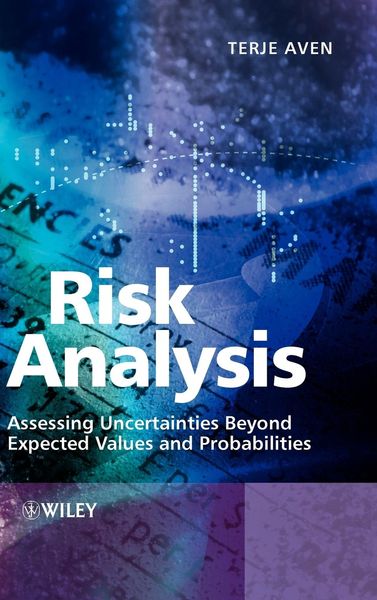
Risk Analysis
-
Sprache:Englisch
-
Auflage:1. Auflage
- 2nd Revised edition 115,99 €
- 1. Auflage 122,99 € ausgewählt
122,99 €
inkl. gesetzl. MwSt.,
Beschreibung
Produktdetails
Einband
Gebundene Ausgabe
Erscheinungsdatum
27.05.2008
Verlag
John Wiley & Sons IncSeitenzahl
208
Maße (L/B/H)
23,5/15,7/1,7 cm
Gewicht
495 g
Auflage
1. Auflage
Sprache
Englisch
ISBN
978-0-470-51736-9
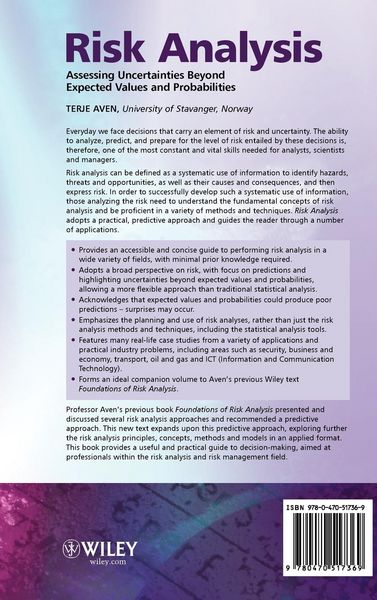
Risk analysis can be defined as a systematic use of information to identify hazards, threats and opportunities, as well as their causes and consequences, and then express risk. In order to successfully develop such a systematic use of information, those analyzing the risk need to understand the fundamental concepts of risk analysis and be proficient in a variety of methods and techniques. Risk Analysis adopts a practical, predictive approach and guides the reader through a number of applications.
* Provides an accessible and concise guide to performing risk analysis in a wide variety of fields, with minimal prior knowledge required.
* Adopts a broad perspective on risk, with focus on predictions and highlighting uncertainties beyond expected values and probabilities, allowing a more flexible approach than traditional statistical analysis.
* Acknowledges that expected values and probabilities could produce poor predictions - surprises may occur.
* Emphasizes the planning and use of risk analyses, rather than just the risk analysis methods and techniques, including the statistical analysis tools.
* Features many real-life case studies from a variety of applications and practical industry problems, including areas such as security, business and economy, transport, oil & gas and ICT (Information and Communication Technology).
* Forms an ideal companion volume to Aven's previous Wiley text Foundations of Risk Analysis.
Professor Aven's previous book Foundations of Risk Analysis presented and discussed several risk analysis approaches and recommended a predictive approach. This new text expands upon this predictive approach, exploring further the risk analysis principles, concepts, methods and models in an applied format. This book provides a useful and practical guide to decision-making, aimed at professionals within the risk analysis and risk management field.
Ein neues Kapitel für Ihre Bücher
Ein neues Kapitel für Ihre Bücher
Schenken Sie Ihren alten Schätzen ein zweites Leben und erhalten dafür eine Thalia Geschenkkarte.
Noch keine Bewertungen vorhanden
Verfassen Sie die erste Bewertung zu diesem Artikel
Helfen Sie anderen Kundinnen und Kunden durch Ihre Meinung.
Kurze Frage zu unserer Seite
Vielen Dank für Ihr Feedback
Wir nutzen Ihr Feedback, um unsere Produktseiten zu verbessern. Bitte haben Sie Verständnis, dass wir Ihnen keine Rückmeldung geben können. Falls Sie Kontakt mit uns aufnehmen möchten, können Sie sich aber gerne an unseren Kund*innenservice wenden.
zum Kundenservice