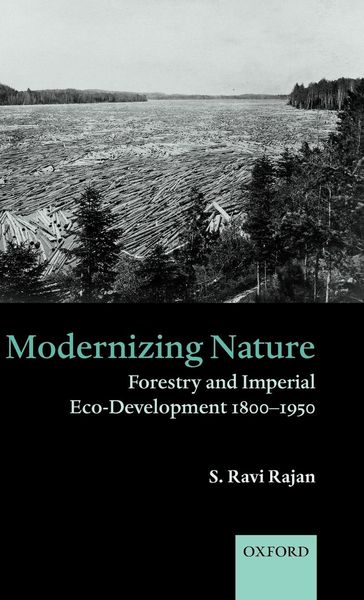
Modernizing Nature Forestry and Imperial Eco-Development 1800-1950
-
- Englisch ausgewählt
328,99 €
inkl. gesetzl. MwSt.,
Beschreibung
Produktdetails
Einband
Gebundene Ausgabe
Erscheinungsdatum
16.02.2006
Abbildungen
4 figures, 1 table
Verlag
Oxford AcademicSeitenzahl
304
Maße (L/B/H)
22,2/14,5/2,1 cm
Gewicht
562 g
Sprache
Englisch
ISBN
978-0-19-927796-4
Modernizing Nature contributes to the debate regarding the origins, institutionalization, and politics of the sciences and systems of knowledge underlying colonial frameworks of environmental management. It departs from the widely prevalent scholarly perspective that colonial science can be understood predominantly as a handmaiden of imperialism. Instead, it argues that the myriad colonial sciences had ideological and interventionist traditions distinct from each other and from the colonial bureaucracy and that these tensions better explain environmental politics and policy dilemmas in the post-colonial era. Professor Rajan argues that tropical forestry in the nineteenth century consisted of at least two distinct approaches towards nature, resource, and people; and what won out in the end was the Continental European forestry paradigm. Rajan also shows that science and scientists were relatively marginal until the First World War. It was the acute scientific and resource crisis felt during the War, along with the rise of experts and expertise in Britain during that period and the lobby-politics of an organized empire-wide scientific community, that resulted in resource management regimes such as forestry beginning to get serious state backing. Over time, considerable differences in approach and outlook towards policy emerged between different colonial scientific communities, such as foresters and agriculturists. These different colonial sciences represented different situated knowledges, with different visions of nature, people, and empire, and in different configurations of power. Finally, in a panoramic overview of post-colonial developments, Rajan argues that the hegemony of these state-scientific regimes of resource-management during the period 1950-1990 engendered not just social revolt, as recent historical work has shown, but also intellectual protest. Consequently, the discipline of forestry became systematically re-conceptualized, with newapproaches to sylviculture, economics, law, and crucially, with new visions of modernity. This disciplinary change constitutes nothing short of a cognitive revolution, one that has been brought about by a clearly articulated political perspective on the orientation of the discipline of forestry by its practitioners.
Ein neues Kapitel für Ihre Bücher
Ein neues Kapitel für Ihre Bücher
Schenken Sie Ihren alten Schätzen ein zweites Leben und erhalten dafür eine Thalia Geschenkkarte.
Noch keine Bewertungen vorhanden
Verfassen Sie die erste Bewertung zu diesem Artikel
Helfen Sie anderen Kundinnen und Kunden durch Ihre Meinung.
Kurze Frage zu unserer Seite
Vielen Dank für Ihr Feedback
Wir nutzen Ihr Feedback, um unsere Produktseiten zu verbessern. Bitte haben Sie Verständnis, dass wir Ihnen keine Rückmeldung geben können. Falls Sie Kontakt mit uns aufnehmen möchten, können Sie sich aber gerne an unseren Kund*innenservice wenden.
zum Kundenservice