• Produktbild: The Oxford Handbook of Contextual Political Analysis
  • Produktbild: The Oxford Handbook of Contextual Political Analysis

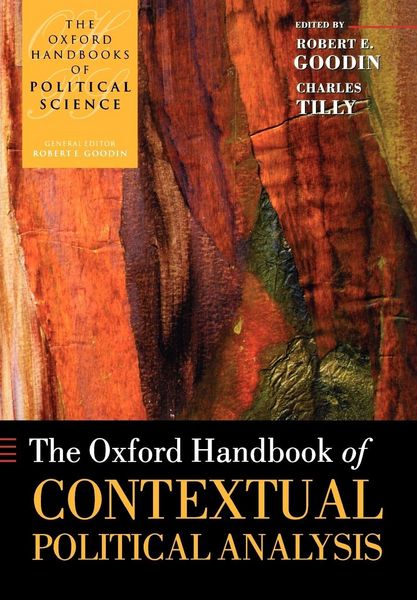
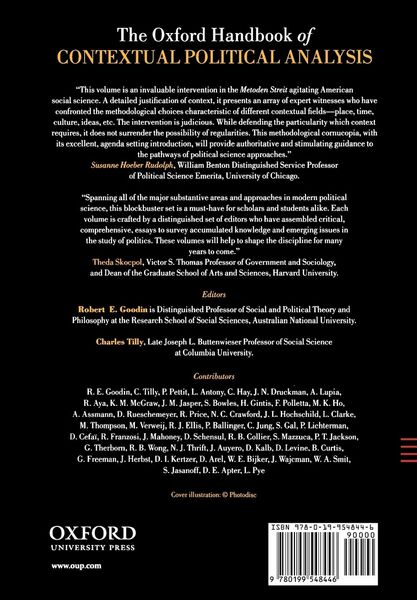
The Oxford Handbook of Contextual Political Analysis

95,99 €

inkl. gesetzl. MwSt., Versandkostenfrei


Beschreibung

Produktdetails

Einband

Taschenbuch

Erscheinungsdatum

19.06.2008

Herausgeber

Goodin Robert E. + weitere

Verlag

Oxford University Press

Seitenzahl

882

Maße (L/B/H)

24,4/17/4,7 cm

Gewicht

1489 g

Sprache

Englisch

ISBN

978-0-19-954844-6

Beschreibung

Produktdetails

Einband

Taschenbuch

Erscheinungsdatum

19.06.2008

Herausgeber

Verlag

Oxford University Press

Seitenzahl

882

Maße (L/B/H)

24,4/17/4,7 cm

Gewicht

1489 g

Sprache

Englisch

ISBN

978-0-19-954844-6

Herstelleradresse

Libri GmbH
Europaallee 1
36244 Bad Hersfeld
DE

Email: gpsr@libri.de

Ein neues Kapitel für Ihre Bücher

Ein neues Kapitel für Ihre Bücher

Schenken Sie Ihren alten Schätzen ein zweites Leben und erhalten dafür eine Thalia Geschenkkarte.

Jetzt verkaufen
Jetzt verkaufen

Noch keine Bewertungen vorhanden

Verfassen Sie die erste Bewertung zu diesem Artikel

Helfen Sie anderen Kundinnen und Kunden durch Ihre Meinung.

Kundinnen und Kunden meinen

Bewertungen (0)

  • Produktbild: The Oxford Handbook of Contextual Political Analysis
  • Produktbild: The Oxford Handbook of Contextual Political Analysis
    • Part I. Introduction
    • 1: Charles Tilly and Robert E. Goodin: It Depends
    • Part II. Philosophy Matters
    • 2: Philip Pettit: Why and How Philosophy Matters
    • 3: Louise Antony: The Socialization of Epistemology
    • 4: Colin Hay: Political Ontology
    • 5: James N. Druckman and Arthur Lupia: Mind, Will, and Choice
    • 6: Rod Aya: Theory, Fact, Logic
    • Part III. Psychology Matters
    • 7: Kathleen M. McGraw: Why and How Psychology Matters
    • 8: James M. Jasper: Motivation and Emotion
    • 9: Samuel Bowles and Herbert Gintis: Social Preferences, Homo Economicus, and Zoon Politikon
    • 10: Francesca Polletta and M. Kai Ho: Frames and Their Consequences
    • 11: Aleida Assmann: Memory, Individual and Collective
    • Part IV. Ideas Matter
    • 12: Dietrich Rueschemeyer: Why and How Ideas Matter
    • 13: Richard Price: Detecting Ideas and Their Effects
    • 14: Neta C. Crawford: How Previous Ideas Affect Later Ideas
    • 15: Jennifer L. Hochschild: How Ideas Affect Actions
    • 16: Lee Clarke: Mistaken Ideas and Their Effects
    • Part V. Culture Matters
    • 17: Michael Thompson, Marco Verweij, and Richard J. Ellis: Why And How Culture Matters
    • 18: Pamela Ballinger: How to Detect Culture and its Effects
    • 19: Courtney Jung: Race, Ethnicity, Religion
    • 20: Susan Gal: Language, Its Stakes and Its Effects
    • 21: Paul Lichterman and Daniel Cefaï: The Idea of Political Culture
    • Part VI. History Matters
    • 22: Charles Tilly: Why and How History Matters
    • 23: Roberto Franzosi: Historical Knowledge and Evidence
    • 24: James Mahoney and Daniel Schensul: Historical Context and Path Dependence
    • 25: Ruth Berins Collier and Sebastián Mazzuca: Does History Repeat?
    • 26: Patrick Thaddeus Jackson: The Present as History
    • Part VII. Place Matters
    • 27: Göran Therborn: Why and How Place Matters
    • 28: R. Bin Wong: Detecting the Significance of Place
    • 29: Nigel J. Thrift: Space, Place, and Time
    • 30: Javier Auyero: Spaces and Places as Sites and Objects of Politics
    • 31: Don Kalb: Uses of Local Knowledge
    • Part VIII. Population Matters
    • 32: David Levine: Why and How Population Matters
    • 33: Bruce Curtis: The Politics of Demography
    • 34: Gary P. Freeman: Politics and Mass Immigration
    • 35: Jeffrey Herbst: Population Change, Urbanization, and Political Consolidation
    • 36: David I. Kertzer and Dominique Arel: Population Composition as an Object of Political Struggle
    • Part IX. Technology Matters
    • 37: Wiebe E. Bijker: Why and How Technology Matters
    • 38: Judy Wacjman: The Gendered Politics of Technology
    • 39: Wim A. Smit: Military Technologies and Politics
    • 40: Sheila Jasanoff: Technology as a Site and Object of Politics
    • Part X. Old and New
    • 41: David E. Apter: Duchamp's Urinal: Who Says What's Rational When Things Get Tough?
    • 42: Lucian Pye: The Behavioral Revolution and the Remaking of Comparative Politics