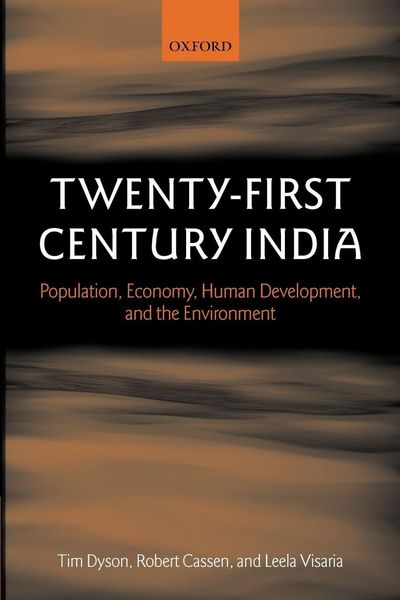
Twenty-First Century India Population, Economy, Human Development, and the Environment
-
- Hardcover
- Taschenbuch ausgewählt
-
Sprache:Englisch
89,99 €
inkl. gesetzl. MwSt.,
Beschreibung
Produktdetails
Einband
Taschenbuch
Erscheinungsdatum
05.05.2005
Abbildungen
numerous figures and tables, 1 map
Herausgeber
Tim Dyson + weitereVerlag
Oxford University PressSeitenzahl
438
Maße (L/B/H)
23,4/15,6/2,3 cm
Gewicht
661 g
Sprache
Englisch
ISBN
978-0-19-928382-8
Twenty-First Century India is the first study of India's development giving a fully integrated account of population and development. It is built on new projections of the population for fifty years from the Census of 2001. India's population then had already passed 1 billion. Twenty-five years later it will exceed 1.4 billion, and will almost certainly pass 1.5 billion by mid-century. The projections incorporate for the first time both inter-state migration and the role of HIV/AIDS. They also show India's urban future, with close to half a billion urban inhabitants by the year 2026.
The implications of this population growth are then traced out in a range of modelling and analytical work. Growing numbers are found to complicate the task of achieving widespread education in a number of India's states, while other states are already experiencing declines in their school-age population. Demographic growth also contributes to poverty, and increasing divergence in social conditions among the states. As population growth slows in the country overall, the labour force continues to grow relatively fast, with difficult consequences for employment. But national economic growth could be accelerated by the 'demographic bonus' of the declining proportion of dependents to workers in the population.
The book is reasonably optimistic about India's food prospects: the country can continue to feed itself. It can also enjoy higher levels of energy use, manufacturing, and modern forms of transport, while experiencing less chemical pollution. India's cities can become cleaner and healthier places to live. Perhaps the most difficult environmental issue, and the one most strongly related to population growth, is water. Some states also face severe pressures on common property resources. A policy chapter concludes the book. India's future problems are large, but in principle manageable. However, whether the country will actually achieve sustainable development for all is another matter.
Ein neues Kapitel für Ihre Bücher
Ein neues Kapitel für Ihre Bücher
Schenken Sie Ihren alten Schätzen ein zweites Leben und erhalten dafür eine Thalia Geschenkkarte.
Noch keine Bewertungen vorhanden
Verfassen Sie die erste Bewertung zu diesem Artikel
Helfen Sie anderen Kundinnen und Kunden durch Ihre Meinung.
Kurze Frage zu unserer Seite
Vielen Dank für Ihr Feedback
Wir nutzen Ihr Feedback, um unsere Produktseiten zu verbessern. Bitte haben Sie Verständnis, dass wir Ihnen keine Rückmeldung geben können. Falls Sie Kontakt mit uns aufnehmen möchten, können Sie sich aber gerne an unseren Kund*innenservice wenden.
zum Kundenservice