
Learning to Solve Complex Scientific Problems
-
- Hardcover
- Taschenbuch ausgewählt
- eBook
-
Sprache:Englisch
107,99 €
inkl. gesetzl. MwSt.,
Beschreibung
Produktdetails
Einband
Taschenbuch
Erscheinungsdatum
11.06.2007
Herausgeber
David H. JonassenVerlag
Taylor and FrancisSeitenzahl
416
Maße (L/B/H)
22,9/15,2/2,2 cm
Gewicht
544 g
Sprache
Englisch
ISBN
978-0-8058-5919-5
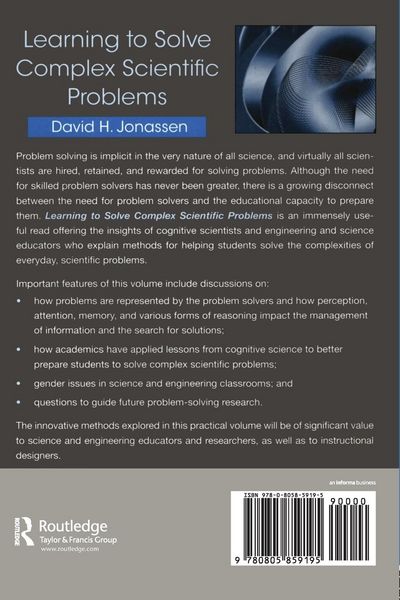
Learning to Solve Complex Scientific Problems is an immensely useful read offering the insights of cognitive scientists and engineering and science educators who explain methods for helping students solve the complexities of everyday, scientific problems. Important features of this volume include discussions on: how problems are represented and how perception, attention, memory, and various forms of reasoning impact the management of information and search for solutions; how academics have applied lessons from cognitive science to better prepare students to solve problems; gender issues in science and engineering classrooms; and questions to guide future problem-solving research.
Ein neues Kapitel für Ihre Bücher
Ein neues Kapitel für Ihre Bücher
Schenken Sie Ihren alten Schätzen ein zweites Leben und erhalten dafür eine Thalia Geschenkkarte.
Noch keine Bewertungen vorhanden
Verfassen Sie die erste Bewertung zu diesem Artikel
Helfen Sie anderen Kundinnen und Kunden durch Ihre Meinung.
Kurze Frage zu unserer Seite
Vielen Dank für Ihr Feedback
Wir nutzen Ihr Feedback, um unsere Produktseiten zu verbessern. Bitte haben Sie Verständnis, dass wir Ihnen keine Rückmeldung geben können. Falls Sie Kontakt mit uns aufnehmen möchten, können Sie sich aber gerne an unseren Kund*innenservice wenden.
zum Kundenservice