• Produktbild: Statistical Methods for Plant Variety Evaluation
  • Produktbild: Statistical Methods for Plant Variety Evaluation
- 12%

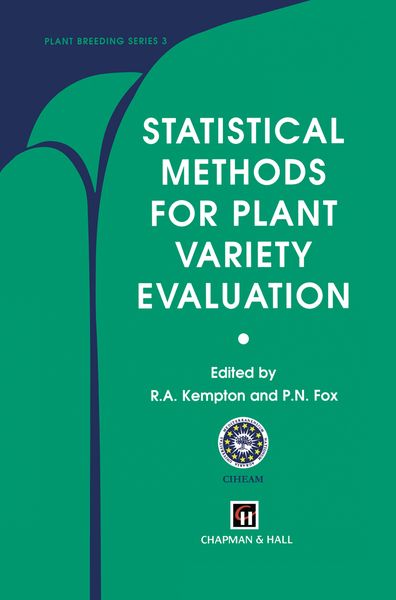
Statistical Methods for Plant Variety Evaluation

Aus der Reihe Plant Breeding
12% sparen

187,99 € UVP 213,99 €

inkl. gesetzl. MwSt., Versandkostenfrei


Beschreibung

Produktdetails

Einband

Gebundene Ausgabe

Erscheinungsdatum

30.11.1996

Herausgeber

R.A. Kempton + weitere

Verlag

Springer Netherland

Seitenzahl

192

Maße (L/B/H)

24,1/16/1,7 cm

Gewicht

472 g

Auflage

1997

Sprache

Englisch

ISBN

978-0-412-54750-8

Beschreibung

Rezension

...an interesting value to teachers and graduate students concerned with agronomy, plant breeding and selection. - Biochemical Systemics and Ecology

Produktdetails

Einband

Gebundene Ausgabe

Erscheinungsdatum

30.11.1996

Herausgeber

Verlag

Springer Netherland

Seitenzahl

192

Maße (L/B/H)

24,1/16/1,7 cm

Gewicht

472 g

Auflage

1997

Sprache

Englisch

ISBN

978-0-412-54750-8

Herstelleradresse

Springer-Verlag GmbH
Tiergartenstr. 17
69121 Heidelberg
DE

Email: ProductSafety@springernature.com

Ein neues Kapitel für Ihre Bücher

Ein neues Kapitel für Ihre Bücher

Schenken Sie Ihren alten Schätzen ein zweites Leben und erhalten dafür eine Thalia Geschenkkarte.

Jetzt verkaufen
Jetzt verkaufen

Noch keine Bewertungen vorhanden

Verfassen Sie die erste Bewertung zu diesem Artikel

Helfen Sie anderen Kundinnen und Kunden durch Ihre Meinung.

Kundinnen und Kunden meinen

Bewertungen (0)

  • Produktbild: Statistical Methods for Plant Variety Evaluation
  • Produktbild: Statistical Methods for Plant Variety Evaluation
  • 1 Introduction.- 1.1 Change and challenges.- 1.2 Managing the information.- 1.3 Statistical design of the selection programme.- 1.4 Statistical models and prediction.- 1.5 Impact of genotype by environment interaction.- 1.6 Summary.- 1.7 Nomenclature.- 2 Field plot technique.- 2.1 Introduction.- 2.2 Terminology.- 2.3 Within-location variation.- 2.4 Inter-plot interference.- 2.5 The plot.- 2.6 Replication.- 2.7 Trial management.- 2.8 Trial layout.- 2.9 Data.- 2.10 Data collection.- 2.11 Data analysis.- 3 Data management and validation.- 3.1 Introduction.- 3.2 Data management.- 3.3 Validation of trial data.- 4 Design of plant breeding trials.- 4.1 Introduction.- 4.2 Experimental design concepts and model assumptions.- 4.3 Plots, replication, randomization, covariance.- 4.4 Blocking - control and adjustment.- 4.5 The construction of incomplete block designs.- 4.6 Precision.- 4.7 Multiple levels of information.- 4.8 Row and column designs.- 4.9 Trial designs for spatial analysis.- 4.10 Multilocation experiments.- 4.11 Additional factors.- 5 Spatial analysis.- 5.1 Why spatial analysis?.- 5.2 Spatial autocorrelation.- 5.3 Sample spatial correlations for uniformity trials.- 5.4 Models for the analysis of field trial data.- 5.5 Stationarity.- 5.6 One-dimensional spatial analysis.- 5.7 Estimation.- 5.8 Assessing model adequacy.- 5.9 Extension to two-dimensional spatial analysis.- 5.10 Example.- 5.11 Conclusion.- 6 Unreplicated trials.- 6.1 Introduction.- 6.2 Local control using check plots.- 6.3 Local control from blocking test plots.- 6.4 Local control by spatial analysis.- 6.5 Conclusions.- 7 Interference between plots.- 7.1 Introduction.- 7.2 Reducing interference through design.- 7.3 Modelling interference.- 7.4 Adjusting for interference.- 7.5 Summary.- 8 Multi-environmenttesting and genotype x environment interaction.- 8.1 What is genotype x environment interaction?.- 8.2 Implications for breeding programmes.- 8.3 Univariate data analysis and exploration of genotype performance.- 8.4 Multivariate exploration of relationships among environments and among genotypes.- 8.5 Information extraction versus computational complexity.- 9 Analysis of series of variety trials.- 9.1 Introduction.- 9.2 Notation and terminology.- 9.3 FITCON and REML.- 9.4 Analysis of Immer’s balanced series.- 9.5 Method of direct differences.- 9.6 Incomplete tables and the adjustment of variety means.- 9.7 An incomplete three-way table.- 9.8 Other models.- 10 Resource allocation for selection systems.- 10.1 Introduction.- 10.2 Variation in trials system.- 10.3 Precision of genotype means.- 10.4 Criteria for assessing the efficiency of the programme.- 10.5 Other issues in resource allocation.- 10.6 Conclusions.- References.