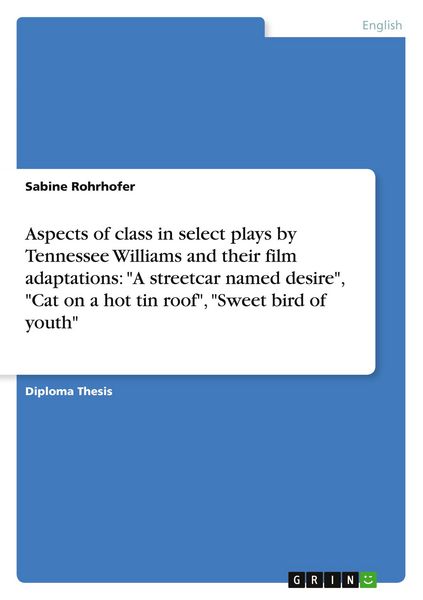
Aspects of class in select plays by Tennessee Williams and their film adaptations: "A streetcar named desire", "Cat on a hot tin roof", "Sweet bird of youth"
-
- Englisch ausgewählt
47,95 €
inkl. gesetzl. MwSt.,
Beschreibung
Produktdetails
Einband
Taschenbuch
Erscheinungsdatum
22.08.2007
Verlag
GRINSeitenzahl
136
Maße (L/B/H)
21/14,8/1 cm
Gewicht
208 g
Auflage
2. Auflage
Sprache
Englisch
ISBN
978-3-638-71307-8
Diploma Thesis from the year 2002 in the subject American Studies - Literature, grade: B (2), University of Vienna (Institute for Anglistics/American Studies), language: English, abstract: Tennessee Williams is one of America's greatest playwrights whose talents of creating tension and atmosphere went beyond the métier of theatre and were convincing in the field of motion pictures, too. Elia Kazan, the successful theatre and film director, particularly admired the artist's gift of evoking emotions. In this thesis, however, I shall not attempt at evaluating Williams's total works. Rather, my object is a comparative analysis of select plays by Tennessee Williams and of their film adaptations: A Streetcar Named Desire (1947, 1951), Cat on a Hot Tin Roof (1955, 1958), and Sweet Bird of Youth (1959, 1962). Special attention has been given to examining the social differences in the plays and films. By focussing on the methods of characterisation employed I shall investigate more or less typical class representations in the two different media. I shall work out the social politics of the playwright, theatre and film directors, and - as far as possible - the actors' and actresses' contributions to the dramatic contents. The multitude of interpretations and variations usually gives proof to the value of artistic works. The methods applied in this thesis are literary research and film studies. As a matter of course, I analysed the plays on their written basis, which raises the general question to what extent the perceptions by the audience and the reader differ. 'The readers of a play must use their imagination to flesh out the characters, and to place them in an appropriate setting' (Sambrook, 6). Williams gives very precise and evocative stage directions, which help the reader to imagine the situations in many details. Meaning is often conveyed by poetic images. By employing figurative language he tries to 'paint a word picture or convey in words the quality of a sound' (Sambrook, 48). The critic also notes that in Streetcar, these stage directions contrast and 'serve to underline the uneducated speech' (Sambrook, 14) of most characters, except for the DuBois sisters. The audience of a play or film, on the other hand, cannot perceive these aspects; rather, the spectators are confronted with a particular setting and with concrete actors and actresses. ...
Ein neues Kapitel für Ihre Bücher
Ein neues Kapitel für Ihre Bücher
Schenken Sie Ihren alten Schätzen ein zweites Leben und erhalten dafür eine Thalia Geschenkkarte.
Noch keine Bewertungen vorhanden
Verfassen Sie die erste Bewertung zu diesem Artikel
Helfen Sie anderen Kundinnen und Kunden durch Ihre Meinung.
Kurze Frage zu unserer Seite
Vielen Dank für Ihr Feedback
Wir nutzen Ihr Feedback, um unsere Produktseiten zu verbessern. Bitte haben Sie Verständnis, dass wir Ihnen keine Rückmeldung geben können. Falls Sie Kontakt mit uns aufnehmen möchten, können Sie sich aber gerne an unseren Kund*innenservice wenden.
zum Kundenservice