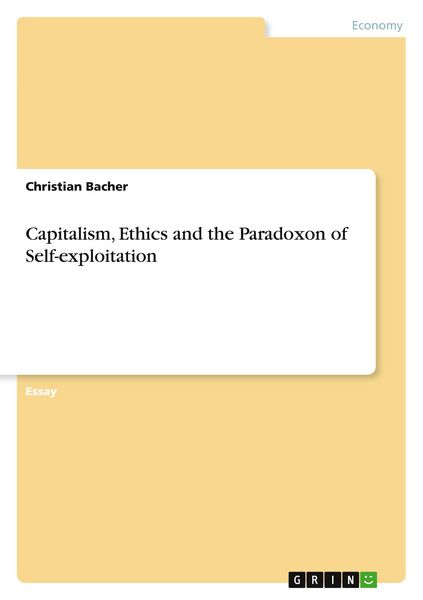
Capitalism, Ethics and the Paradoxon of Self-exploitation
-
- Englisch ausgewählt
18,95 €
inkl. gesetzl. MwSt.,
Beschreibung
Produktdetails
Einband
Taschenbuch
Erscheinungsdatum
04.07.2007
Verlag
GRINSeitenzahl
44
Maße (L/B/H)
21/14,8/0,4 cm
Gewicht
79 g
Auflage
5. Auflage
Sprache
Englisch
ISBN
978-3-638-63658-2
Essay from the year 2005 in the subject Business economics - Operations Research, grade: A+, University of Otago (Department of Management), course: Business Policy, language: English, abstract: "The driving force of capitalism is the attainment of increasing rates of surplus value. This is inevitably exploitative and demeaning of the human condition. This makes an increased awareness of ethics in business practise untenable. Discuss." The statement comprises of three arguments, or, more specifically, one argument and two consequences. They consist of the type argument 'if A then B' and 'if A and B then C'. In addition there is the request to 'discuss' in the statement. 'Discuss' could only apply to 'C'. In this case 'A' and 'B' would be taken for granted. I cannot easily accept this so I apply 'discuss' to 'A', 'B' and finally 'C' and approach each phrase separately. So I can reveal that 'if A and B then C' is only true under prior assumptions made about 'A' and 'B'. Chapter A deals with 'A', capitalism. Here I will provide a definition of capitalism containing its characteristics and effects and arrive at the answer as to whether "increasing rates of surplus value" are the "driving force of capitalism". Chapter B shall examine whether capitalism "is inevitably exploitative and demeaning to the human condition". But before the terms 'exploitation', 'demeaning' and 'human condition' are discussed, they need to be defined. This chapter contains an analysis how 'capitalism' and 'humans' interact and interfere each other. Chapter C works on 'untenable (business) ethics'. Ethics, business ethics and their significance for 'humans' and 'capitalism' are presented. The focus here will be on the overlapping areas of 'ethics' with the contents of the other two chapters. The chapter concludes with conditions that fulfil the statement 'if A and B then C', with arguments discussed in light of the essay statement. But, actually, things are not that easy. The path of argumentation is relatively thin and unsatisfying. That is why the 'findings' section at the end of this essay questions the facts 'if A and B then C'. There are some underlying assumptions that this statement is built on. I will uncover some of these 'granted facts' and try to go one step back. The then broader but also deeper insight into the notions of 'rationality', 'bureaucracy' and 'ideology' also mark the turn to my self-reflective essay.
Ein neues Kapitel für Ihre Bücher
Ein neues Kapitel für Ihre Bücher
Schenken Sie Ihren alten Schätzen ein zweites Leben und erhalten dafür eine Thalia Geschenkkarte.
Noch keine Bewertungen vorhanden
Verfassen Sie die erste Bewertung zu diesem Artikel
Helfen Sie anderen Kundinnen und Kunden durch Ihre Meinung.
Kurze Frage zu unserer Seite
Vielen Dank für Ihr Feedback
Wir nutzen Ihr Feedback, um unsere Produktseiten zu verbessern. Bitte haben Sie Verständnis, dass wir Ihnen keine Rückmeldung geben können. Falls Sie Kontakt mit uns aufnehmen möchten, können Sie sich aber gerne an unseren Kund*innenservice wenden.
zum Kundenservice