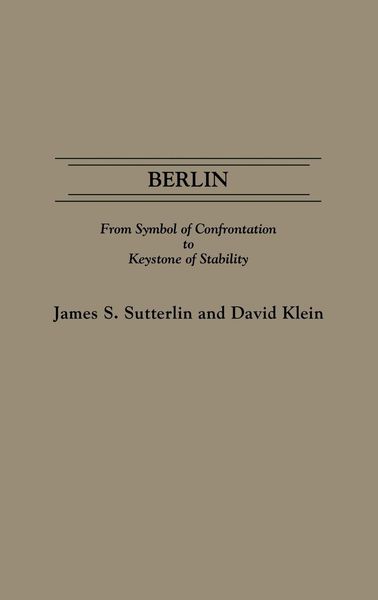
Berlin From Symbol of Confrontation to Keystone of Stability
-
- Englisch ausgewählt
111,99 €
inkl. gesetzl. MwSt.,
Beschreibung
Produktdetails
Einband
Gebundene Ausgabe
Erscheinungsdatum
03.11.1989
Verlag
Bloomsbury AcademicSeitenzahl
248
Maße (L/B/H)
24/16,1/1,8 cm
Gewicht
540 g
Sprache
Englisch
ISBN
978-0-275-93259-6
This book meticulously follows the volatile and frequently threatening relationship between the Western powers and the Soviet Union with regard to Berlin. The authors begin their study at that point when the State Department first considered the fate of Berlin during World War II and take the reader through to the 1971 Four Power Agreement that governs the present operation of the city ending with their assessment of its implications for the future. The book provides an in-depth understanding of the 1971 agreement as well as the disputes and interests which defined the major powers' positions on Berlin and, to a large extent, determined the city's post-war fate. The authors examine in detail the negotiations that culminated in the Four Powers Agreement and include much heretofore unpublished information stemming from their personal roles in the negotiating process.
Sutterlin and Klein contend that after the extended period of dangerous tension and confrontation surrounding Berlin after World War II, the four powers have succeeded in defining a modus vivendi for Berlin that has substantially improved the conditions of life for the residents of West Berlin and removed the city as a serious hindrance to the normalization of East-West relations. The book also asserts that the agreement led to more constructive relations between the Soviet Union and the United States in dealing with other world problems. At the same time the authors view the sensitive areas of the quadripartite relationship from the perspective of the East and West Germans presenting a situation less than totally satisfactory. The book assesses the negotiations leading to the 1971 agreement as successful from the Western perspective, and probably from the Soviet Perspective as well. The authors contend that the particular negotiating procedure followed by Henry Kissinger and other U.S. representatives were needlessly deceptive and dangerous as a precedent.Ein neues Kapitel für Ihre Bücher
Ein neues Kapitel für Ihre Bücher
Schenken Sie Ihren alten Schätzen ein zweites Leben und erhalten dafür eine Thalia Geschenkkarte.
Noch keine Bewertungen vorhanden
Verfassen Sie die erste Bewertung zu diesem Artikel
Helfen Sie anderen Kundinnen und Kunden durch Ihre Meinung.
Kurze Frage zu unserer Seite
Vielen Dank für Ihr Feedback
Wir nutzen Ihr Feedback, um unsere Produktseiten zu verbessern. Bitte haben Sie Verständnis, dass wir Ihnen keine Rückmeldung geben können. Falls Sie Kontakt mit uns aufnehmen möchten, können Sie sich aber gerne an unseren Kund*innenservice wenden.
zum Kundenservice