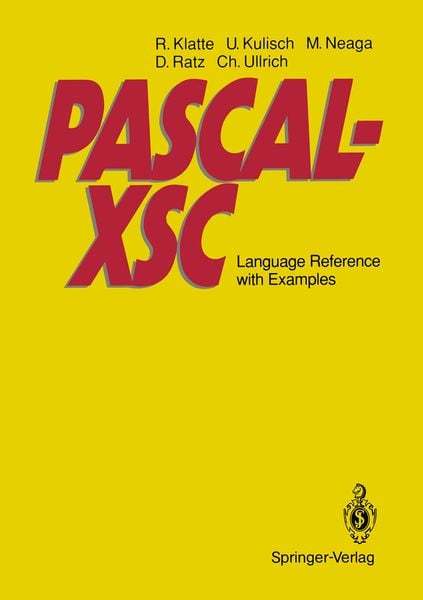
Produktbild: PASCAL-XSC

PASCAL-XSC Language Reference with Examples

49,99 €

inkl. gesetzl. MwSt., Versandkostenfrei


Beschreibung

Produktdetails

Einband

Taschenbuch

Erscheinungsdatum

28.02.1992

Abbildungen

X, 344 p.

Verlag

Springer Berlin

Seitenzahl

344

Maße (L/B/H)

24,2/17/1,9 cm

Gewicht

597 g

Auflage

Softcover reprint of the original 1st ed. 1992

Übersetzt von

G.F. Corliss + weitere

Sprache

Englisch

ISBN

978-3-540-55137-9

Beschreibung

Produktdetails

Einband

Taschenbuch

Erscheinungsdatum

28.02.1992

Abbildungen

X, 344 p.

Verlag

Springer Berlin

Seitenzahl

344

Maße (L/B/H)

24,2/17/1,9 cm

Gewicht

597 g

Auflage

Softcover reprint of the original 1st ed. 1992

Übersetzt von

  • G.F. Corliss
  • R. Klatte
  • U. Kulisch
  • D. Ratz
  • C. Wolff

Sprache

Englisch

ISBN

978-3-540-55137-9

Herstelleradresse

Springer-Verlag KG
Sachsenplatz 4-6
1201 Wien
AT

Email: ProductSafety@springernature.com

Ein neues Kapitel für Ihre Bücher

Ein neues Kapitel für Ihre Bücher

Schenken Sie Ihren alten Schätzen ein zweites Leben und erhalten dafür eine Thalia Geschenkkarte.

Jetzt verkaufen
Jetzt verkaufen

Noch keine Bewertungen vorhanden

Verfassen Sie die erste Bewertung zu diesem Artikel

Helfen Sie anderen Kundinnen und Kunden durch Ihre Meinung.

Kundinnen und Kunden meinen

Bewertungen (0)

  • Produktbild: PASCAL-XSC
  • 1 Introduction.- 1.1 Typography.- 1.2 Historical Remarks and Motivation.- 1.3 Advanced Computer Arithmetic.- 1.4 Connection with Programming Languages.- 1.5 Survey of PASCAL-XSC.- 2 Language Reference.- 2.1 Basic Symbols.- 2.2 Identifiers.- 2.3 Constants, Types, and Variables.- 2.4 Expressions.- 2.5 Statements.- 2.6 Program Structure.- 2.7 Subroutines.- 2.8 Modules.- 2.9 String Handling and Text Processing.- 2.10 How to Use Dynamic Arrays.- 3 The Arithmetic Modules.- 3.1 The Module C_ARI.- 3.2 The Module I_ARI.- 3.3 The Module CI_ARI.- 3.4 The Module MV_ARI.- 3.5 The Module MVC_ARI.- 3.6 The Module MVI_ARI.- 3.7 The Module MVCI_ARI.- 3.8 The Hierarchy of the Arithmetic Modules.- 3.9 A Complete Sample Program.- 4 Problem-Solving Routines.- 5 Exercises with Solutions.- 5.1 Test of Representability.- 5.2 Summation of Exponential Series.- 5.3 Influence of Rounding Errors.- 5.4 Scalar Product.- 5.5 Boothroyd/Dekker Matrices.- 5.6 Complex Functions.- 5.7 Surface Area of a Parallelepiped.- 5.8 Parallelism and Intersection of Lines.- 5.9 Transposed Matrix, Symmetry.- 5.10 Rail Route Map.- 5.11 Inventory Lists.- 5.12 Complex Numbers and Polar Representation.- 5.13 Complex Division.- 5.14 Electric Circuit.- 5.15 Alternating Current Measuring Bridge.- 5.16 Optical Lens.- 5.17 Interval Evaluation of a Polynomial.- 5.18 Calculations for Interval Matrices.- 5.19 Differentiation Arithmetic.- 5.20 Newton’s Method with Automatic Differentiation.- 5.21 Measurement of Time.- 5.22 Iterative Method.- 5.23 Trace of a Product Matrix.- 5.24 Calculator for Polynomials.- 5.25 Interval Newton Method.- 5.26 Runge-Kutta Method.- 5.27 Rational Arithmetic.- 5.28 Evaluation of Polynomials.- A Syntax Diagrams.- B Indices and Lists.- B.1 Syntax Diagrams.- B.2 Reserved Words.- B.3 PredefinedIdentifiers.- B.4 Operators.- B.4.1 Basic Operators.- B.4.2 Arithmetic Operators.- B.4.3 Relational Operators for the Arithmetic Types.- B.4.4 Assignment Operators.- B.5 Predefined Functions.- B.6 Transfer Functions.- B.7 Predefined Procedures.- B.8 #-Expressions.- B.8.1 Real and Complex #-Expressions.- B.8.2 Real and Complex Interval #-Expressions.