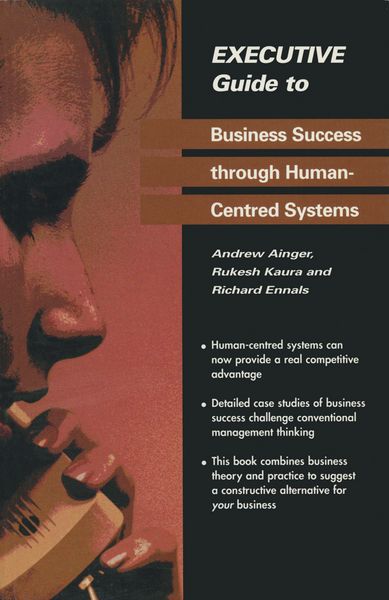
• Produktbild: Executive Guide to Business Success through Human-Centred Systems
  • Produktbild: Executive Guide to Business Success through Human-Centred Systems

Executive Guide to Business Success through Human-Centred Systems

Aus der Reihe Executive Guides

49,99 €

inkl. gesetzl. MwSt., Versandkostenfrei


Beschreibung

Produktdetails

Einband

Taschenbuch

Erscheinungsdatum

15.09.1995

Abbildungen

IX, 181 p.

Verlag

Springer Berlin

Seitenzahl

181

Maße (L/B/H)

23,5/15,5/1,1 cm

Gewicht

300 g

Auflage

Softcover reprint of the original 1st edition 1995

Sprache

Englisch

ISBN

978-3-540-19929-8

Beschreibung

Produktdetails

Einband

Taschenbuch

Erscheinungsdatum

15.09.1995

Abbildungen

IX, 181 p.

Verlag

Springer Berlin

Seitenzahl

181

Maße (L/B/H)

23,5/15,5/1,1 cm

Gewicht

300 g

Auflage

Softcover reprint of the original 1st edition 1995

Sprache

Englisch

ISBN

978-3-540-19929-8

Herstelleradresse

Springer-Verlag GmbH
Tiergartenstr. 17
69121 Heidelberg
DE

Email: GPSR Kontakt

Ein neues Kapitel für Ihre Bücher

Ein neues Kapitel für Ihre Bücher

Schenken Sie Ihren alten Schätzen ein zweites Leben und erhalten dafür eine Thalia Geschenkkarte.

Jetzt verkaufen
Jetzt verkaufen

Noch keine Bewertungen vorhanden

Verfassen Sie die erste Bewertung zu diesem Artikel

Helfen Sie anderen Kundinnen und Kunden durch Ihre Meinung.

Kundinnen und Kunden meinen

Bewertungen (0)

  • Produktbild: Executive Guide to Business Success through Human-Centred Systems
  • Produktbild: Executive Guide to Business Success through Human-Centred Systems
  • 1. Introduction.- Why Read this book?.- What is the Role of Technology in Human-Centred Systems?.- What Will You Learn?.- The Role of Case Studies.- Human-Centred Systems as a Critique.- Knowledge-Based Industry and World Markets.- Competition in Europe.- Innovation vs. Productivity.- Research and Development.- 2. Insights Into Human-Centredness.- Reuniting Hand and Brain.- Taylor and Scientific Management.- McGregor’s Theory X and Theory Y.- What are Human-Centred Systems?,..- Human-Centred IT.- Designing Tools for Skilled Workers.- Technocentric and Human-Centred Approaches.- Introducing New Technology and Methods.- Towards Human-Centred Design.- The Next Cycle.- 3. The New Rules.- Knowledge and the Worker.- What is Knowledge?.- The Darwinian Workplace.- Loyalty, the Outdated Concept?.- A New Form of Work Organisation.- The Ethics of Business.- Lessons for Business from the Voluntary Sector.- What Can Be Learnt?.- 4. Business Process Re-Engineering.- Lessons from East Germany.- Two Degrees of Culture.- Types of Re-engineering.- Back to the Drawing Board.- IT the Enabler.- Learning from the Factory.- Regenerating the Organisation.- 5. Empowerment.- Flat Pyramids: the Future?.- Responsibilisation: Is it for You?.- Levels of Empowerment.- IT and the Shop Floor.- A New Structure.- Potential Problems: Opening Pandora’s Box.- The Hawthorne Effect.- Abraham Maslow and B. F. Skinner.- 6. Teamworking.- Teams: Flavour of the Month.- Groupware.- Challenging Orthodoxy.- A Question of Language.- Group Working on the Factory Floor.- Implementing Cells.- Forming Cells into Business Units.- IT in Cells.- 7. Skill And Competence.- Skill: Comparison.- Vocational vs. Academic.- National Vocational Qualifications (NVQs).- The German System.- The Apprentice: Twentieth-century Dodo.-Manufacturing in Britain.- What is Management Training?.- Management Training and a Competence Approach.- 8. Quality.- The Search for Total Quality.- What is TQM?.- Benchmarking.- The Quality Standards.- The Quality Awards.- TQM in the Public Sector: An Oxymoron?.- The Quality of Life.- Deming Revisited.- Deming vs. Taylor: The Differences.- 9. Developments And The Way Forward.- Context.- Human-Centred Strategy.- Appendix 1: Volvo, Uddevalla and Kalmar, Sweden.- Appendix 2: ESPRIT 1217 (1199): Human-Centred CIM.- Appendix 3: The MOPS Programme.- Appendix 4: BESTMAN.- Appendix.5: ITW DeVilbiss Ransburg.- References and Further Reading.- Name Index.