
Dupuytren’s Disease Pathobiochemistry and Clinical Management
-
- Englisch ausgewählt
95,99 €
UVP
106,99 €
inkl. gesetzl. MwSt.,
Beschreibung
Produktdetails
Einband
Taschenbuch
Erscheinungsdatum
18.03.1994
Abbildungen
XVIII, 301 p. 58 illus.
Herausgeber
Alfred Berger + weitereVerlag
Springer BerlinSeitenzahl
301
Maße (L/B/H)
23,5/15,5/1,8 cm
Gewicht
487 g
Auflage
Softcover reprint of the original 1st edition 1994
Sprache
Englisch
ISBN
978-3-540-57239-8
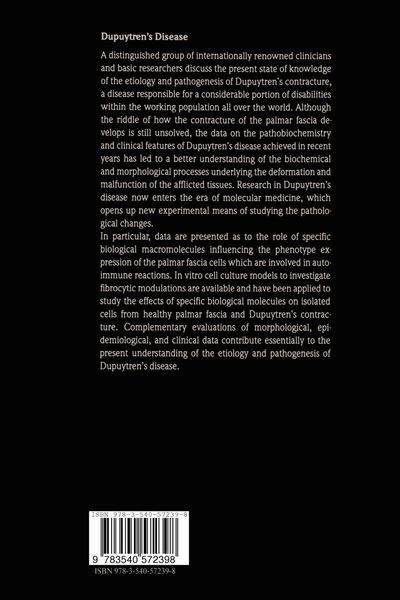
renowned clinicians and basic researchers discuss the
present state of knowledge of the etiologyand pathogenesis
of Dupuytren's contracture, a disease responsible for a
considerable portion of disabilities within the working
population allover the world. Although the riddle of how
the contracture of the palmar fascia develops is still
unsolved, the data on the pathobiochemistry and clinic of
Dupuytren's Disease achieved in recent years has led to a
better understanding of the biochemical and morphological
processes underlying the deformation and malfunction of the
afflicted tissues. Research in Dupuytren's Disease now
enters the era of molecular medicine, which opens up new
experimental means of studying the pathological changes
which occur during the formation of the contracture on a
molecular level. In particular, data are presented as to the
role of specific biological macromolecules influencing the
phenotype expression of the palmar fascia cells which are
involved in autoimmune reactions and present both at the
cell surface as well as in the extracellular matrix to
regulate cell-to-cell and cell-to-matrix interactions. In
vitro cell culture models to investigate fibro-cytic
modulations are available and havebeen applied to study the
effects of specific biological molecules on isolated cells
from healthy palmar fascia and Dupuytren's contracture.
Complementary evaluations of morphological, epidemiological,
and clinical data contribute essentially to the present
understanding of the etiology and pathogenesis of
Dupuytren's Disease. This comprehensive and informative
summary of the state of the art is completed by numerous
references affixed to the individual contributions.
Ein neues Kapitel für Ihre Bücher
Ein neues Kapitel für Ihre Bücher
Schenken Sie Ihren alten Schätzen ein zweites Leben und erhalten dafür eine Thalia Geschenkkarte.
Noch keine Bewertungen vorhanden
Verfassen Sie die erste Bewertung zu diesem Artikel
Helfen Sie anderen Kundinnen und Kunden durch Ihre Meinung.
Kurze Frage zu unserer Seite
Vielen Dank für Ihr Feedback
Wir nutzen Ihr Feedback, um unsere Produktseiten zu verbessern. Bitte haben Sie Verständnis, dass wir Ihnen keine Rückmeldung geben können. Falls Sie Kontakt mit uns aufnehmen möchten, können Sie sich aber gerne an unseren Kund*innenservice wenden.
zum Kundenservice