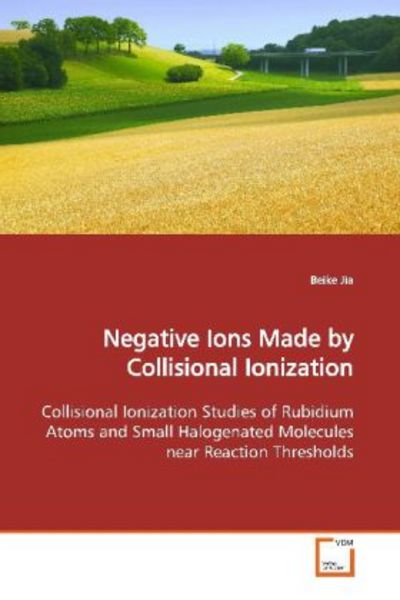
Beschreibung
Produktdetails
Einband
Taschenbuch
Erscheinungsdatum
28.05.2009
Verlag
VDMSeitenzahl
104
Maße (L/B/H)
22/15/0,6 cm
Gewicht
173 g
Sprache
Englisch
ISBN
978-3-639-15325-5
Negative ions are common in solutions and important
in many biological processes, but they are far less
well-characterized in the gas phase compared to
positive ions. One of the reasons is that it is hard
to make a thermodynamically stable negative ion in
the gas phase. Directly attaching a low energy
electron to a molecule could produce a transient
negative ion, which usually autodetaches an electron
or fragments to release the excess energy. In this
work, alkali metal atoms are used to collide with
halogenated molecules in crossed supersonic beams.
Electron transfer occurs during the collision and a
positive-negative ion pair is produced. The transient
negative ion can release part of its excess energy to
the alkali positive ion in the form of translation
and a stable negative ion could be formed. The
energetics of the collision is studied and the
electron affinities of the negative ions are
measured. This study opens a new pathway to produce
negative ions and provides insight into the electron
transfer mechanism. It is useful to professionals in
the field of gas phase ion chemistry, or anyone else
who may be considering utilizing this method to make
biological negative ions.
in many biological processes, but they are far less
well-characterized in the gas phase compared to
positive ions. One of the reasons is that it is hard
to make a thermodynamically stable negative ion in
the gas phase. Directly attaching a low energy
electron to a molecule could produce a transient
negative ion, which usually autodetaches an electron
or fragments to release the excess energy. In this
work, alkali metal atoms are used to collide with
halogenated molecules in crossed supersonic beams.
Electron transfer occurs during the collision and a
positive-negative ion pair is produced. The transient
negative ion can release part of its excess energy to
the alkali positive ion in the form of translation
and a stable negative ion could be formed. The
energetics of the collision is studied and the
electron affinities of the negative ions are
measured. This study opens a new pathway to produce
negative ions and provides insight into the electron
transfer mechanism. It is useful to professionals in
the field of gas phase ion chemistry, or anyone else
who may be considering utilizing this method to make
biological negative ions.
Ein neues Kapitel für Ihre Bücher
Ein neues Kapitel für Ihre Bücher
Schenken Sie Ihren alten Schätzen ein zweites Leben: Einfach Barcode scannen, Versandetikett ausdrucken, Bücher verschicken und Thalia Geschenkkarte erhalten.
Jetzt verkaufenKundinnen und Kunden meinen
Verfassen Sie die erste Bewertung zu diesem Artikel
Helfen Sie anderen Kund*innen durch Ihre Meinung
Kurze Frage zu unserer Seite
Vielen Dank für Ihr Feedback
Wir nutzen Ihr Feedback, um unsere Produktseiten zu verbessern. Bitte haben Sie Verständnis, dass wir Ihnen keine Rückmeldung geben können. Falls Sie Kontakt mit uns aufnehmen möchten, können Sie sich aber gerne an unseren Kund*innenservice wenden.
zum Kundenservice