Beschreibung
Produktdetails
Einband
Taschenbuch
Erscheinungsdatum
17.10.2009
Verlag
GRINSeitenzahl
16
Maße (L/B/H)
21/14,8/0,2 cm
Gewicht
40 g
Auflage
5. Auflage
Sprache
Englisch
ISBN
978-3-640-44219-5
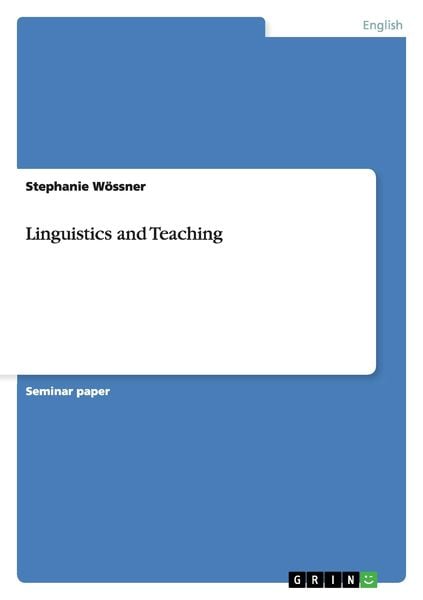
Seminar paper from the year 1999 in the subject English Language and Literature Studies - Linguistics, grade: 2,0 (B), University of Tubingen (Institute for Anglistics), course: PS I Introduction to Linguistics, 4 entries in the bibliography, language: English, abstract: "Grammar is what has always made English a school subject." (Lewis,1993: iii) - Jimmie Hill¿s opinion on English as a school subject is one of the simplest put but most accurate views I have ever come across so far. In this short phrase lies far more than one would imagine at first sight. Its explicit message is, of course, that grammar is a feature of great value for a student learning English and I would never contradict that. However, reading and thinking about this short sentence one comes to understand that there must be far more than that to really be able to communicate in English. In his list of principles Michael Lewis puts it as follows: "Successful language is a wider concept than accurate language." (Lewis, 1993: vi) That means that in order to communicate not only grammatical competence is required but that there are other factors which need to be considered when teaching English. A student learning a great amount of grammar will not be able to communicate in English if he isn¿t, for instance, able to communicate at all, no matter if in his mother tongue or in the language he is newly acquiring because "socio - linguistic competence - communcative power - precedes and is the basis, not the product of grammatical competence." (Lewis, 1993: vii) As a consequence, a teacher of English (for Germans) can¿t only teach grammar to his students and expect them to be able to fluently and correctly speak English but he or she (I will in the following stick to the masculine form only) is also obliged to keep in mind various long - term aims which cannot be checked on in the form of a test or an essay. Here arises the question about what a teacher of English might want to know about linguistics in order to provide students with the best conditions for successfully communicating in English especially outside the classroom situation. In which way and to what extent should a teacher make use of his linguistic knowledge though? Should students be made familiar with linguistic theories? Will it be sufficient if a teacher is aware of these theories and lets them slip into his teaching in class on a secondary basis? Or should he just forget about linguistics at all because it is too complicated a field to be used in teaching English to high school students?
Ein neues Kapitel für Ihre Bücher
Ein neues Kapitel für Ihre Bücher
Schenken Sie Ihren alten Schätzen ein zweites Leben: Einfach Barcode scannen, Versandetikett ausdrucken, Bücher verschicken und Thalia Geschenkkarte erhalten.
Jetzt verkaufenNoch keine Bewertungen vorhanden
Verfassen Sie die erste Bewertung zu diesem Artikel
Helfen Sie anderen Kundinnen und Kunden durch Ihre Meinung.
Kurze Frage zu unserer Seite
Vielen Dank für Ihr Feedback
Wir nutzen Ihr Feedback, um unsere Produktseiten zu verbessern. Bitte haben Sie Verständnis, dass wir Ihnen keine Rückmeldung geben können. Falls Sie Kontakt mit uns aufnehmen möchten, können Sie sich aber gerne an unseren Kund*innenservice wenden.
zum Kundenservice