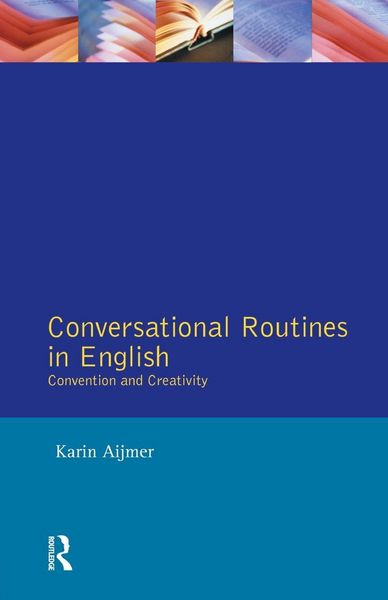
Produktbild: Conversational Routines in English
- 17%

Conversational Routines in English Convention and Creativity

17% sparen

84,99 € UVP 103,50 €

inkl. gesetzl. MwSt., Versandkostenfrei


Beschreibung

Produktdetails

Einband

Taschenbuch

Erscheinungsdatum

29.10.1996

Verlag

Taylor & Francis

Seitenzahl

268

Maße (L/B/H)

21,6/14/1,5 cm

Gewicht

342 g

Sprache

Englisch

ISBN

978-0-582-08211-3

Beschreibung

Produktdetails

Einband

Taschenbuch

Erscheinungsdatum

29.10.1996

Verlag

Taylor & Francis

Seitenzahl

268

Maße (L/B/H)

21,6/14/1,5 cm

Gewicht

342 g

Sprache

Englisch

ISBN

978-0-582-08211-3

Herstelleradresse

Libri GmbH
Europaallee 1
36244 Bad Hersfeld
DE

Email: gpsr@libri.de

Ein neues Kapitel für Ihre Bücher

Ein neues Kapitel für Ihre Bücher

Schenken Sie Ihren alten Schätzen ein zweites Leben und erhalten dafür eine Thalia Geschenkkarte.

Jetzt verkaufen
Jetzt verkaufen

Noch keine Bewertungen vorhanden

Verfassen Sie die erste Bewertung zu diesem Artikel

Helfen Sie anderen Kundinnen und Kunden durch Ihre Meinung.

Kundinnen und Kunden meinen

Bewertungen (0)

Die Leseprobe wird geladen.
  • Produktbild: Conversational Routines in English
  • Preface
    Acknowledgements

    CHAPTER ONE: Introduction
    1.1 Aim and scope of the present study
    1.2 Material and method
    1.3 Frequency of conversational routines in spoken language
    1.4 Psychological aspects of conversational routines
    1.5 Conversational routines and ritualisation
    1.6 Lexicalization, grammaticalisation an idiomatisation
    1.7 Conversational routines and meaning
    1.8 Criteria of fixdedness
    1.9. The processing of conversational routines
    1.10. Routines and discourse
    1.11 Conversational routines and grammatical analysis
    1.12. A model for describing the strucural flexibility of conversational routines
    1.13 The pragmatic function of conversational routines
    1.14 The pragmatics of conversational routines
    1.15 Conversational routines and language teaching

    CHAPTER TWO: Thanking
    2.1 Introduction
    2.2 Thank you/thanks as an illolcutionary force indicating device
    2.3 Thanking and politeness
    2.4 Strategies of thanking
    2.5 Gratitude expressions
    2.6 Continuation patterns
    2.7 The grammatical analysis of gratitude expressions
    2.8 Prosody an fixedness
    2.9 Distribution of thanking over different texts
    2.10 Thank you/thanks as stems
    2.11 The functions of gratitutude expressions
    2.12 Thanking as a discourse marker
    2.13 The pragmatics of thanking
    2.14 Frames for thanking
    2.15 Conclusion

    CHAPTER THREE: Apologies
    3.1 Introduction
    3.2 Defining apologies
    3.3 Apologising strategies
    3.4 The form of apologising
    3.5 Continuation patterns
    3.6 The grammatical analysis of apology and expression
    3.7 Apologies and prosody
    3.8 Distribution of apologies over different texts
    3.9 Collocational fixedness and flexibility
    3.10 Apologies and function
    3.11 Retrospective and anticipatory apologies
    3.12 The structural function of apologies
    3.13 The type of offence
    3.14 Apologies and pragmatic frames
    3.15 Conclusion

    CHAPTER FOUR: Requests and offers
    4.1 Introduction
    4.2 The speech act assignment mechanism and indirect speech acts
    4.3 Indirect speech acts and pragmatic principles
    4.4 Indirect speech acts and implicature
    4.5 Pragmatic ambiguity
    4.6 Defining requests
    4.7 Requestive strategies
    4.8 A taxonomy of requests
    4.9 Requests and politeness
    4.10 Continuation patterns
    4.11 The grammatical analysis of requestive routines
    4.12 Describing request expressions
    4.13 Indirect requests and speech act stems
    4.14 Types of stem
    4.15 Lexical mitigating devices
    4.16 Internal and external modifiers
    4.17 Referential strategies
    4.18 Requests and pragmatic conventions
    4.19 Imperatives
    4.20 Patterns expressing offers
    4.21 Conclusion

    CHAPTER FIVE: Discourse markers as conversational routines
    5.1 Introduction
    5.2 Coherence and discourse markers
    5.3 Discourse markers characterized
    5.4 The metalinguistic function
    5.5 Relevance theory and communication
    5.6 The approach to discourse markers in this work
    5.7 The linguistic properties of discourse markers
    5.8 Contextual properties of discourse markers
    5.9 Functional properties of discourse markers
    5.10 Combinations in the discourse marker slot
    5.11 Discourse markers and cognitive frames
    5.12 Conclusion

    References
    Index