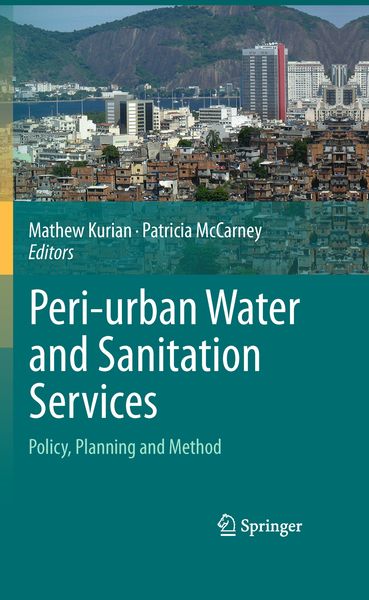
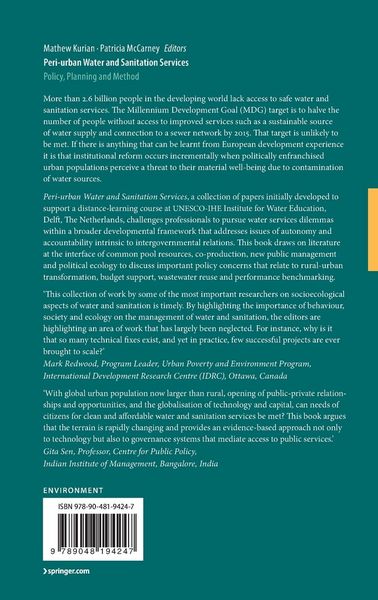
• Produktbild: Peri-urban Water and Sanitation Services
  • Produktbild: Peri-urban Water and Sanitation Services
- 13%

Peri-urban Water and Sanitation Services Policy, Planning and Method

13% sparen

138,99 € UVP 160,49 €

inkl. gesetzl. MwSt., Versandkostenfrei


Beschreibung

Produktdetails

Einband

Gebundene Ausgabe

Erscheinungsdatum

20.08.2010

Herausgeber

Mathew Kurian + weitere

Verlag

Springer Netherland

Seitenzahl

300

Maße (L/B/H)

24,1/16/2,4 cm

Gewicht

725 g

Auflage

1st Edition

Sprache

Englisch

ISBN

978-90-481-9424-7

Beschreibung

Portrait

Dr. Mathew Kurian is Academic Officer and leads the Capacity Development and Governance unit at United Nations University Institute for Integrated Management of Material Fluxes and of Resources (UNU-FLORES). Prior to joining UNU-FLORES, he served as Senior Water and Sanitation Specialist at Water and Sanitation Programme (WSP) of The World Bank where he led policy advocacy efforts related to rural water supply, wastewater reuse, and climate adaptation options in secondary towns. He began his career as a Robert McNamara Fellow at the World Bank where his work on land tenure reform was hosted by the Tata Energy Research Institute (TERI), New Delhi.


Upon completing his PhD in Development Studies from the Institute of Social Studies (ISS), Erasmus University, The Hague, Netherlands, Dr. Kurian was employed as Associate Expert (Dutch Ministry of Foreign Affairs) at International Water Management Institute (IWMI-CGIAR) where he undertook assessments of soil and water conservation interventions in the Mekong and Nile river basins. In 2009 as member of faculty at UNESCO-IHE, Delft, Dr. Kurian led the development of a policy note on urban sanitation and the Millennium Development Goals (MDGs) for the Directorate General of International Cooperation (DGIS) in the Netherlands. While still at UNESCO-IHE, Dr. Kurian developed an online e-learning course on governance of water and sanitation services in developing countries.


He has published in the area of water institutions and policy and has mentored students of the MSc programme in environment and development planning while on the faculty of University College London (UCL). His experience in the field of capacity development includes training civil servants and managers of water utilities in Iran and Tanzania, consulting assignments withthe Asian Development Bank (ADB), Philippines and teaching undergraduate courses in human geography at the University of British Columbia (UBC) Vancouver, Canada. In his current function, he leads the design of public policy research, policy advocacy in support of evidence-based decision making and fund raising to support establishment of a nexus observatory network.

Produktdetails

Einband

Gebundene Ausgabe

Erscheinungsdatum

20.08.2010

Herausgeber

Verlag

Springer Netherland

Seitenzahl

300

Maße (L/B/H)

24,1/16/2,4 cm

Gewicht

725 g

Auflage

1st Edition

Sprache

Englisch

ISBN

978-90-481-9424-7

Herstelleradresse

Springer-Verlag KG
Sachsenplatz 4-6
1201 Wien
AT

Email: GPSR Kontakt

Ein neues Kapitel für Ihre Bücher

Ein neues Kapitel für Ihre Bücher

Schenken Sie Ihren alten Schätzen ein zweites Leben und erhalten dafür eine Thalia Geschenkkarte.

Jetzt verkaufen
Jetzt verkaufen

Noch keine Bewertungen vorhanden

Verfassen Sie die erste Bewertung zu diesem Artikel

Helfen Sie anderen Kundinnen und Kunden durch Ihre Meinung.

Kundinnen und Kunden meinen

Bewertungen (0)

  • Produktbild: Peri-urban Water and Sanitation Services
  • Produktbild: Peri-urban Water and Sanitation Services
  • Preface by Elinor Ostrom.- Acknowledgements.- List of Contributors.- Abbreviations.- List of Boxes.- List of Figures.- List of Tables.- 1. Introduction - Institutions and Development: A Framework for Understanding Water Services.- 1.1 Introduction.- 1.2 Urban Environmental Governance.- 1.2.1 Interdependence of the Water Cycle.- 1.2.2. Architecture of Water Service Provision.- 1.2.3 Governance Arrangements at the Peri-urban Interface.- 1.2.4 Common Pool Resources and Environmental Externalities.- 1.2.5 Institutions and Eonomic Development.- 1.3. Water and Sanitation Services: Infrastructure, Policy and Co-production.- 1.3.1 Equity Effects of Policy Intervention.- 1.3.2 Infrastructure and Contracts.- 1.3.3 Infrastructure: Cost and Price Considerations.- 1.3.4 Co-production and Service Delivery.- 1.4 Approach Adopted by This Book.- 1.4.1 Framework for Understanding Water Services.- 1.4.2 Institutional Environment.- 1.4.3 Contractual Hazards and Credible Commitment.- 1.4.4 The Poor, Decision-making and Path Dependence.- 1.4.5 Time, Space and Information.- 1.4.6 From Development Aid to Cooperation.- 1.4.7 Service Selivery Reform in an Inter-connected World.- 1.4.8 Incremental Reform: Concluding Thoughts.- 1.5 Structure to the Message.- 2. Neither Rural nor Urban: Service Delivery Options that Work for the Peri-urban Poor.- 2.1 Introduction.- 2.2 Zooming Out: Beyond the Rural-urban Divide.- 2.3 Emerging Landscapes in the Rural-urban Continuum.- 2.3.1 Shifting Boundaries.- 2.3.2 Spatial Considerations and the Informational City.- 2.3.3 Peri-urbanisation: Trends in Africa, Latin America and Asia.- 2.4 Neither Urban nor Rural: Understanding Change at the Peri-urban Interface.- 2.4.1 Process of Change.- 2.4.2 Need for a Regional Planning Focus.- 2.5 Living Between Two Worlds: The Peri-urbanisation of Poverty.- 2.5.1 Differential Impacts on the Poor in Rural and Urban Areas.- 2.5.2 Decision-making, the Poor and the Political Process.- 2.6 Service Provision at the Peri-urban Interface: Moving Beyond the Public-Private Divide.- 2.6.1 Private Sector Participation and Access of the Poor to Services.- 2.6.2 A Fault Line.- 2.6.3 A Role for Municipalities and Local Governments.- 2.7 Access to Basic Services on the Ground: A Wider Spectrum of Service Providers.- 2.7.1 Beyond International Private Sector Participation?- 2.7.2 A Future for Simplified Sewerage Systems?- 2.7.3 Co-production Options: Hybridity and Informality.- 2.8 Crossing the Public-Private Divide: Rethinking Service Delivery Options that Work for the Peri-urban Poor.- 3. Prospects for Resource Recovery through Wastewater Reuse.- 3.1 Water Scarcity and the Need for Allocation.- 3.2 Water as an Economic Good.- 3.3 Urban Water Use, Sanitation and Wastewater Disposal.- 3.3.1 Urban Water Footprint.- 3.3.2 Water Stress in Cities: Upstream and Downstream Implications of Sanitation Provision.- 3.3.3 Sanitation and Waste Disposal Infrastructure in Cities.- 3.4 Valuing Wastewater as a Resource.- 3.4.1 Definitions of Wastewater and Typology.- 3.4.2 Overview of Planned and Unplanned Use in Agriculture.- 3.4.3 Drivers, Benefits, and Risks of Wastewater Agriculture.- 3.5 Sustainable Approaches to Sanitation and Wastewater Management.- 3.5.1 Design for Service Planning Approach.- 3.5.2 Ecological Sanitation.- 3.6 Conclusions.- 4. Climate-based Risks in Cities.- 4.1 Introduction: Megacities and Climate Risks.- 4.1.1 Climate-induced Urbanisation.- 4.1.2 Climate risks for City Populations and Climate Change.- 4.2 Responses of Municipalities to Climate Risks.- 4.2.1 Municipalities, Climate Risks, Water and Sanitation.- 4.2.2 Floods, Pollution and Health Risks.- 4.2.3 Reduced Water Supplies and Heat.- 4.2.4 Climate Change and Rural-urban Interfaces.- 4.3 Conclusion.- 5. Wastewater Management under the Dutch Water Boards: Any Lessons for Developing Countries?- 5.1 Introduction.- 5.2 Wastewater Treatment in the Netherlands.- 5.2.1 Historical Development.- 5.2.2 Changes in Policy and Legal Framework.-