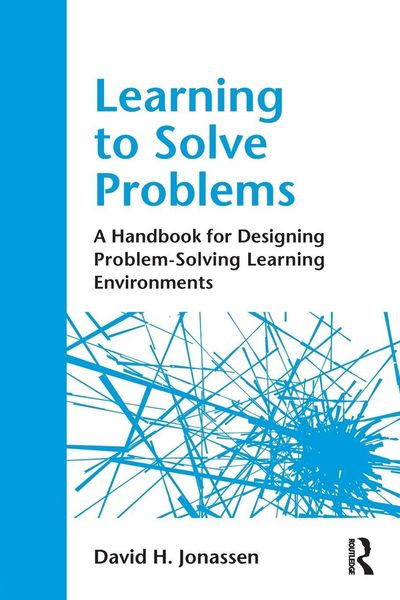
Learning to Solve Problems A Handbook for Designing Problem-Solving Learning Environments
-
- Hardcover
- Taschenbuch ausgewählt
- eBook
-
Sprache:Englisch
101,99 €
UVP
118,60 €
inkl. gesetzl. MwSt.,
Beschreibung
Produktdetails
Einband
Taschenbuch
Erscheinungsdatum
07.09.2010
Abbildungen
100 SW-Zeichn., 13 Tabellen
Verlag
Taylor & FrancisSeitenzahl
474
Maße (L/B/H)
22,9/15,2/2,8 cm
Gewicht
763 g
Sprache
Englisch
ISBN
978-0-415-87194-5
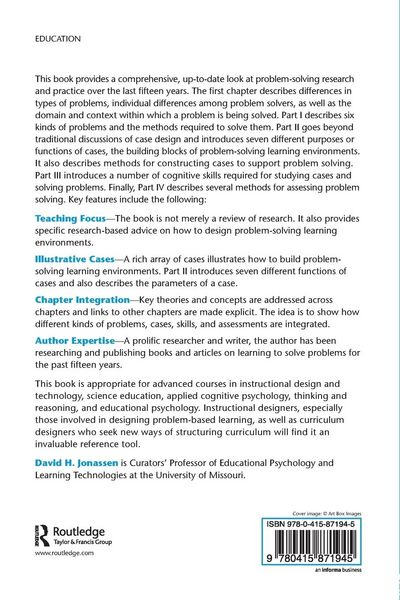
This book provides a comprehensive, up-to-date look at problem solving research and practice over the last fifteen years. The first chapter describes differences in types of problems, individual differences among problem-solvers, as well as the domain and context within which a problem is being solved. Part one describes six kinds of problems and the methods required to solve them. Part two goes beyond traditional discussions of case design and introduces six different purposes or functions of cases, the building blocks of problem-solving learning environments. It also describes methods for constructing cases to support problem solving. Part three introduces a number of cognitive skills required for studying cases and solving problems. Finally, Part four describes several methods for assessing problem solving. Key features includes:
- Teaching Focus - The book is not merely a review of research. It also provides specific research-based advice on how to design problem-solving learning environments.
- Illustrative Cases - A rich array of cases illustrates how to build problem-solving learning environments. Part two introduces six different functions of cases and also describes the parameters of a case.
- Chapter Integration - Key theories and concepts are addressed across chapters and links to other chapters are made explicit. The idea is to show how different kinds of problems, cases, skills, and assessments are integrated.
- Author expertise - A prolific researcher and writer, the author has been researching and publishing books and articles on learning to solve problems for the past fifteen years.
This book is appropriate for advanced courses in instructional design and technology, science education, applied cognitive psychology, thinking and reasoning, and educational psychology. Instructional designers, especially those involved in designing problem-based learning, as well as curriculum designers who seek new ways of structuring curriculum will find it an invaluable reference tool.
Ein neues Kapitel für Ihre Bücher
Ein neues Kapitel für Ihre Bücher
Schenken Sie Ihren alten Schätzen ein zweites Leben und erhalten dafür eine Thalia Geschenkkarte.
Noch keine Bewertungen vorhanden
Verfassen Sie die erste Bewertung zu diesem Artikel
Helfen Sie anderen Kundinnen und Kunden durch Ihre Meinung.
Kurze Frage zu unserer Seite
Vielen Dank für Ihr Feedback
Wir nutzen Ihr Feedback, um unsere Produktseiten zu verbessern. Bitte haben Sie Verständnis, dass wir Ihnen keine Rückmeldung geben können. Falls Sie Kontakt mit uns aufnehmen möchten, können Sie sich aber gerne an unseren Kund*innenservice wenden.
zum Kundenservice