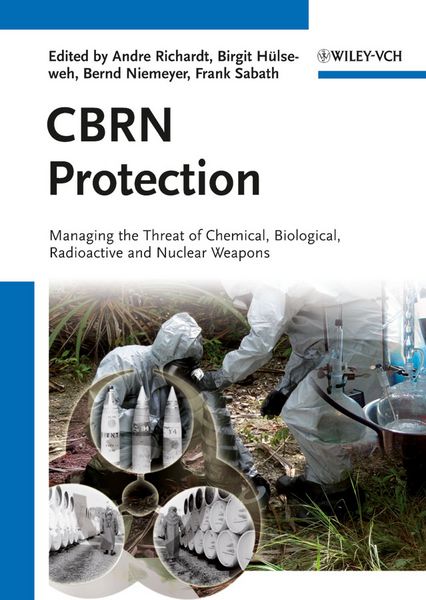
Produktbild: CBRN Protection
- 22%

CBRN Protection Managing the Threat of Chemical, Biological, Radioactive and Nuclear Weapons

22% sparen

69,99 € UVP 89,90 €

inkl. gesetzl. MwSt., Versandkostenfrei


Beschreibung

Produktdetails

Einband

Gebundene Ausgabe

Erscheinungsdatum

14.11.2012

Abbildungen

Tabellen, schwarz-weiss, schwarz-weiss Illustrationen

Herausgeber

Andre Richardt + weitere

Verlag

Wiley-VCH

Seitenzahl

514

Maße (L/B/H)

25/17,5/3,2 cm

Gewicht

1059 g

Auflage

1. Auflage

Sprache

Englisch

ISBN

978-3-527-32413-2

Beschreibung

Produktdetails

Einband

Gebundene Ausgabe

Erscheinungsdatum

14.11.2012

Abbildungen

Tabellen, schwarz-weiss, schwarz-weiss Illustrationen

Herausgeber

Verlag

Wiley-VCH

Seitenzahl

514

Maße (L/B/H)

25/17,5/3,2 cm

Gewicht

1059 g

Auflage

1. Auflage

Sprache

Englisch

ISBN

978-3-527-32413-2

Herstelleradresse

Wiley-VCH GmbH
product_safety@wiley.com
Wiley-VCH GmbH, Boschstrasse 12, DE-69469 Weinheim

Ein neues Kapitel für Ihre Bücher

Ein neues Kapitel für Ihre Bücher

Schenken Sie Ihren alten Schätzen ein zweites Leben: Einfach Barcode scannen, Versandetikett ausdrucken, Bücher verschicken und Thalia Geschenkkarte erhalten.

Jetzt verkaufen
Jetzt verkaufen

Kundinnen und Kunden meinen

0 Bewertungen

Informationen zu Bewertungen

Zur Abgabe einer Bewertung ist eine Anmeldung im Konto notwendig. Die Authentizität der Bewertungen wird von uns nicht überprüft. Wir behalten uns vor, Bewertungstexte, die unseren Richtlinien widersprechen, entsprechend zu kürzen oder zu löschen.

Die Bewertungen sind nach Format, Anzahl Sterne und Datum sortiert.

Verfassen Sie die erste Bewertung zu diesem Artikel

Helfen Sie anderen Kund*innen durch Ihre Meinung

Kundinnen und Kunden meinen

0 Bewertungen filtern

Die Leseprobe wird geladen.
  • Produktbild: CBRN Protection
  • PREFACE


    PART I: History and Treaties in CBRN - Warfare and Terrorism


    A GLANCE BACK - MYTHS AND FACTS ABOUT CBRN INCIDENTS

    Introduction

    History of Chemical Warfare

    Introduction to Biological Warfare

    Introduction to Radiological and Nuclear Warfare


    INTERNATIONAL TREATIES - ONLY A MATTER FOR DIPLOMATS?

    Introduction to the Minefield of Negotiations

    Why It Is so Difficult to Implement International Regulations?

    Historic Development of Treaties - the Link to the Incidents

    Today's System of Treaties - a Global Network

    Nuclear Weapons

    Organizations

    Conclusions and Where Does the Road Lead?


    PART II: CBRN Characteristics - Is There Something Inimitable?


    CHEMICAL AGENTS - SMALL MOLECULES WITH DEADLY PROPERTIES

    Are Special Properties Required for Chemical Warfare Agents?

    How can we Classify Chemical Warfare Agents?

    Properties of Chemical Warfare Agents

    Choking and Irritant Agents

    Incapacitating Agents

    Dissemination Systems of Chemical Warfare Agents

    Conclusions and Outlook


    CHARACTERISTICS OF BIOLOGICAL WARFARE AGENTS - DIVERSITY OF BIOLOGY

    What Is Special?

    Types of Biological Agents

    Risk Classification of Biological and Biological Warfare Agents

    Routes of Entry

    Origin, Spreading, and Availability

    The Biological Event - Borderline to Pandemics, Endemics, and Epidemics

    The Bane of Biotechnology - Genetically Engineered Pathogens

    Conclusions and Outlook


    CHARACTERISTICS OF NUCLEAR AND RADIOLOGICAL WEAPONS

    Introduction to Nuclear Explosions

    Direct Effects

    Indirect Effects

    Radiological Weapons


    PART III: CBRN Sensors - Key Technology for an Effective CBRN Countermeasure Strategy


    WHY ARE RELIABLE CBRN DETECTOR TECHNOLOGIES NEEDED?

    Introduction

    A Concept to Track CBRN Substances

    Low-Level Exposure and Operational Risk Management

    Conclusions and Outlook


    ANALYSIS OF CHEMICAL WARFARE AGENTS - SEARCHING FOR MOLECULES

    Analytical Chemistry - the Scientific Basis for Searching Molecules

    Standards for Chemical Warfare Agent Sensor Systems and Criteria for Deployment

    False Alarm Rate and Limit of Sensitivity

    Technologies for Chemical Warfare Agent Sensor Systems

    Testing of Chemical Warfare Agent Detectors

    Conclusions and Future Developments


    DETECTION AND ANALYSIS OF BIOLOGICAL AGENTS

    What Makes the Difference?

    The Ideal Detection and Identification Platform

    Bioaerosols: Particulate and Biological Background

    Aerosol Detection - A Tool for Threat Monitoring

    Identification of Biological Warfare Agents

    Developing and Upcoming Technologies

    Conclusions


    MEASUREMENT OF IONIZING RADIATION

    Why Is Detection of Ionizing Radiation So Important?

    Physical Quantities used to Describe Radioactivity and Ionizing Radiation

    Different Measuring Tasks Concerning Ionizing Radiation

    Basics of Radiation Detectors

    Gamma Dose Rate and Detection of Gamma Radiation

    Conclusions and Outlook


    PART IV: Technologies for Physical Protection


    FILTER TECHNOLOGY - CLEAN AIR IS REQUIRED

    Filters - Needed Technology Equipment for Collective and Individual Protection

    General Considerations

    What are the Principles for Filtration and Air-Cleaning?

    Test Methods

    Selection Process for CBRN Filters

    Conclusions and Outlook


    INDIVIDUAL PROTECTIVE EQUIPMENT - DO YOU KNOW WHAT TO WEAR?

    Basics of Individual Protection

    Which Challenges for Individual Protection Equipment (IPE) Can Be Identified?

    The Way to Design Individual Protective Equipment

    Function

    Ergonomics - a Key Element for Individual Protection Equipment

    Donning and Doffing - Training Is Required

    Overview of IPE Items - They Have to Act in Concert

    Quality Assurance

    Workplace Safety

    Future Prospects


    COLLECTIVE PROTECTION - A SECURE AREA IN A TOXIC ENVIRONMENT

    Why Is Collective Protection of Interest?

    Collective Protection Systems - Required for Different Scenarios

    Basic Design

    Conclusions and Outlook


    PART V: Cleanup after a CBRN Event


    DECONTAMINATION OF CHEMICAL WARFARE AGENTS - WHAT IS THOROUGH?

    What Is Decontamination?

    Dispersal and Fate of Chemical Warfare Agents

    Decontamination Media for Chemical Warfare Agents

    Selected Chemical Warfare Agents and Decont Reaction Schemes

    Soman (GD)

    VX

    Catalysis in Decontamination

    Decont Procedures

    Conclusions and Outlook


    PRINCIPLES AND PRACTICE OF DISINFECTION OF BIOLOGICAL WARFARE AGENTS - HOW CLEAN IS CLEAN ENOUGH?

    General Principles of Disinfection and Decontamination

    Mechanisms of Action of Biocides against Microorganisms

    Levels of Disinfection

    Biological Target Sites of Selected Biocides

    The Spores Problem

    Inactivation as Kinetic Process

    Evaluation of Antimicrobial Efficiency

    Carrier Tests versus Suspension Tests

    Resistance to Biocide Inactivation - a Growing Concern

    New and Emerging Technologies for Disinfection

    'Is Clean Clean Enough' or 'How Clean Is Clean Enough'?


    RADIOLOGICAL/NUCLEAR DECONTAMINATION - REDUCE THE RISK

    Why Is Radiological/Nuclear Decontamination So Special?

    Contamination

    Decontamination

    Conclusions and Outlook


    PART VI: CBRN Risk Management - Are We Prepared to Respond?


    PREPAREDNESS

    Introduction to Risk Management

    Key Elements Influencing a Counter-CBRN Strategy

    A Special Strategy for CBRN

    Proliferation Prevention

    Active Countermeasures

    If Things Get Real: Responding to a CBRN Event

    Research

    Aftermath Action - Lessons Learned

    Conclusions and Outlook


    INDEX