• Produktbild: Living Histories
  • Produktbild: Living Histories

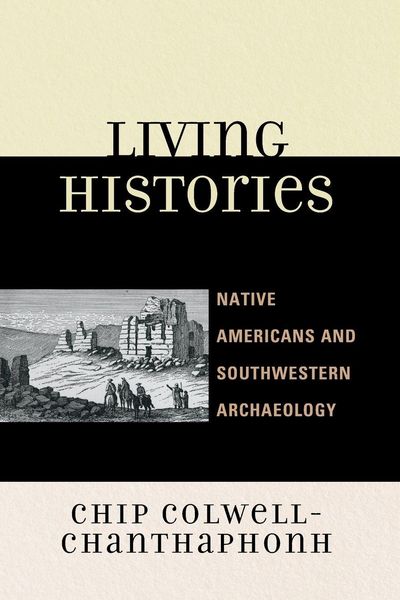
Living Histories Native Americans and Southwestern Archaeology

41,99 €

inkl. gesetzl. MwSt., Versandkostenfrei


Beschreibung

Produktdetails

Einband

Taschenbuch

Erscheinungsdatum

16.11.2010

Verlag

AltaMira Press

Seitenzahl

212

Maße (L/B/H)

22,9/15,2/1,2 cm

Gewicht

315 g

Sprache

Englisch

ISBN

978-0-7591-1196-7

Beschreibung

Zitat

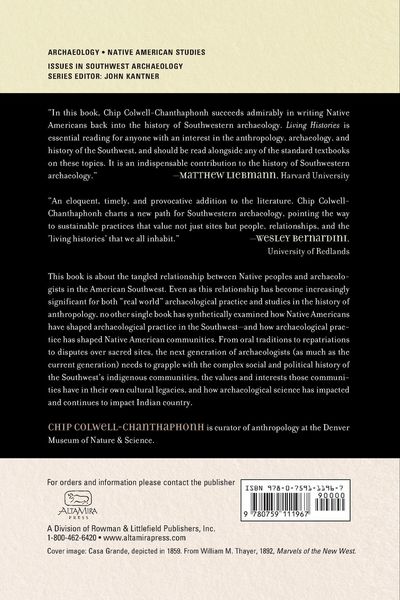
In this book, Chip Colwell-Chanthaphonh succeeds admirably in writing Native Americans back into the history of Southwestern archaeology. Living Histories is essential reading for anyone with an interest in the anthropology, archaeology, and history of the Southwest, and should be read alongside any of the standard textbooks on these topics. It is an indispensable contribution to the history of Southwestern archaeology. -- Matthew Liebmann, Harvard University An eloquent, timely, and provocative addition to the literature. Colwell-Chanthaphonh charts a new path for Southwestern Archaeology, pointing the way to sustainable practices that value not just sites but people, relationships, and the 'living histories' that we all inhabit. -- Wesley Bernardini, University of Redlands Rather than reviewing what is known about the ancient Southwest, this book examines how archaeological practices have impacted living communities. Colwell-Chanthaphonh (Denver Museum of Nature and Science) usefully summarizes the alienations and entanglements between mainstream archaeological practices and southwestern Native American understandings of deep history. He concisely outlines how indigenous people historically were barred from the archaeological study of their past, and their recent (yet still incomplete) successes in breaking into the conversation. Colwell-Chanthaphonh consistently tacks back and forth between the perspectives of archaeologists and Native peoples, attempting to keep them "separate but equal." The book treats their divergent approaches to the value of the past and sites, the history of archaeological research, and federal laws governing indigenous heritage. Coverage of Native participation in and resistance to early excavations, the emergence of tribal-run heritage programs, and recent collaborative efforts between indigenous people and mainstream archaeologists is particularly strong. The volume, written for nonspecialists, will also be a great addition to introductory courses in southwestern and North American archaeology. Summing Up: Highly recommended. CHOICE The general reader and archaeology student will find this book enjoyable and enlightening...Several of the sidebars present specific topics that would make good class discussions at either the undergraduate or graduate level. Given the history it provides and the discussions it will provoke, this book should be required reading in all university survey courses on Southwest archaeology. Journal of Anthropological Research

Produktdetails

Einband

Taschenbuch

Erscheinungsdatum

16.11.2010

Verlag

AltaMira Press

Seitenzahl

212

Maße (L/B/H)

22,9/15,2/1,2 cm

Gewicht

315 g

Sprache

Englisch

ISBN

978-0-7591-1196-7

Herstelleradresse

Libri GmbH
Europaallee 1
36244 Bad Hersfeld
DE

Email: GPSR Kontakt

Ein neues Kapitel für Ihre Bücher

Ein neues Kapitel für Ihre Bücher

Schenken Sie Ihren alten Schätzen ein zweites Leben: Einfach Barcode scannen, Versandetikett ausdrucken, Bücher verschicken und Thalia Geschenkkarte erhalten.

Jetzt verkaufen
Jetzt verkaufen

Noch keine Bewertungen vorhanden

Verfassen Sie die erste Bewertung zu diesem Artikel

Helfen Sie anderen Kundinnen und Kunden durch Ihre Meinung.

Kundinnen und Kunden meinen

Bewertungen (0)

Die Leseprobe wird geladen.
  • Produktbild: Living Histories
  • Produktbild: Living Histories
  • Chapter 1 List of Figures
    Chapter 2 List of Tables
    Chapter 3 Chapter 1. Introduction
    Chapter 4 Chapter 2. Histories and Traditions
    Chapter 5 Chapter 3. Explorations and Contestations
    Chapter 6 Chapter 4. Laws and Ethics
    Chapter 7 Chapter 5. Communities and Collaborations
    Chapter 8 Chapter 6. Conclusions
    Chapter 9 References