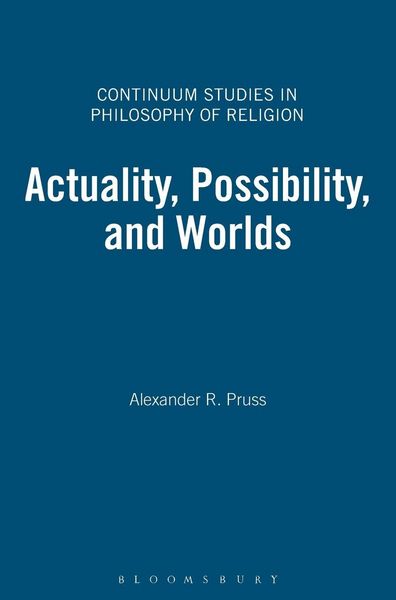
Actuality, Possibility, and Worlds
228,99 €
inkl. gesetzl. MwSt.,
Beschreibung
Produktdetails
Einband
Gebundene Ausgabe
Erscheinungsdatum
19.05.2011
Verlag
Bloomsbury USASeitenzahl
320
Maße (L/B/H)
25/17,5/2,2 cm
Gewicht
734 g
Sprache
Englisch
ISBN
978-1-4411-4516-1
Actuality, Possibility and Worlds is an exploration of the Aristotelian account that sees possibilities as grounded in causal powers. On his way to that account, Pruss surveys a number of historical approaches and argues that logicist approaches to possibility are implausible.
The notion of possible worlds appears to be useful for many purposes, such as the analysis of counterfactuals or elucidating the nature of propositions and properties. This usefulness of possible worlds makes for a second general question: Are there any possible worlds and, if so, what are they? Are they concrete universes as David Lewis thinks, Platonic abstracta as per Robert M. Adams and Alvin Plantinga, or maybe linguistic or mathematical constructs such as Heller thinks? Or is perhaps Leibniz right in thinking that possibilia are not on par with actualities and that abstracta can only exist in a mind, so that possible worlds are ideas in the mind of God?
Ein neues Kapitel für Ihre Bücher
Ein neues Kapitel für Ihre Bücher
Schenken Sie Ihren alten Schätzen ein zweites Leben: Einfach Barcode scannen, Versandetikett ausdrucken, Bücher verschicken und Thalia Geschenkkarte erhalten.
Jetzt verkaufenKundinnen und Kunden meinen
Verfassen Sie die erste Bewertung zu diesem Artikel
Helfen Sie anderen Kund*innen durch Ihre Meinung
Kurze Frage zu unserer Seite
Vielen Dank für Ihr Feedback
Wir nutzen Ihr Feedback, um unsere Produktseiten zu verbessern. Bitte haben Sie Verständnis, dass wir Ihnen keine Rückmeldung geben können. Falls Sie Kontakt mit uns aufnehmen möchten, können Sie sich aber gerne an unseren Kund*innenservice wenden.
zum Kundenservice