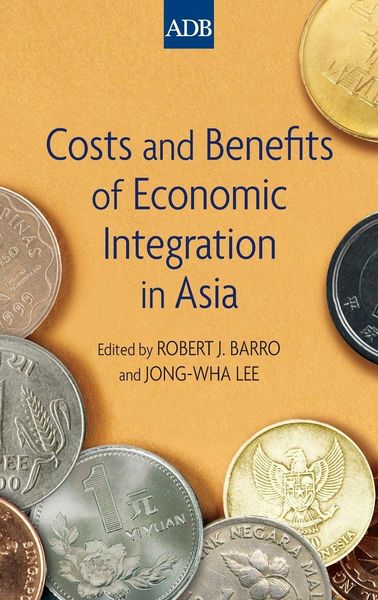
Produktbild: Costs and Benefits of Economic Integration in Asia

Costs and Benefits of Economic Integration in Asia

129,99 €

inkl. gesetzl. MwSt., Versandkostenfrei


Beschreibung

Produktdetails

Einband

Gebundene Ausgabe

Erscheinungsdatum

01.02.2011

Herausgeber

Robert J. Barro + weitere

Verlag

Oxford University Press

Seitenzahl

304

Maße (L/B/H)

24/16,1/2,2 cm

Gewicht

544 g

Sprache

Englisch

ISBN

978-0-19-975398-7

Beschreibung

Produktdetails

Einband

Gebundene Ausgabe

Erscheinungsdatum

01.02.2011

Herausgeber

Verlag

Oxford University Press

Seitenzahl

304

Maße (L/B/H)

24/16,1/2,2 cm

Gewicht

544 g

Sprache

Englisch

ISBN

978-0-19-975398-7

Herstelleradresse

Libri GmbH
Europaallee 1
36244 Bad Hersfeld
DE

Email: gpsr@libri.de

Ein neues Kapitel für Ihre Bücher

Ein neues Kapitel für Ihre Bücher

Schenken Sie Ihren alten Schätzen ein zweites Leben und erhalten dafür eine Thalia Geschenkkarte.

Jetzt verkaufen
Jetzt verkaufen

Noch keine Bewertungen vorhanden

Verfassen Sie die erste Bewertung zu diesem Artikel

Helfen Sie anderen Kundinnen und Kunden durch Ihre Meinung.

Kundinnen und Kunden meinen

Bewertungen (0)

  • Produktbild: Costs and Benefits of Economic Integration in Asia
    • Foreword

    • Acknowledgements

    • Contributors

    • Acronyms

    • I. Introductory Essay

    • Robert J. Barro and Jong-Wha Lee

    • II. East Asian Currency Union

    • Jong-Wha Lee and Robert J. Barro

    • 1. Introduction

    • 2. The Benefits and Costs of an East Asian Currency Union

    • 2.1 Benefits and Costs of Currency Unions

    • 2.2 Optimum Currency Area (OCA) Criteria

    • 3. Which Currency Union for East Asia?

    • 3.1 Data for East Asia Monetary Union Analysis

    • 3.2 Is East Asia an OCA?

    • 4. Welfare Effects of East Asian Currency Unions

    • 4.1 The Effects of Currency Unions on Growth and Volatility

    • 4.2 Rare Disasters and Currency Unions

    • 4.3 Estimation of Welfare Effects of East Asian Currency Unions: An Illustration

    • 5. Concluding Remarks

    • III. Asian Financial Integration: Trends and Interruptions

    • Eduardo Borensztein and Prakash Loungani

    • 1. Introduction

    • 2. Convergence in Interest Rates and Equity Premia

    • 3. Portfolio Holdings and Home Bias

    • 3.1 Portfolio Holdings: Summary Statistics

    • 3.2 Portfolio Holdings: Gravity Model Estimates

    • 3.3 Home Bias

    • 4. Risk-Sharing and Financial Stability

    • 4.1 Risk-Sharing

    • 4.2 Financial Integration and Crises

    • 4.3 Local vs. Foreign Investors: Recent Studies

    • 4.4 Investor Behavior during the Subprime Crisis: Evidence from Brazil

    • 5. Conclusions

    • IV. Understanding Business Cycle Synchronization: Is Inflation Targeting Paving the Way to Asian Monetary Union?

    • Andrew K. Rose

    • 1. Motivation and Introduction

    • 2. The Effect of Trade on Business Cycle Synchronization

    • 3. Inflation Targeting and Business Cycle Synchronization: Theory and Literature

    • 4. The Data Set

    • 5. Decoupling

    • 6. Business Cycle Synchronization and Inflation Targeting

    • 7. Regression Analysis

    • 8. Estimating Treatment Effects via Matching

    • 9. Why?

    • 10. Summary and Conclusion

    • V. Trading Silver for Gold: Nineteenth-Century Asian Exports and the Political Economy of Currency Unions

    • Kris James Mitchener and Hans-Joachim Voth

    • 1. Introduction

    • 2. Historical Background and Context

    • 3. Data

    • 4. Method and Results

    • 4.1 Multilateral Resistance

    • 4.2 Results for Sub-Periods

    • 4.3 Discussion

    • 5. Identifying the Effects of Currency Choice

    • 6. The Political Economy of Currency Arrangements

    • 7. Conclusion

    • VI. The ASEAN Free Trade Agreement: Impact on Trade Flows and External Trade Barriers

    • Hector Calvo-Pardo, Caroline Freund and Emanuel Ornelas

    • 1. Introduction

    • 2. Trade Creation, Trade Diversion, and Import Barriers on Outsiders

    • 3. The ASEAN Free Trade Agreement

    • 3.1 Data

    • 3.2 Tariffs

    • 3.3 Aggregate Trade

    • 4. The Effect of Tariffs on Trade in ASEAN

    • 5. Preferences and External Tariffs in ASEAN

    • 6. Conclusion

    • VII. Economic Integration in Remote Resource-Rich Regions

    • Anthony J. Venables

    • 1. Introduction

    • 2. Regional Characteristics

    • 3. Trade Policy for Remote-Rich Economies

    • 3.1 Low Supply Response of External Exports

    • 3.2 The Distribution of Natural Resources

    • 3.3 Regionally and Globally Traded Goods

    • 4. A Benchmark Model

    • 5. Trade Liberalizations

    • 5.1 Trade Policy and the Intra-Regional Terms of Trade

    • 5.2 Trade Policy: General Equilibrium Outcomes

    • 5.3 Non-Resource Income and Within Country Income Distribution

    • 5.4 Trade Creation and Trade Diversion

    • 6. Policy Implications

    • 7. Concluding Comments

    • VIII. Regional Trade Integration and Multinational Firm Strategies

    • Pol Antràs and C. Fritz Foley

    • 1. Introduction

    • 2. A First Look at the Data

    • 3. Theoretical Framework

    • 3.1 A Simple Model of FDI

    • 3.2 Analysis

    • 3.3 Effects of a Regional Trade Agreement

    • 4. Econometric Evidence

    • 5. Conclusion

    • IX. A World Factory in Global Production Chains: Estimating Imported Value-Added in Exports by the People's Republic of China

    • Robert Koopman, Zhi Wang and Shang-Jin Wei

    • 1. Introduction

    • 2. Conceptual Framework and Estimation Method

    • 2.1 When Special Features of Processing Exports Are Not Taken Into Account

    • 2.2 Domestic Content in Exports When Processing Trade is Prevalent

    • 2.3 Estimation Issues

    • 3. Estimation Results on Domestic and Foreign Content in Exports of the PRC

    • 3.1 Data

    • 3.2 Domestic and Foreign Contents in Total Exports

    • 4. Slicing Up the Value Chains along Multiple Countries: Methodology

    • 4.1 When a World Input-Output Table (That Covers All Countries) is Available

    • 4.2 Working with an Inter-Regional Input-Output Table (for a Subset of Countries)

    • 5. Empirical Estimates on Value-Added Along Production Chains

    • 5.1 Data Source

    • 5.2 Comparing the PRC with Other Asian Economies in Production Chain

    • 5.3 Slicing Up Production Chains Across Countries

    • 5.4 Multinational Value-Added Chains in the PRC for Disaggregated Export Categories

    • 6. Concluding Remarks