• Produktbild: Gradients in a Tropical Mountain Ecosystem of Ecuador
  • Produktbild: Gradients in a Tropical Mountain Ecosystem of Ecuador
Band 198

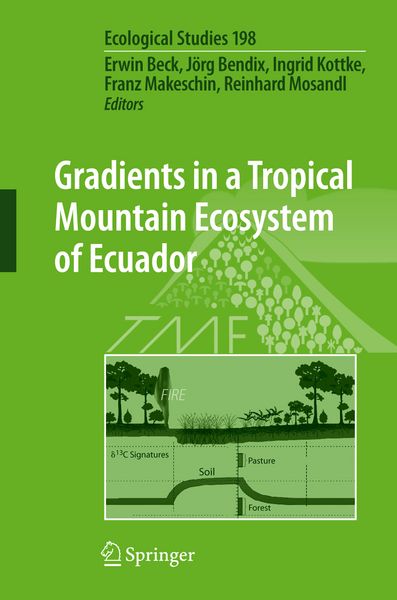
Gradients in a Tropical Mountain Ecosystem of Ecuador

Aus der Reihe Ecological Studies

295,99 €

inkl. gesetzl. MwSt., Versandkostenfrei


Beschreibung

Produktdetails

Einband

Taschenbuch

Erscheinungsdatum

22.11.2010

Abbildungen

XIII, 525 p.

Herausgeber

Erwin Beck + weitere

Verlag

Springer Berlin

Seitenzahl

525

Maße (L/B/H)

23,5/15,5/3 cm

Gewicht

826 g

Auflage

Softcover reprint of hardcover 1st edition 2008

Sprache

Englisch

ISBN

978-3-642-09266-4

Beschreibung

Rezension

From the reviews:


"The editors of this book have attempted to address the complexity of this mountain ecosystem through the work of 140 researchers in around 30 research groups. … The many illustrations throughout the book are clear and informative. … The book is targeted at those interested in ecosystem studies and sustainable land management and resource use … . I would recommend it to anyone interested in the complexities of mountain ecosystems … ." (Paul M. Ramsay, Mountain Research and Development, Vol. 28 (3/4), August-November, 2008)


"The book offers a detailed picture of the research conducted within the interdisciplinary project in Ecuador and is therefore particularly suited for people working in tropical mountain rainforests. Yet, it may also be of interest to anybody studying altitudinal or disturbance gradients as the chapters address a large number of ecologically important aspects. … Overall, the chapters are very well illustrated with lots of coloured flow-charts, photos and figures." (Nina Farwig, Basic and Applied Ecology, Issue 10, 2009)

Portrait

The tropical mountain ecosystem of one of the "hottest" hotspots of biodiversity in the world was investigated by almost 30 groups of researchers from various disciplines. They performed ecosystem analyses following two gradients: an altitudinal gradient and a gradient of land use intensity and ecosystem regeneration following human use. Based on these analyses, this volume discusses findings in macro and microclimate; physics, chemistry, and biology of soils; water relations; matter turnover and nutrient availability; biomass allocation; plant growth; floral composition; vegetation structure and dynamics; plant life forms; organismic interactions; population diversity of birds, moths, and microarthropods; ethnobotanical and sociological aspects; forest management; and reforestation with indigenous species. Several new hypotheses regarding biodiversity, ecosystem functioning, and the sustainable management of a biodiversity hotspot are presented.

Produktdetails

Einband

Taschenbuch

Erscheinungsdatum

22.11.2010

Abbildungen

XIII, 525 p.

Herausgeber

Verlag

Springer Berlin

Seitenzahl

525

Maße (L/B/H)

23,5/15,5/3 cm

Gewicht

826 g

Auflage

Softcover reprint of hardcover 1st edition 2008

Sprache

Englisch

ISBN

978-3-642-09266-4

Herstelleradresse

Springer-Verlag KG
Sachsenplatz 4-6
1201 Wien
AT

Email: ProductSafety@springernature.com

Ein neues Kapitel für Ihre Bücher

Ein neues Kapitel für Ihre Bücher

Schenken Sie Ihren alten Schätzen ein zweites Leben und erhalten dafür eine Thalia Geschenkkarte.

Jetzt verkaufen
Jetzt verkaufen

Noch keine Bewertungen vorhanden

Verfassen Sie die erste Bewertung zu diesem Artikel

Helfen Sie anderen Kundinnen und Kunden durch Ihre Meinung.

Kundinnen und Kunden meinen

Bewertungen (0)

Weitere Artikel finden Sie in

  • Produktbild: Gradients in a Tropical Mountain Ecosystem of Ecuador
  • Produktbild: Gradients in a Tropical Mountain Ecosystem of Ecuador
  • The Ecosystem (Reserva Biológica San Francisco).- Mountain Rain Forests in Southern Ecuador as a Hotspot of Biodiversity – Limited Knowledge and Diverging Patterns.- The People Settled Around Podocarpus National Park.- Ecuador Suffers the Highest Deforestation Rate in South America.- Methodological Challenges of a Megadiverse Ecosystem.- Gradients in Ecosystem Analysis.- Investigating Gradients in Ecosystem Analysis.- The Investigated Gradients.- The Altitudinal Gradient.- Climate.- Soils Along the Altitudinal Transect and in Catchments.- Flora and Fungi: Composition and Function.- Flora and Fungi: Composition and Function.- Flora and Fungi: Composition and Function.- Flora and Fungi: Composition and Function.- Flora and Fungi: Composition and Function.- Fauna: Composition and Function.- Fauna: Composition and Function.- Fauna: Composition and Function.- Fauna: Composition and Function.- Water Relations.- Nutrient Status and Fluxes at the Field and Catchment Scale.- Biotic Soil Activities.- Altitudinal Changes in Stand Structure and Biomass Allocation of Tropical Mountain Forests in Relation to Microclimate and Soil Chemistry.- Stand Structure, Transpiration Responses in Trees and Vines and Stand Transpiration of Different Forest Types Within the Mountain Rainforest.- Plant Growth Along the Altitudinal Gradient — Role of Plant Nutritional Status, Fine Root Activity, and Soil Properties.- Spatial Heterogeneity Patterns — a Comparison Between Gorges and Ridges in the Upper Part of an Evergreen Lower Montane Forest.- The Unique Purdiaea nutans Forest of Southern Ecuador — Abiotic Characteristics and Cryptogamic Diversity.- Climate Variability.- Growth Dynamics of Trees in Tropical Mountain Ecosystems.- Temporal Heterogeneities — Matter Deposition from RemoteAreas.- Gradients of Disturbance.- Gap Dynamics in a Tropical Lower Montane Forest in South Ecuador.- Landslides as Important Disturbance Regimes — Causes and Regeneration.- Sustainable and Non-Sustainable Use of Natural Resources by Indigenous and Local Communities.- Natural Forest Management in Neotropical Mountain Rain Forests — An Ecological Experiment.- Permanent Removal of the Forest: Construction of Roads and Power Supply Lines.- Forest Clearing by Slash and Burn.- Gradients of Regeneration.- Gradients and Patterns of Soil Physical Parameters at Local, Field and Catchment Scales.- Visualization and Analysis of Flow Patterns and Water Flow Simulations in Disturbed and Undisturbed Tropical Soils.- Pasture Management and Natural Soil Regeneration.- Succession Stages of Vegetation Regeneration: Secondary Tropical Mountain Forests.- Reforestation of Abandoned Pastures: Seed Ecology of Native Species and Production of Indigenous Plant Material.- Reforestation of Abandoned Pastures: Silvicultural Means to Accelerate Forest Recovery and Biodiversity.- Successional Stages of Faunal Regeneration — A Case Study on Megadiverse Moths.- Synopsis.- Gradients in a Tropical Mountain Ecosystem — a Synthesis.