Gutscheinbedingungen

Gültig bis 13.07.2026 | Gültig für Spielzeug (außer Tonieboxen & ausgewählte Tonies), Filme, Musik, Software, Games, Schreibwaren, Hörbücher und Hörbuch-Downloads (außer Abo & Shelfies), gebrauchte Bücher, nicht preisgebundene Bücher und Kalender | Einlösbar unter thalia.de und in der Thalia App | Click & Collect nur mit Online-Zahlung (Paypal/Kreditkarte) vorab | Einzelne Artikel können ausgeschlossen sein | Nicht kombinierbar mit anderen Gutscheinen oder Preisaktionen | Nur einmal pro Einkauf einlösbar | Gutschein wird auf max. 500€ Bestellwert angerechnet | Keine Barauszahlung | Digitale Hörbücher nur für Android | Nicht gültig für preisgebundene Artikel (aufgrund der Buchpreisbindung sind Gutscheine nicht auf Bücher, eBooks, Presse einlösbar), tolino eReader & Zubehör, Elektronik, Geschenke & Trends, Abonnements & Flatrates, Geschenkkarten, Versandkosten und Services

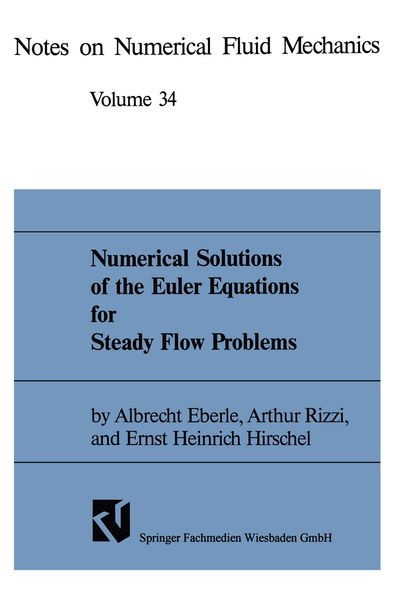
  • Produktbild: Numerical Solutions of the Euler Equations for Steady Flow Problems
  • Produktbild: Numerical Solutions of the Euler Equations for Steady Flow Problems
Band 48

Numerical Solutions of the Euler Equations for Steady Flow Problems

48,99 €

inkl. gesetzl. MwSt., Versandkostenfrei


Beschreibung

Produktdetails

Einband

Taschenbuch

Erscheinungsdatum

01.01.1992

Verlag

Vieweg & Teubner

Seitenzahl

448

Maße (L/B/H)

23,5/15,5/2,6 cm

Gewicht

703 g

Auflage

Softcover reprint of the original 1st ed. 1992

Sprache

Englisch

ISBN

978-3-528-07634-4

Beschreibung

Produktdetails

Einband

Taschenbuch

Erscheinungsdatum

01.01.1992

Verlag

Vieweg & Teubner

Seitenzahl

448

Maße (L/B/H)

23,5/15,5/2,6 cm

Gewicht

703 g

Auflage

Softcover reprint of the original 1st ed. 1992

Sprache

Englisch

ISBN

978-3-528-07634-4

Herstelleradresse

Vieweg+Teubner Verlag
Abraham-Lincoln-Straße 46
65189 Wiesbaden
DE

Email: ProductSafety@springernature.com

Ein neues Kapitel für Ihre Bücher

Ein neues Kapitel für Ihre Bücher

Schenken Sie Ihren alten Schätzen ein zweites Leben: Einfach Barcode scannen, Versandetikett ausdrucken, Bücher verschicken und Thalia Geschenkkarte erhalten.

Jetzt verkaufen
Jetzt verkaufen

Noch keine Bewertungen vorhanden

Verfassen Sie die erste Bewertung zu diesem Artikel

Helfen Sie anderen Kundinnen und Kunden durch Ihre Meinung.

Kundinnen und Kunden meinen

Bewertungen (0)

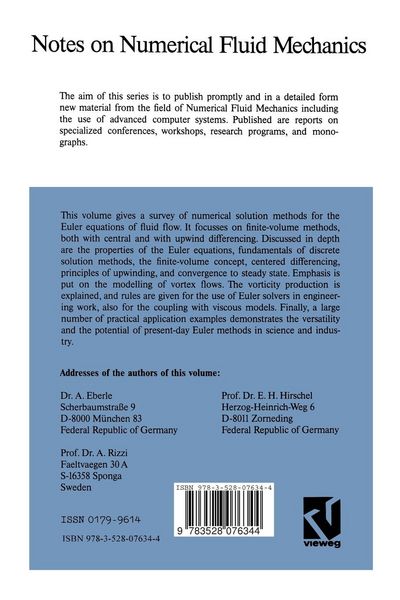
  • Produktbild: Numerical Solutions of the Euler Equations for Steady Flow Problems
  • Produktbild: Numerical Solutions of the Euler Equations for Steady Flow Problems
  • I Historical Origins of the Inviscid Model.- 1.1 From Antiquity to the Renaissance.- 1.2 The Enlightenment: the Age of Reason.- 1.2.1 Leonhard Euler.- 1.3 The 19th Century: Mathematical Fluid Mechanics.- 1.3.1 Vortex Discontinuities and Resistance.- 1.3.2 Shock Waves.- 1.4 The 20th Century: The Computational Era.- 1.4.1 Early Methods.- 1.4.2 Methods to Solve the Euler Equations: 1950–1970.- 1.4.3 Methods to Solve the Euler Equations: 1970–1990.- 1.5 Brief Overview of Field.- 1.5.1 Secondary Reference Sources.- 1.5.2 Three Categories of Methods.- 1.6 Outline of the Remaining Chapters.- 1.7 References.- II The Euler Equations.- 2.1 The Classical Euler Equations in Gas Dynamics.- 2.2 Basic Results of the Non-Conservative Equations.- 2.2.1 Isentropic Flow.- 2.2.2 Homentropic Flow.- 2.3 Basic Results of the Conservative Equations.- 2.3.1 Isenthalpic Flow.- 2.3.2 Shock Flow.- 2.3.3 Speed of Sound.- 2.3.4 Eigenvalues of Pressure Waves.- 2.3.5 Homogeneous Property of the Euler Equations.- 2.4 Coordinate Transformations.- 2.5 Stokes’ Integral.- 2.6 Physical Boundary Conditions.- 2.7 Other Forms of the Euler Equations.- 2.8 References.- III Fundamentals of Discrete Solution Methods.- 3.1 Hyperbolic Equations and Waves.- 3.2 Characteristics.- 3.3 Wavefronts Bounding a Constant State.- 3.4 Riemann Invariants.- 3.5 Well-Posed and Unique Solutions.- 3.6 Initial Boundary-Value Problems.- 3.7 Weak Solutions and Shocks.- 3.8 Discrete Solution Methods.- 3.9 Classical Finite-Difference Approximations to Derivatives.- 3.10 Computational Grid and Accuracy.- 3.11 Local Truncation Error.- 3.12 Consistency.- 3.13 Convergence and Stability.- 3.14 Notion of Convergence.- 3.15 Notion of Stability.- 3.15.1 A Bound for the Spectral Radius.- 3.16 Von Neumann Method.- 3.17 Matrix Method.- 3.18 The Energy Method.- 3.19 Schemes for Non-Linear Equations.- 3.20 References.- IV The Finite Volume Concept.- 4.1 Coordinate Transformations.- 4.1.1 The Differential Approach.- 4.2 The Finite-Volume Approach.- 4.2.1 Continuum Equations.- 4.2.2 Coordinate Geometry.- 4.2.3 Spatial Finite-Volume Discretization.- 4.2.4 Flux Evaluation.- 4.2.5 Stability and Accuracy at Mesh Singularities.- 4.3 Relationship to Finite Differences.- 4.4 Numerical Conservation.- 4.4.1 Uniform Free Stream.- 4.5 Cell Vertex Methods.- 4.6 Boundary Conditions for the Continuous Problem.- 4.6.1 Coordinate Cuts.- 4.6.2 Solid Walls.- 4.6.3 Zero-Flux Transport.- 4.6.4 Inflow/Outflow Boundary.- 4.7 Discretization of the Flow Domain.- 4.7.1 Resolution of Scales.- 4.7.2 Topology of Grid-Point Patterns.- 4.8 Finite-Volume Truncation Error.- 4.9 Multi-Block Meshes.- 4.10 Boundary Conditions for the Discrete Problem.- 4.10.1 Accuracy and Stability.- 4.10.2 Empirical Rule for Boundary-Condition Accuracy.- 4.10.3 Farfield Boundary Conditions.- 4.11 References.- V Centered Differencing.- 5.1 Flux-Averaged Methods.- 5.2 Local Fourier Stability.- 5.3 Local Time-Step Scaling.- 5.4 Artificial-Viscosity Model.- 5.4.1 Non-Linear Artificial Viscosity.- 5.4.2 Linear Artificial Viscosity.- 5.4.3 Boundary Conditions.- 5.5 Time Integration and Convergence to Steady State.- 5.5.1 Steady State Operator.- 5.5.2 Eigenspectrum of Centered Schemes.- 5.6 References.- VI Principles of Upwinding.- 6.1 Initial Considerations.- 6.2 Foundation of Upwinding.- 6.3 A Local Solution to the Model Equation.- 6.4 Conservative Upwinding.- 6.5 Accuracy of Three-Point Schemes.- 6.6 Stability Considerations for Three-Point Schemes.- 6.7 The Finite-Volume Cell-Face Concept.- 6.8 The Riemann Probem at a Finite-Volume Cell Face.- 6.9 The Characteristic Derivative.- 6.10 The Scalar Invariant.- 6.11 Characteristic Condition.- 6.12 Eigenvalues and Invariants.- 6.13 A Simple Linear Riemann Solver.- 6.14 A Near Exact Riemann Solver.- 6.15 The Isentropic Riemann Solver.- 6.16 An Osher-Type Riemann Solver.- 6.17 A Linear Riemann Solver Using Primitive Variables.- 6.18 The Exact Non-Conservative Riemann Solver.- 6.19 An Alternative Osher-Type Approximate Riemann Solver.- 6.20 Asymmetric Osher-Type Approximate Riemann Solvers.- 6.21 A Linear Newton-Type Riemann Solver.- 6.22 A Quadratic Newton-Type Riemann Solver.- 6.23 A Linear Conservative Riemann Solver.- 6.24 The Exact Conservative Riemann Solver.- 6.25 Roe’s Average.- 6.26 Riemann Solvers Based on Fluxes: The Steger-Warming Fluxes.- 6.27 Generalized Steger-Warming Fluxes.- 6.28 Einfeldt-Type Fluxes.- 6.29 Van Leer-Type Fluxes.- 6.30 1D-Mass Flux of van Leer Type.- 6.31 1D-Momentum Flux of van Leer Type.- 6.32 1D-Energy Flux of van Leer Type.- 6.33 3D-Mass Flux.- 6.34 3D-Momentum Fluxes.- 6.35 3D-Energy Flux.- 6.36 The Use of the Conservative Riemann Solver for Splitting Flux Differences.- 6.37 The Use of the Conservative Riemann Solver for Splitting Flux Differences by Projection.- 6.38 Evaluation of Eigenvalues by Projection.- 6.39 Non-Oscillating Interpolation: Introduction.- 6.40 Five-Point Schemes.- 6.41 First-Order Upwind Scheme.- 6.42 Second-Order Upwind Scheme.- 6.43 Third-Order Biased Upwind Scheme.- 6.44 Fourth-Order Centered Scheme.- 6.45 The von Neumann Stability Test for Upwind Schemes.- 6.46 Criticism on the von Neumann Stability Test for Upwind Schemes.- 6.47 Extremum Principles for Upwind Schemes.- 6.48 Foundation of Flux Limiting.- 6.49 Flux Limiting by Sensing Functions.- 6.50 Flux Limiting by Biased Differences.- 6.51 Flux Limiting with Minimum Dispersion.- 6.52 Limiters.- 6.53 Seven-Point Schemes.- 6.54 Truth Functions.- 6.55 Non-oscillating Interpolation and Riemann Solvers.- 6.56 Riemann Solvers and Strong Shocks.- 6.57 Riemann Solvers and Boundary Conditions.- 6.58 Other Updates.- 6.59 Lax-Wendroff (L-W) Type Updates.- 6.60 Implicit Updates.- 6.61 Implicit Formulation.- 6.62 The Split Matrix.- 6.63 The Homogeneous Implicit Solution.- 6.64 Matrix Conditioning.- 6.65 References.- VII Convergence to Steady State.- 7.1 Introduction.- 7.2 Mathematical Understanding of Convergence.- 7.2.1 The Continuous Problem.- 7.2.2 Linear Semi-Discrete Problem.- 7.2.3 Linearized Euler Equations.- 7.2.4 Effect of Discrete Space Operator.- 7.3 Multi-Grid Scheme.- 7.4 Enthalpy Damping.- 7.5 Residual Averaging.- 7.6 Mesh Sequencing.- 7.7 References.- VIII A Note on the Use of Supercomputers.- 8.1 Supercomputers as Driver of Computational Fluid Dynamics.- 8.2 Future Developments in Supercomputing: Parallel Processing.- 8.3 References.- IX Coupling of Euler Solutions to Viscous Models.- 9.1 Diffusive Transport Effects in Fluid Flows.- 9.2 Treatment of Weak Interaction Flow Problems.- 9.3 Treatment of Strong Interaction Flow Problems.- 9.4 References.- X Modelling of Vortex Flows: Vorticity in Euler Solutions.- 10.1 Boundary Layers, Wakes and Vortices in their Inviscid Limit.- 10.2 The Lifting Wing as Inviscid Computation Problem.- 10.3 The Structure of the Wake of a Lifting Wing.- 10.4 Vorticity Creation and Entropy Rise in Euler Solutions for Lifting Wings.- 10.5 The State of the Art: a Critical Evaluation.- 10.6 A Note on the Solution of the Navier-Stokes Equations.- 10.7 References.- XI Methods in Practical Applications.- 11.1 Near-Incompressible Flow.- 11.1.1 Transverse Circular Cylinder.- 11.1.2 Some Numerical Experiments on Transverse Cylinders.- 11.1.3 Airfoil with Lift.- 11.1.4 Vortex Flow Over Sharp-Edged Delta Wing.- 11.1.5 Flow Through a Francis Water Turbine.- 11.1.6 Flow Past an Automobile.- 11.2 Subsonic/Transonic Flow.- 11.2.1 Comparison of Different Riemann Solvers.- 11.2.2 Flow Around Airfoils.- 11.2.3 Vortex Flow Over Sharp-Edged Delta Wings.- 11.2.4 Vortex Flow Over Round-Edged Delta Wings.- 11.2.5 Analysis of Flow Around a Project Wing.- 11.2.6 Flow Through Ducts.- 11.3 Supersonic/Hypersonic Flow.- 11.3.1 Leeside Flow Using Centered Scheme.- 11.3.2 Computation of Leeside Flow Using an Upwind Scheme.- 11.3.3 Supersonic Flow Around Delta Wings.- 11.4 Flow Past Complex Configuratons.- 11.4.1 Generic Fighter Configuration at Transonic and Supersonic Speed.- 11.4.2 Flow past Hypersonic Generic Aircraft.- 11.4.3 Equilibrium Real-Gas Solution for a Reentry Configuration.- 11.5 Coupling with Viscous Models.- 11.6 A Note on Unsteady Applications.- 11.7 References.- XII Future Prospects.- 12.1 General Considerations.- 12.2 Beyond Dimensional Splitting.- 12.3 Finite Element Formulations.- 12.4 Geometric Complexity.- 12.5 Interdisciplinary Problems.- 12.6 References.- XIII List of Symbols.- XIV Index of Authors.- XV Subject Index.