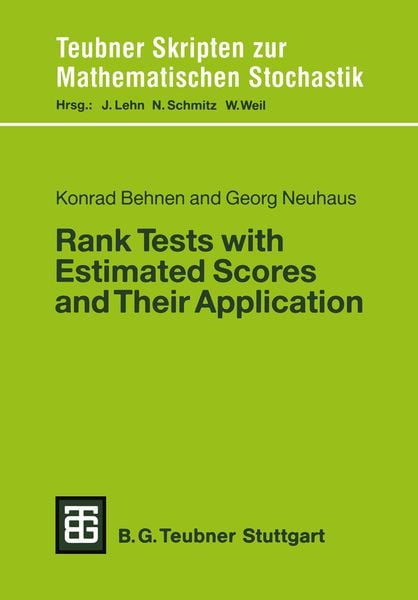

• Produktbild: Rank Tests with Estimated Scores and Their Application
  • Produktbild: Rank Tests with Estimated Scores and Their Application

Rank Tests with Estimated Scores and Their Application

49,95 €

inkl. gesetzl. MwSt., Versandkostenfrei


Beschreibung

Produktdetails

Einband

Taschenbuch

Erscheinungsdatum

01.01.1989

Verlag

Vieweg & Teubner

Seitenzahl

418

Maße (L/B/H)

24,4/17/2,4 cm

Gewicht

741 g

Auflage

1989

Sprache

Deutsch

ISBN

978-3-519-02728-7

Beschreibung

Produktdetails

Einband

Taschenbuch

Erscheinungsdatum

01.01.1989

Verlag

Vieweg & Teubner

Seitenzahl

418

Maße (L/B/H)

24,4/17/2,4 cm

Gewicht

741 g

Auflage

1989

Sprache

Deutsch

ISBN

978-3-519-02728-7

Herstelleradresse

Vieweg+Teubner Verlag
Abraham-Lincoln-Straße 46
65189 Wiesbaden
DE

Email: GPSR Kontakt

Ein neues Kapitel für Ihre Bücher

Ein neues Kapitel für Ihre Bücher

Schenken Sie Ihren alten Schätzen ein zweites Leben: Einfach Barcode scannen, Versandetikett ausdrucken, Bücher verschicken und Thalia Geschenkkarte erhalten.

Jetzt verkaufen
Jetzt verkaufen

Noch keine Bewertungen vorhanden

Verfassen Sie die erste Bewertung zu diesem Artikel

Helfen Sie anderen Kundinnen und Kunden durch Ihre Meinung.

Kundinnen und Kunden meinen

Bewertungen (0)

  • Produktbild: Rank Tests with Estimated Scores and Their Application
  • Produktbild: Rank Tests with Estimated Scores and Their Application
  • I Motivation and Applications.- 1 Introduction and Motivation.- 1.1 The shift model: A review.- 1.2 Generalized shift models.- 1.3 General alternatives.- 2 Applications.- 2.1 Two samples differing in location.- 2.2 Two samples differing in scale.- 2.3 Several samples on the real line.- 2.4 Several samples on the circle.- 2.5 Two samples under type II censoring.- 2.6 The hypothesis of symmetry.- 2.7 The hypothesis of independence.- II Mathematical Foundation.- 3 Two samples differing in location.- 3.1 Kernel estimators of the score function.- 3.2 Projection estimators of the score function.- 3.3 Treatment of ties.- 4 Randomness versus related alternatives.- 4.1 Two samples differing in scale.- 4.2 Several samples on the real line.- 4.3 Several samples on the circle.- 4.4 Two samples under type II censoring.- 5 The hypothesis of symmetry.- 5.1 Linear rank tests.- 5.2 Kernel estimators of the score function.- 5.3 Projection estimators of the score function.- 5.4 Treatment of ties.- 6 The hypothesis of independence.- 6.1 Linear rank tests.- 6.2 Kernel estimators of the score function.- 6.3 Projection estimators of the score function.- 6.4 Treatment of ties.- 7 Appendix.- 7.1 Proof of Theorem 3.0.1.- 7.2 Proof of Proposition 3.2.1.- 7.3 A characterization of monotone functions.- 7.4 Proof of formulae (3.2.32) and (3.2.33).- 7.5 Linear interpolation.- 7.6 Proof of inequality (4.2.22).- 7.7 Proof of Theorem 4.2.2.- 7.8 Proof of Theorem 5.2.1.- 7.9 Proof of inequality (6.2.33).- Tables.- Author Index.- of Program Disks.