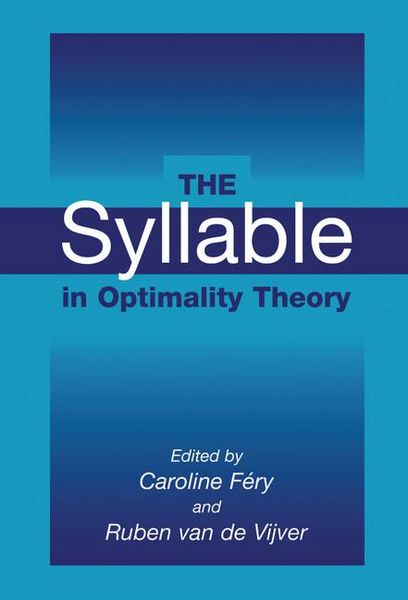
The Syllable in Optimality Theory
-
- Hardcover ausgewählt
- Taschenbuch
- eBook
-
Sprache:Englisch
153,99 €
inkl. gesetzl. MwSt.,
Beschreibung
Produktdetails
Einband
Gebundene Ausgabe
Erscheinungsdatum
08.03.2012
Herausgeber
Caroline Fery + weitereVerlag
Cambridge University PressSeitenzahl
428
Maße (L/B/H)
23,5/15,7/3 cm
Gewicht
842 g
Sprache
Englisch
ISBN
978-0-521-77262-4
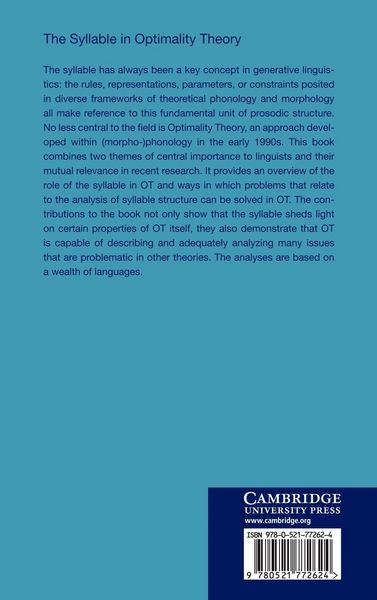
The syllable has always been a key concept in generative linguistics: the rules, representations, parameters, or constraints posited in diverse frameworks of theoretical phonology and morphology all make reference to this fundamental unit of prosodic structure. No less central to the field is Optimality Theory, an approach developed within (morpho-)phonology in the early 1990s. This 2003 book combines two themes of central importance to linguists and their mutual relevance in recent research. It provides an overview of the role of the syllable in OT and ways in which problems that relate to the analysis of syllable structure can be solved in OT. The contributions to the book not only show that the syllable sheds light on certain properties of OT itself, they also demonstrate that OT is capable of describing and adequately analyzing many issues that are problematic in other theories. The analyses are based on a wealth of languages.
Ein neues Kapitel für Ihre Bücher
Ein neues Kapitel für Ihre Bücher
Schenken Sie Ihren alten Schätzen ein zweites Leben: Einfach Barcode scannen, Versandetikett ausdrucken, Bücher verschicken und Thalia Geschenkkarte erhalten.
Jetzt verkaufenNoch keine Bewertungen vorhanden
Verfassen Sie die erste Bewertung zu diesem Artikel
Helfen Sie anderen Kundinnen und Kunden durch Ihre Meinung.
Kurze Frage zu unserer Seite
Vielen Dank für Ihr Feedback
Wir nutzen Ihr Feedback, um unsere Produktseiten zu verbessern. Bitte haben Sie Verständnis, dass wir Ihnen keine Rückmeldung geben können. Falls Sie Kontakt mit uns aufnehmen möchten, können Sie sich aber gerne an unseren Kund*innenservice wenden.
zum Kundenservice