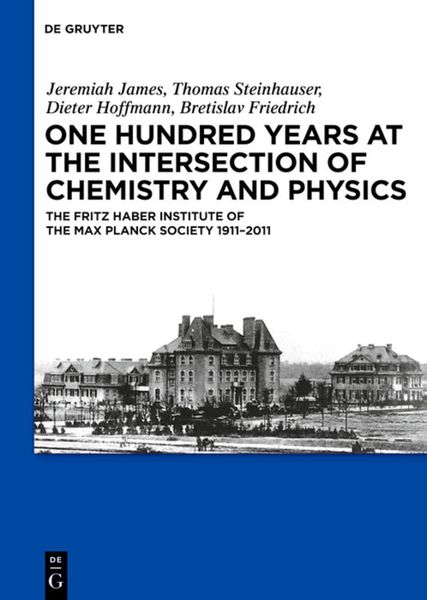
One Hundred Years at the Intersection of Chemistry and Physics The Fritz Haber Institute of the Max Planck Society 1911-2011
104,99 €
inkl. gesetzl. MwSt.,
Beschreibung
Produktdetails
Einband
Gebundene Ausgabe
Erscheinungsdatum
17.10.2011
Verlag
De GruyterSeitenzahl
310
Maße (L/B/H)
24,6/17,5/2,4 cm
Gewicht
918 g
Auflage
1
Sprache
Englisch
ISBN
978-3-11-023953-9
This volume, occasioned by the centenary of the Fritz Haber Institute, formerly the Institute for Physical Chemistry and Electrochemistry, covers the institute's scientific and institutional history from its founding until the present. The institute was among the earliest established by the Kaiser Wilhelm Society, and its inauguration was one of the first steps in the development of Berlin-Dahlem into a center for scientific research. Its establishment was made possible by an endowment from Leopold Koppel, granted on the condition that Fritz Haber, well-known for his discovery of a method to synthesize ammonia from its elements, be made its director. The history of the institute has largely paralleled that of 20th-century Germany. It undertook controversial weapons research during World War I, followed by a "Golden Era" during the 1920s, in spite of financial hardships. Under the National Socialists it experienced a purge of its scientific staff and a diversion of its research into the service of the new regime, accompanied by a breakdown in its international relations. In the immediate aftermath of World War II it suffered crippling material losses, from which it recovered slowly in the post-war era. In 1953, shortly after taking the name of its founding director, the institute joined the fledgling Max Planck Society. During the 1950s and 60s, the institute supported diverse researches into the structure of
matter and electron microscopy in a territorially insular and politically precarious West-Berlin. In subsequent decades, as both Berlin and the Max Planck Society underwent significant changes, the institute reorganized around a board of coequal scientific directors and a renewed focus on the investigation of elementary processes on surfaces and interfaces, topics of research that had been central to the work of Fritz Haber and the first "Golden Era" of the institute.
Ein neues Kapitel für Ihre Bücher
Ein neues Kapitel für Ihre Bücher
Schenken Sie Ihren alten Schätzen ein zweites Leben: Einfach Barcode scannen, Versandetikett ausdrucken, Bücher verschicken und Thalia Geschenkkarte erhalten.
Jetzt verkaufenKundinnen und Kunden meinen
Verfassen Sie die erste Bewertung zu diesem Artikel
Helfen Sie anderen Kund*innen durch Ihre Meinung
Kurze Frage zu unserer Seite
Vielen Dank für Ihr Feedback
Wir nutzen Ihr Feedback, um unsere Produktseiten zu verbessern. Bitte haben Sie Verständnis, dass wir Ihnen keine Rückmeldung geben können. Falls Sie Kontakt mit uns aufnehmen möchten, können Sie sich aber gerne an unseren Kund*innenservice wenden.
zum Kundenservice