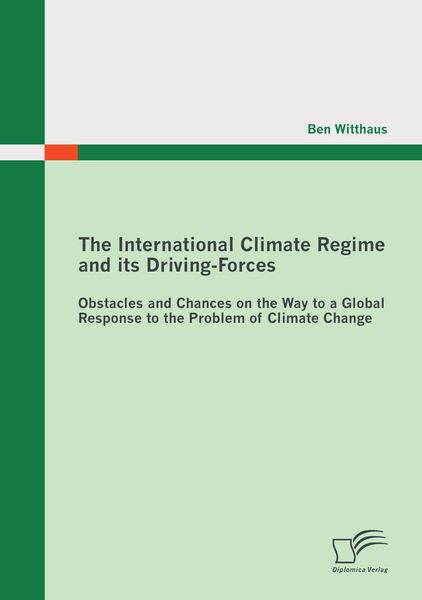
The International Climate Regime and its Driving-Forces: Obstacles and Chances on the Way to a Global Response to the Problem of Climate Change Obstacles and Chances on the Way to a Global Response to the Problem of Climate Change
-
- Englisch ausgewählt
38,00 €
inkl. gesetzl. MwSt.,
Beschreibung
Produktdetails
Einband
Taschenbuch
Erscheinungsdatum
07.03.2012
Verlag
Diplomica Verlag GmbHSeitenzahl
134
Maße (L/B/H)
27/19/1 cm
Gewicht
370 g
Auflage
1. Auflage
Sprache
Englisch
ISBN
978-3-8428-7383-4
The international climate regime is the main platform to further cooperation between nations and to tackle this problem. Since the first world climate conference in 1979 the international community of states pursues the goal of stabilizing greenhouse gas emissions. In 2009, the 15th COP of the UNFCCC aimed at achieving the final breakthrough with regard to framing new long-term mitigation commitments.
However, the regime theory tells us that states behave as rational egoists and solely follow selfishly defined interests to maximize own profits. So it not only has to be assumed that just states with a favourable benefit-cost ratio will take the role of a ‘pusher” in international climate negotiations but also that powerful states are more likely to reach a favourable outcome. Indeed the highly ineffective Kyoto Protocol, which amongst others had to deal with the exit of the United States, the creation of ‘hot air” reductions and an overall lack of compliance incentives, has already shown the difficulties of creating an effective climate regime. In Copenhagen it became obvious that influential actors still do not seem to have an interest to significantly change their energy consumption patterns in order to reduce emissions. The majority of developing countries, politically prioritize the protection of their economic development which heavily depends on the use of cheap energy from fossil fuels. Especially China by no means intends to cut its impressive GDP growth figures to please international crowds. Meanwhile the hands of the US President on the international stage were once again tied by domestic restrictions. However, although it seemed that the long prevailing differences of interests between industrial and developing countries are more than ever insuperable, there is hope. A ‘global race’ towards renewable energy and related jobs has already started. Nations and international corporations are positioning themselves to take advantage of the inevitable transition from fossil fuels to renewable energy sources. This could be the starting point for a sustainable bottom-up policy architecture on the international level replacing the current top-down approach.
Ein neues Kapitel für Ihre Bücher
Ein neues Kapitel für Ihre Bücher
Schenken Sie Ihren alten Schätzen ein zweites Leben: Einfach Barcode scannen, Versandetikett ausdrucken, Bücher verschicken und Thalia Geschenkkarte erhalten.
Jetzt verkaufenKundinnen und Kunden meinen
Verfassen Sie die erste Bewertung zu diesem Artikel
Helfen Sie anderen Kund*innen durch Ihre Meinung
Kurze Frage zu unserer Seite
Vielen Dank für Ihr Feedback
Wir nutzen Ihr Feedback, um unsere Produktseiten zu verbessern. Bitte haben Sie Verständnis, dass wir Ihnen keine Rückmeldung geben können. Falls Sie Kontakt mit uns aufnehmen möchten, können Sie sich aber gerne an unseren Kund*innenservice wenden.
zum Kundenservice