• Produktbild: Breeding strategies for sustainable forage and turf grass improvement
  • Produktbild: Breeding strategies for sustainable forage and turf grass improvement
- 13%

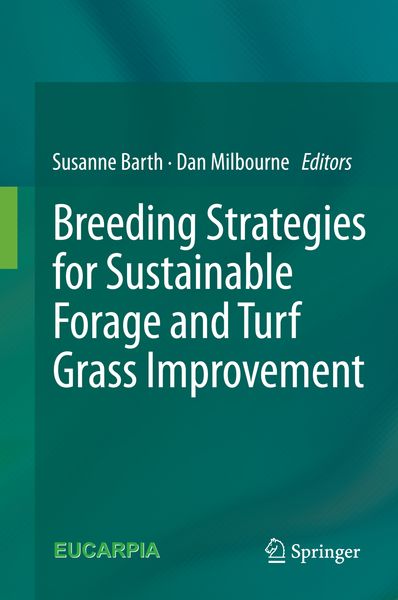
Breeding strategies for sustainable forage and turf grass improvement

13% sparen

138,99 € UVP 160,49 €

inkl. gesetzl. MwSt., Versandkostenfrei


Beschreibung

Produktdetails

Einband

Gebundene Ausgabe

Erscheinungsdatum

18.07.2012

Abbildungen

XII, 392 p.

Herausgeber

Susanne Barth + weitere

Verlag

Springer Netherland

Seitenzahl

392

Maße (L/B/H)

24,1/16/2,7 cm

Gewicht

770 g

Auflage

1. Auflage

Sprache

Englisch

ISBN

978-94-007-4554-4

Beschreibung

Portrait

Susanne Barth war zuletzt wissenschaftliche Assistentin am Lehrstuhl für historische Leseforschung an der Universität Köln.

Produktdetails

Einband

Gebundene Ausgabe

Erscheinungsdatum

18.07.2012

Abbildungen

XII, 392 p.

Herausgeber

Verlag

Springer Netherland

Seitenzahl

392

Maße (L/B/H)

24,1/16/2,7 cm

Gewicht

770 g

Auflage

1. Auflage

Sprache

Englisch

ISBN

978-94-007-4554-4

Herstelleradresse

Springer-Verlag GmbH
Tiergartenstr. 17
69121 Heidelberg
DE

Email: GPSR Kontakt

Ein neues Kapitel für Ihre Bücher

Ein neues Kapitel für Ihre Bücher

Schenken Sie Ihren alten Schätzen ein zweites Leben und erhalten dafür eine Thalia Geschenkkarte.

Jetzt verkaufen
Jetzt verkaufen

Noch keine Bewertungen vorhanden

Verfassen Sie die erste Bewertung zu diesem Artikel

Helfen Sie anderen Kundinnen und Kunden durch Ihre Meinung.

Kundinnen und Kunden meinen

Bewertungen (0)

  • Produktbild: Breeding strategies for sustainable forage and turf grass improvement
  • Produktbild: Breeding strategies for sustainable forage and turf grass improvement

  • Preface.- 1. What global and/or European agriculture will need from grasslands and grassland breeding over the next 10-15 years for a sustainable agriculture.- 2.1. Marker Assisted Selection Made Cheap and Easy.- 2.2. Genome-wide SNP marker development and QTL identification for genomic selection in red clover.- 2.3. Breeding for resistance to bacterial wilt in ryegrass: insights into the genetic control of plant resistance and pathogen virulence.- 2.4. Mechanisms utilized within the IBERS diploid
    Lolium perenne
    L. forage grass breeding programmes to improve rumen nitrogen use efficiency.- 2.5. Population genetics of the grass self-incompatibility system – Practical implications for grass breeding programmes.- 2.6. Use of molecular marker information in the construction of polycrosses to enhance yield in a
    Lolium perenne
    breeding programme.- 2.7. An analysis of chromosome pairing behaviour in newly synthesized alfalfa tetraploids by means of SSR markers.- 2.8. Genome constitution in selected and unselected plants of F
    2
    -F
    4
    generations derived from an allotetraploid
    Festuca pratensis x Lolium perenne
    hybrid.- 2.9. Estimation of temporal allele frequency changes in ryegrass populations selected for axillary tiller development.- 2.10. Understanding the genetic basis for slow plant-mediated proteolysis in
    Festulolium
    hybrids.- 2.11. Chromosomal rearrangements in tetraploid introgressions of
    Lolium perenne/Festuca pratensis
    .- 3.1. Establishing Chromosome Genomics in Forage and Turf Grasses.- 3.2. DArTFest DNA Array – Applications and Perspectives for Grass Genetics, Genomic s and Breeding.- 3.3. Using DArT markers in
    Festuca x Lolium
    breeding.- 3.4. Development of an SNP identification pipeline for highly heterozygous crops.- 3.5. First insights into the mitochondrial genome of perennial ryegrass (
    Lolium perenne
    ).- 3.6. Quantifying early vigour and ground cover using digital image analysis.- 3.7. Expression of the
    Lolium perenne TERMINAL

    FLOWER 1
    gene in alfalfa and tobacco.- 3.8. Morphological and molecular characterization of branching in red clover (
    Trifolium pratense
    ).- 4.1. Designing grass cultivars for droughts and floods.- 4.2. Variation and heritability of α-linolenic acid content and rumen escape protein fraction in fodder grass and clover.- 4.3. Similarities and differences in leaf proteome response to cold acclimation between
    Festuca pratensis
    and
    Lolium

    perenne
    .- 4.4. Multi-population QTL detection for flowering time, stem elongation and quality traits in
    Medicago truncatula
    .- 4.5. Role of RCT1 gene in anthracnose resistance in alfalfa.- 4.6. The EUCARPIA multi-site rust evaluation – results 2010.- 4.7. The main topics of resistance breeding in grasses in the Czeck Republic.- 5.1. Origins of diploid Dactylis from the Canary Islands as determined by DNA sequencing.- 5.2. Introduction and adaptation of Cynodon L. C. Richspecies in Australia.- 5.3. Variation in traits associated with carbon sequestration for a range of common amenity grass species.- 5.4. Suitability of different grass species for phytoremediation of soils polluted with heavy metals.- 5.5. Targeting Lucerne cultivars to saline-soil environments.- 5.6. Comparison of seed mixtures for technical revegetation at high altitude.- 5.7. Genetic diversity for cell wall digestibility in a diverse Lolium perenne collection.- 5.8. Variability among accessions of forage vetch for basic agronomic and morphological traits under agro-ecological conditions of Serbia.- 5.9. Genetic variation of root characteristics and deep root production in perennial ryegrass cultivars contrasting in field persistency.- 5.10. The study of similarities among
    Medicago sativa
    L. accessions.- 5.11. Genetic structure and agronomic value of Italian lucerne landacres: a synopsis. 5.12. The use of genebank accessions in the breeding programme of Lolium perenne.- 5.13. Characterization and evaluation of genebank accessions as a pre-selection instrument for plant breeding objectives and strategies.- 5.14. Exploitation of ‘site-specific’ Alpine grass germplasm for revegetation at high altitude.- 6.1. The impact of perennial ryegrass variety throughout the growing season on
    in vitro
    rumen methane output.- 6.2. Origin and yield of European perennial ryegrass (
    Lolium perenne
    L.) varieties in Ireland.- 6.3. Yield dynamics and quality of white clover and perennial ryegrass.- 6.4. Influence of plant growth promoting rhizobacteria on alfalfa,
    Medicago sativa
    L. yield by inoculation of a preceding Italian ryegrass,
    Lolium

    multiflorum
    Lam..- 6.5. Optimal plant type of pea for mixed cropping with cereals.- 6.6. Dry matter recovery and aerobic stability of maize whole-crop, cob and stover silages – harvest date and cultivar effects.- 6.7. Performance of forage soya bean (
    Glycine max
    ) cultivars in the northern Balkans.- 6.8. Effects of trinexapac-ethyl (Moddus) on seed yields and its quality of eleven temperate grass species.- 6.9. The chemical composition of a range of forage grasses grown under two nitrogen fertilizer inputs and harvested at different stages of maturity.- 6.10. NIRS calibration strategies for the botanical composition of grass-clover mixtures.- 6.11. Comparison of LOCAL and GLOBAL calibration models to predict ryegrass quality using near infrared reflectance spectroscopy.- 6.12. Grass for biogas production – anaerobic methane production from give common grassland species at sequential stages of maturity.- Index.