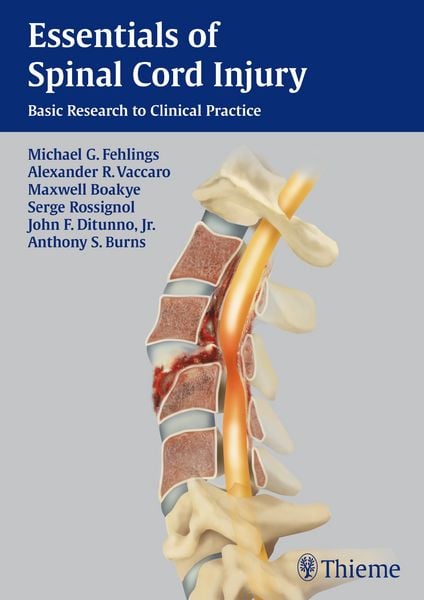
Produktbild: Essentials of Spinal Cord Injury

Essentials of Spinal Cord Injury Basic Research to Clinical Practice

151,99 €

inkl. gesetzl. MwSt., Versandkostenfrei


Beschreibung

Produktdetails

Einband

Gebundene Ausgabe

Erscheinungsdatum

23.10.2012

Abbildungen

177 Abb.

Herausgeber

Michael G. Fehlings + weitere

Verlag

Thieme Medical Publishers

Seitenzahl

682

Maße (L/B/H)

26,1/18,4/3,5 cm

Gewicht

1724 g

Auflage

1. Auflage

Sprache

Englisch

ISBN

978-1-60406-726-2

Beschreibung

Produktdetails

Einband

Gebundene Ausgabe

Erscheinungsdatum

23.10.2012

Abbildungen

177 Abb.

Herausgeber

Verlag

Thieme Medical Publishers

Seitenzahl

682

Maße (L/B/H)

26,1/18,4/3,5 cm

Gewicht

1724 g

Auflage

1. Auflage

Sprache

Englisch

ISBN

978-1-60406-726-2

EU-Ansprechpartner

Georg Thieme Verlag KG
Oswald-Hesse-Straße 50
70469 Stuttgart
DE
info@thieme.de

Herstelleradresse

Thieme Medical Publishers
333 Seventh Avenue, 18th Floor
10001 New York
US
customerservice@thieme.com

Ein neues Kapitel für Ihre Bücher

Ein neues Kapitel für Ihre Bücher

Schenken Sie Ihren alten Schätzen ein zweites Leben und erhalten dafür eine Thalia Geschenkkarte.

Jetzt verkaufen
Jetzt verkaufen

Noch keine Bewertungen vorhanden

Verfassen Sie die erste Bewertung zu diesem Artikel

Helfen Sie anderen Kundinnen und Kunden durch Ihre Meinung.

Kundinnen und Kunden meinen

Bewertungen (0)

Die Leseprobe wird geladen.
  • Produktbild: Essentials of Spinal Cord Injury
  • I Principles of Spinal Cord Injury Clinical Practice
    1 Anatomy and Physiology of the Spinal Cord
    2 Evaluation of the Patient with Spinal Cord Injury
    3 Imaging of Acute Spinal Cord Trauma and Spinal Cord Injury
    4 Pathophysiology of Spinal Cord Injury
    5 Epidemiology of Spinal Cord Injury
    6 Spinal Cord Injury Classification
    7 Spontaneous Recovery Patterns and Prognoses after Spinal Cord Injury
    8 Management of Spinal Cord Injury in the Intensive Care Unit
    9 Concomitant Traumatic Brain Injury and Spinal Cord Injury
    10 Pharmacotherapy in Acute Spinal Cord Injury: Focus on Steroids
    11 Halo Application and Closed Skeletal Reduction of Cervical Dislocations
    12 Principles of Surgical Management of Spinal Trauma Associated with Spinal Cord Injury
    13 Venous Thromboembolism Prophylaxis
    14 Sexuality and Fertility after Spinal Cord Injury
    15 InterdiSpinal Cord Injuryplinary Essentails in Pressure Ulcer Management
    16 Autonomic Dysreflexia and Cardiovascular Complications of Spinal Cord Injury
    17 Pain after Spinal Cord Injury
    18 Essentials of Spinal Cord Injury: Psychosocial Aspects of Spinal Cord Injury
    19 Posttraumatic Kyphotic Deformity of the Cervical Spine
    20 Posttraumatic Syringomyelia: Pathophysiology and Management
    21 Rehabilitation of the Individual with Spinal Cord Injury
    22 The Management of Secondary Complications Following Spinal Cord Injury
    II Controversies in Management
    23 Timing of Surgery for Acute Spinal Cord Injury: From Basic Science to Clinical Application
    24 Hypothermia: Evidence-Based Review
    25 Management of Cervical Facet Dislocation
    26 Management of Acute Spinal Cord Injury in Thoracolumbar Burst Fractures Including Cauda Equina Syndrome
    27 Management of Central Cord Syndrome
    III Neuroprotective and Neuroregenerative Approaches
    28 Research in Spinal Cord Injury: Building an Effective Translational Research Program
    29 North American Clinical Trials Network: Building a Clinical Trials Network for Spinal Cord Injury
    30 Considerations for the Initiation and Conduct of Spinal Cord Injury Clinical Trials
    31 Animal Models of Spinal Cord Injury
    32 Glial Scar and Monocyte-Derived Macrophages Are Needed for Spinal Cord Repair: Timing, Location, and Level as Critical Factors
    33 Promising Preclinical Pharmacological Approaches to Spinal Cord Injury
    34 Cellular Transplantation in Spinal Cord Injury
    35 Neuroregeneration Approaches
    36 Neuroprotective Trials in Spinal Cord Injury
    37 Approaches Using Biomaterials for Tissue Engineering
    IV Neurophysiology and Imaging
    38 Electrophysiological Measures after Spinal Cord Injury
    39 Quantitative Tests of Sensory, Motor, and Autonomic Function
    40 Basic Neurophysiological Approaches to Probing Spinal Circuits
    41 Neuroimaging after Spinal Cord Injury: Evaluation Injury Severity and Prognosis Using Magnetic Resonance Imaging
    42 The Role of Neurophysiology in Study of Recovery and Spasticity
    V Plasticity and Recovery
    43 Spinal and Supraspinal Plasticity after Spinal Cord Injury
    44 The Human Central Pattern Generator and Its Role in Spinal Cord Injury Recovery
    45 Electrophysiology Predictors of Lower Limb Motor Recovery: The Rehabiliations Perspective
    46 Somatosensory Function and Recovery after Spinal Cord Injury: Advanced Assessment of Segmental Sensory Function
    47 Electrical Stimulation Following Spinal Cord Injury
    48 Operant Conditioning of Spinal Reflexes to Improve Motor Function after Spinal Cord Injury
    49 Functional Restoration through Robotics
    50 Peripheral Nerve Grafts and the Repair of Axonal Circuits Following Spinal Cord Injury
    IV Resources
    51 Population-Based Spinal Cord Injury Registries: Potential Impacts and Challenges
    52 Resources to Empower and Expand the Opportunities of People with Spinal Cord Injury
    VII Achieving Success
    53 Neurogenomic and Neuroproteomic Approaches to Studying Neural Injury
    54 Breakthroughs of the Last Twenty Years