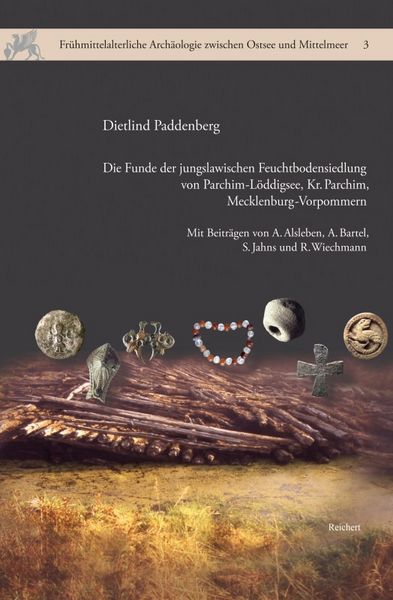
Die Funde der jungslawischen Feuchtbodensiedlung von Parchim-Löddigsee, Kr. Parchim, Mecklenburg-Vorpommern
-
- Deutsch ausgewählt
72,99 €
inkl. gesetzl. MwSt.,
Beschreibung
Produktdetails
Einband
Gebundene Ausgabe
Erscheinungsdatum
12.04.2012
Verlag
Reichert, LSeitenzahl
502
Maße (L/B/H)
29/19/3,4 cm
Gewicht
2480 g
Sprache
Deutsch
ISBN
978-3-89500-876-4
For the first time ever, from 1981 to 1999 a fortified late Slavonic trading place with a subsequent, late medieval settlement was excavated in its full extent in Parchim-Löddigsee, Lkr. Parchim (Mecklenburg-Vorpommern). As a result of waterlogged deposits the place was characterised by an excellent preservation - even of organic material -, and by a find assemblage which differs widely from the average assemblage in Slavonic settlement sites; for example, it contained a large amount of imported objects. Besides thousands of pottery sherds and animal bones ca 6.000 small finds were recovered for analysis. This enabled to scientifically reconstruct a so-called central place in the middle of the Northwest Slavonic settlement area, which was not known in this form before. Amongst other things, the place was characterised by a massive fortification, the presence of an aristocratic class, a long-distance trading net and selective craft; above all the place had a central sanctuary.
In train of ameliorations activities in 1975, late Slavonic pottery, animal bones and wooden construction elements were recovered. On one hand the preservation of organic remains was given, on the other hand the preservation was endangered by the ongoing land improvement activities. The first indication that the site somewhat differed from ordinary Slavonic settlement sites was given by a richly decorated antler artefact. This and other extraordinary surface finds finally lead to the beginning of large-scale excavations. From 1981 to 1991 more than half of the settlement area was excavated, and the place operated as the “main research project of the Landesmuseum Schwerin”.
In train of the political change in Eastern Germany the excavations stopped from 1992 on for several years. They finally continued and could be completely finished from 1996 to 1999. All in all fifteen years of field work had led to the excavation of the whole settlement site. This is until today a unique research situation for settlements of this kind and age.
This situation facilitated for the first time the analysis of the find assemblage not only in a typological, chronological and functional way, but also spatially, chorologically and structurally. Detailed maps of the typologically and chronologically defined find objects enable - together with pollen and macro botanical, textile and numismatic analysis - an insight into the structure of a young Slavonic “central place”, a “Regiopol” of the 11th/12th century AD and its completely differing, subsequent late medieval settlement site.
Ein neues Kapitel für Ihre Bücher
Ein neues Kapitel für Ihre Bücher
Schenken Sie Ihren alten Schätzen ein zweites Leben: Einfach Barcode scannen, Versandetikett ausdrucken, Bücher verschicken und Thalia Geschenkkarte erhalten.
Jetzt verkaufenNoch keine Bewertungen vorhanden
Verfassen Sie die erste Bewertung zu diesem Artikel
Helfen Sie anderen Kundinnen und Kunden durch Ihre Meinung.
Kurze Frage zu unserer Seite
Vielen Dank für Ihr Feedback
Wir nutzen Ihr Feedback, um unsere Produktseiten zu verbessern. Bitte haben Sie Verständnis, dass wir Ihnen keine Rückmeldung geben können. Falls Sie Kontakt mit uns aufnehmen möchten, können Sie sich aber gerne an unseren Kund*innenservice wenden.
zum Kundenservice