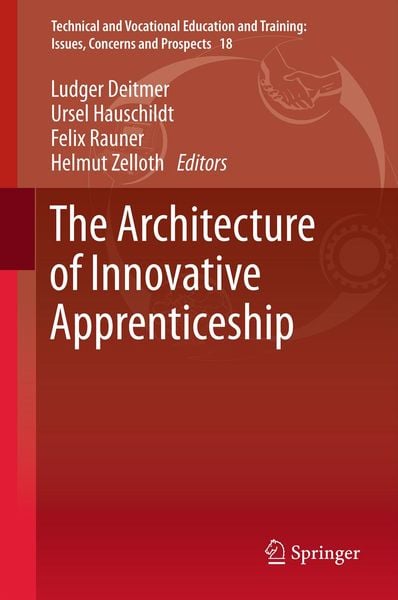
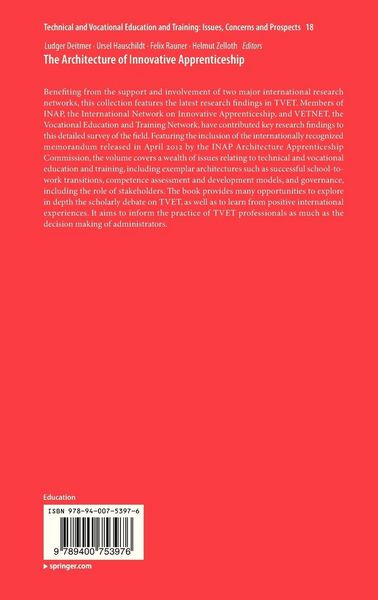
• Produktbild: The Architecture of Innovative Apprenticeship
  • Produktbild: The Architecture of Innovative Apprenticeship
Band 18 - 13%

The Architecture of Innovative Apprenticeship

13% sparen

92,99 € UVP 106,99 €

inkl. gesetzl. MwSt., Versandkostenfrei


Beschreibung

Produktdetails

Einband

Gebundene Ausgabe

Erscheinungsdatum

14.12.2012

Herausgeber

Ludger Deitmer + weitere

Verlag

Springer Netherland

Seitenzahl

346

Maße (L/B/H)

24,1/16/2,4 cm

Gewicht

699 g

Auflage

1. Auflage

Sprache

Englisch

ISBN

978-94-007-5397-6

Beschreibung

Rezension

This publication admirably demonstrates the technical and bureaucratic obstacles to advancing skills and resolving the current dilemmas of youth school to work transitions - and for those new to the field illustrates the political complexities of seemingly neutral vocational educational systems and framework classifications.

The editors have compiled a compelling vision that despite diverse national formulations, innovative apprenticeships have the potential to mitigate the current dramatic levels of international youth unemployment and a template for future research in transitional and developing economies.

Sylvia Hammond in E-Journal of International and Comparative LABOUR STUDIES

Portrait

Felix Rauner ist Professor am Institut Technik und Bildung der Universität Bremen.

Produktdetails

Einband

Gebundene Ausgabe

Erscheinungsdatum

14.12.2012

Herausgeber

Verlag

Springer Netherland

Seitenzahl

346

Maße (L/B/H)

24,1/16/2,4 cm

Gewicht

699 g

Auflage

1. Auflage

Sprache

Englisch

ISBN

978-94-007-5397-6

Herstelleradresse

Springer-Verlag KG
Sachsenplatz 4-6
1201 Wien
AT

Email: ProductSafety@springernature.com

Ein neues Kapitel für Ihre Bücher

Ein neues Kapitel für Ihre Bücher

Schenken Sie Ihren alten Schätzen ein zweites Leben: Einfach Barcode scannen, Versandetikett ausdrucken, Bücher verschicken und Thalia Geschenkkarte erhalten.

Jetzt verkaufen
Jetzt verkaufen

Kundinnen und Kunden meinen

0 Bewertungen

Informationen zu Bewertungen

Zur Abgabe einer Bewertung ist eine Anmeldung im Konto notwendig. Die Authentizität der Bewertungen wird von uns nicht überprüft. Wir behalten uns vor, Bewertungstexte, die unseren Richtlinien widersprechen, entsprechend zu kürzen oder zu löschen.

Die Bewertungen sind nach Format, Anzahl Sterne und Datum sortiert.

Verfassen Sie die erste Bewertung zu diesem Artikel

Helfen Sie anderen Kund*innen durch Ihre Meinung

Kundinnen und Kunden meinen

0 Bewertungen filtern

  • Produktbild: The Architecture of Innovative Apprenticeship
  • Produktbild: The Architecture of Innovative Apprenticeship
  • 1. From School into Apprenticeship: Pathways for a Successful Transition.- 1.1    Relationship between Potential Recruits from VET and HE - Case Studies from Germany, England and Switzerland, Ute Hippach-Schneider, Tanja Weigel.- 1.2  Exploring Intermediate Vocational Education and Training for 16-19 Year-olds in Germany and England, Jeremy Higham, H.-Hugo Kremer, David Yeomans.- 1.3 Apprenticeship, Pathways and Career Guidance: A Cautionary Tale.- Richard Sweet.- 1.4 No Choice – No Guidance? The rising demand for career guidance in EU neighboring countries and its potential implications for apprenticeships, Helmut Zelloth.- 1.5 How can Governance, Private Sector and Work Based Learning promote Labour Market Relevant Training in Developing and Transition Countries?, Manfred Wallenborn.- 1.6 A Renaissance for Apprenticeship Learning? - And its Implications for Transition Countries, Sören Nielsen.- 1.7 Work-based Learning in China, Joanna Burchert, Ludger Deitmer, Xu Han.- 2. Competence Measurement and Development .- 2.1 Occupational Identity in Australian Traineeships: An initial Exploration, Erica Smith.- 2.2 Competency-Based Training in Australia: What happened and where might we “capably” go? Lewis Hughes, Len Cairns.- 2.3 Measuring Occupational Competences: Concept, Method and Findings of the COMET project, Felix Rauner, Lars Heinemann,  Ursel Hauschildt.- 2.4 Occupational Identity and Motivation of Apprentices in a System of Integrated Dual VET, Ursel Hauschildt, Lars Heinemann.- 2.5 Innovative Models of more Interactive Cooperation of VET Schools and Enterprise in China, Zhiqun Zhao, Zishi Luo, Donglian Gu.- 2.6 Developing Complex Performance through Learning Trajectories and re-creating Mediating Artefacts.- Michael Eraut.- 2.7 Conceptual Change Research in TVET, Waldemar Bauer.- 2.8 Experiential Learning Assessment and Competence Development for a Second Career: The case of alternating training pprogrammes for professional promotion, Philippe Astier, Lucie Petit.-  3. Towards an Open TVET Architecture: Why European and National Qualification Frameworks do not suffice.- 3.1 Differences in the Organisation of Apprenticeship in Europe: Findings of a Comparative Evaluation Study, Felix Rauner,  Wolfgang Wittig.- 3.2 Implementing the EQF: English as distinct from Continental Bricklaying Qualifications, Michaela Brockmann, Linda Clarke, Christopher Winch.- 3.3 Trends, Issues and Challenges for EU VET Policies beyond 2010, Pascaline Descy, Guy Tchibozo, Jasper van Loo.- 3.4 ‘Evidence’ about ‘Outcome Orientation’ – Austrian experience with European policies, Lorenz Lassnigg.- 3.5 Successful in Reforming the TVET System and Shaping the Society: The Example of the Mubarak Kohl Initiative, Edda Grunwald, Bernhard Becker.- 3.6 Accelerating Artisan Training: A Response to the South African Skills Challenge, Salim Akoojee.- 3.7 The Role of Social Partners and the Status of Apprenticeship in Turkey, Özlem Ünlühisarcıklı,  Arjen Vos.