• Produktbild: Learning Environments
  • Produktbild: Learning Environments

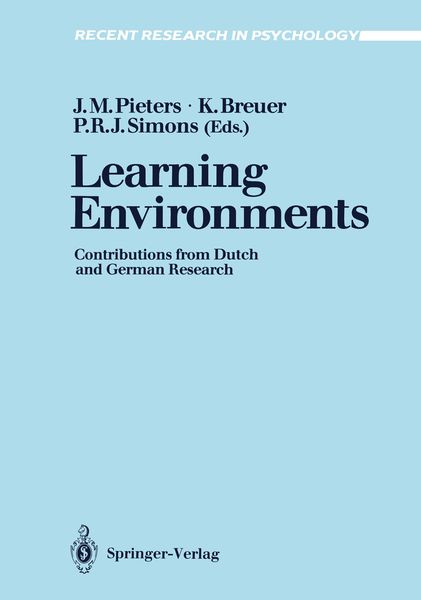
Learning Environments Contributions from Dutch and German Research

97,99 €

inkl. gesetzl. MwSt., Versandkostenfrei


Beschreibung

Produktdetails

Einband

Taschenbuch

Erscheinungsdatum

05.09.1990

Abbildungen

IX, 364 p.

Herausgeber

Jules M. Pieters + weitere

Verlag

Springer Berlin

Seitenzahl

364

Maße (L/B/H)

24,2/17/2,1 cm

Gewicht

643 g

Sprache

Englisch

ISBN

978-3-540-52903-3

Beschreibung

Produktdetails

Einband

Taschenbuch

Erscheinungsdatum

05.09.1990

Abbildungen

IX, 364 p.

Herausgeber

Verlag

Springer Berlin

Seitenzahl

364

Maße (L/B/H)

24,2/17/2,1 cm

Gewicht

643 g

Sprache

Englisch

ISBN

978-3-540-52903-3

Herstelleradresse

Springer-Verlag GmbH
Tiergartenstr. 17
69121 Heidelberg
DE

Email: GPSR Kontakt

Ein neues Kapitel für Ihre Bücher

Ein neues Kapitel für Ihre Bücher

Schenken Sie Ihren alten Schätzen ein zweites Leben und erhalten dafür eine Thalia Geschenkkarte.

Jetzt verkaufen
Jetzt verkaufen

Noch keine Bewertungen vorhanden

Verfassen Sie die erste Bewertung zu diesem Artikel

Helfen Sie anderen Kundinnen und Kunden durch Ihre Meinung.

Kundinnen und Kunden meinen

Bewertungen (0)

  • Produktbild: Learning Environments
  • Produktbild: Learning Environments
  • General Introduction.- Learning environments: An introduction.- I: Classroom Environments.- Facilitating adults’ learning by coaching: Development and evaluation of an andragogical model of continuing vocational education within industrial companies.- Concepts of schooling and the learning environment: A relationship tested in law faculties.- Work simulation: A natural environment for learning job skills and job attitudes.- Teacher enthusiasm: Congruence between ratings and behaviour.- Teacher praise and classroom climate: Another paradoxical relation.- II: Evaluation of Learning Environments.- Assessing the quality of kindergarten environments with the Early Childhood Environment Rating Scale.- School-provided measures against truancy and drop-out.- Some school effectiveness indicators and their relation to school characteristics.- III: Computer-Based Environments.- The use of a computer microworld as a learning environment to develop conceptual change in the field of mechanics.- Intelligent tutoring system for learning English.- A genetic model for tutoring addition and subtraction skills in an adaptive computer program.- A production system explaining errors in long division of learning disabled students in junior vocational education.- A computer simulation of the acquisition of a computational skill in a discovery-oriented microworld.- A systematic problem approach in business administration: A methodology to make knowledge explicit for Computer-Assisted Instruction.- On the surplus of computerized traffic education.- IV: Environments for Meta-Learning.- Metacognition: Learning to learn and learning to think.- General and differential effectiveness of learning-to-learn programs.- Teaching problem solving in higher education: From field regulation toself-regulation.- Executive control, self-regulation trained in mathematics.- Children’s reflection on text-coherence during reading.- The Leittext method: Learning to learn in commerce and industry.- Training self-regulation in several educational fields.- V: Theoretical Issues of Learning Environments.- Measuring individual differences in cognitive processes: How a speed-accuracy methodology can improve the results.- The influence of topic interest, prior knowledge and cognitive capabilities on text comprehension.- Instructional implications of recent research and empirically-based theories on the effect of prior knowledge on learning.- Contributors’ addresses.