• Produktbild: The Theory of Binocular Vision
  • Produktbild: The Theory of Binocular Vision

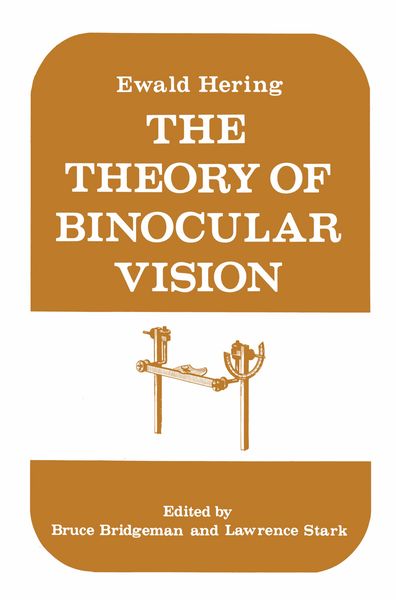
The Theory of Binocular Vision Ewald Hering (1868)

97,99 €

inkl. gesetzl. MwSt., Versandkostenfrei


Beschreibung

Produktdetails

Einband

Taschenbuch

Erscheinungsdatum

13.10.2011

Abbildungen

VI, 218 p.

Verlag

Springer Us

Seitenzahl

218

Maße (L/B/H)

23,5/15,5/1,3 cm

Gewicht

353 g

Auflage

Softcover reprint of the original 1st ed. 1997

Sprache

Englisch

ISBN

978-1-4613-4150-5

Beschreibung

Produktdetails

Einband

Taschenbuch

Erscheinungsdatum

13.10.2011

Abbildungen

VI, 218 p.

Verlag

Springer Us

Seitenzahl

218

Maße (L/B/H)

23,5/15,5/1,3 cm

Gewicht

353 g

Auflage

Softcover reprint of the original 1st ed. 1997

Sprache

Englisch

ISBN

978-1-4613-4150-5

Herstelleradresse

Springer-Verlag KG
Sachsenplatz 4-6
1201 Wien
AT

Email: ProductSafety@springernature.com

Ein neues Kapitel für Ihre Bücher

Ein neues Kapitel für Ihre Bücher

Schenken Sie Ihren alten Schätzen ein zweites Leben und erhalten dafür eine Thalia Geschenkkarte.

Jetzt verkaufen
Jetzt verkaufen

Noch keine Bewertungen vorhanden

Verfassen Sie die erste Bewertung zu diesem Artikel

Helfen Sie anderen Kundinnen und Kunden durch Ihre Meinung.

Kundinnen und Kunden meinen

Bewertungen (0)

  • Produktbild: The Theory of Binocular Vision
  • Produktbild: The Theory of Binocular Vision
  • Translator’s Note.- Ch. 1 Introduction.- One On the Bifixation of the Double Eye.- Ch. 2 On the equal innervation of both eyes.- Ch. 3 Grounds for and against the assumption of an always equal innervation of both eyes.- Ch. 4 Proofs for equal innervation with unequal lateral movement.- Ch. 5 On the artificial upward or downward deviation of one eye.- Ch. 6 Proof that the compulsion to equal innervation of both eyes is inborn.- Ch. 7 On the motives of eye movement.- Ch. 8 On the innervation of the double eye.- Ch. 9 The basic law of innervation and muscle action.- Ch. 10 Proofs for the law of innervation.- Ch. 11 Deviations from the laws of muscle actions described in Chapter 9.- Ch. 12 On the fixation space of the double eye.- Two On the Orientation of the Double Eye.- Ch. 13 Mechanical prerequisites.- Ch. 14 The law of equal retinal position with equal fixation position.- Ch. 15 The law of orientation with parallel lines of sight.- Ch. 16 Determination of retinal position with afterimages.- Ch. 17 Determination of retinal position with binocular images.- Ch. 18 Investigation of retinal position with converging lines of sight.- Ch. 19 On the optical meaning of the orientation laws.- Three On the Eye Muscles.- Ch. 20 Background about the eye muscles.- Ch. 21 On the single actions of the eye muscles.- Ch. 22 Mechanical proofs for the innervation law given in Chapter 10.- Four On the Accommodation of the Double Eye.- Ch. 24 On the equal innervation of both eyes.- Ch. 25 On the relationship between accommodation and convergence.- Ch. 26 On the artificial dissociation of the relationship between accommodation and convergence.- Ch. 27 On the origin of the relationship of accommodation and convergence.- Ch. 28 Pathology.- Summary of the Modern Status of Hering’s Law.-References.- References for Introduction and Commentaries.