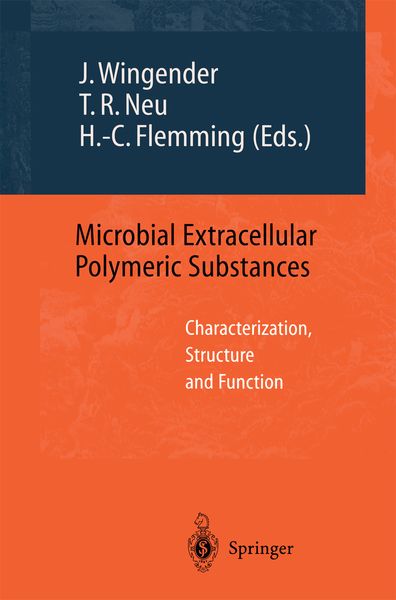
Produktbild: Microbial Extracellular Polymeric Substances

Microbial Extracellular Polymeric Substances Characterization, Structure and Function

96,99 €

inkl. gesetzl. MwSt., Versandkostenfrei


Beschreibung

Produktdetails

Einband

Taschenbuch

Erscheinungsdatum

03.10.2011

Abbildungen

XIV, 258 p. 6 illus. in color.

Herausgeber

Jost Wingender + weitere

Verlag

Springer Berlin

Seitenzahl

258

Maße (L/B/H)

23,5/15,5/1,6 cm

Gewicht

423 g

Auflage

Softcover reprint of the original 1st ed. 1999

Sprache

Englisch

ISBN

978-3-642-64277-7

Beschreibung

Produktdetails

Einband

Taschenbuch

Erscheinungsdatum

03.10.2011

Abbildungen

XIV, 258 p. 6 illus. in color.

Herausgeber

Verlag

Springer Berlin

Seitenzahl

258

Maße (L/B/H)

23,5/15,5/1,6 cm

Gewicht

423 g

Auflage

Softcover reprint of the original 1st ed. 1999

Sprache

Englisch

ISBN

978-3-642-64277-7

Herstelleradresse

Springer-Verlag KG
Sachsenplatz 4-6
1201 Wien
AT

Email: ProductSafety@springernature.com

Ein neues Kapitel für Ihre Bücher

Ein neues Kapitel für Ihre Bücher

Schenken Sie Ihren alten Schätzen ein zweites Leben und erhalten dafür eine Thalia Geschenkkarte.

Jetzt verkaufen
Jetzt verkaufen

Noch keine Bewertungen vorhanden

Verfassen Sie die erste Bewertung zu diesem Artikel

Helfen Sie anderen Kundinnen und Kunden durch Ihre Meinung.

Kundinnen und Kunden meinen

Bewertungen (0)

  • Produktbild: Microbial Extracellular Polymeric Substances
  • What are Bacterial Extracellular Polymeric Substances?.- 1 Introduction.- 2 Definitions of EPS.- 3 Composition, Secretion and Spatial Arrangement of EPS.- 4 Industrial and Clinical Importance of EPS.- 5 Bacterial Alginate — an Example of Bacterial EPS.- 6 Functions of EPS.- 7 Ecological Aspects of EPS.- References.- In Situ Characterization of Extracellular Polymeric Substances (EPS) in Biofilm Systems.- 1 Introduction.- 2 Destructive Analysis of EPS.- 3 Non-Destructive Analysis of EPS.- 4 CLSM Approach.- 5 Image Analyses and Three-Dimensional Data Presentation.- 6 Case Studies: In Situ Characterization of EPS.- 7 Limitations of Non-Destructive Analyses.- References.- Extraction of EPS.- 1 Introduction.- 2 Sampling and Pretreatment.- 3 Extraction of EPS.- 4 Contamination by Intracellular Macromolecules.- 5 Disruption of Macromolecules.- 6 Extraction Efficiency.- 7 Purification and Analysis.- 8 Conclusion.- References.- Biofilm Exopolysaccharides.- 1 Introduction.- 2 Polysaccharide Composition and Structure.- 3 Promotion of Order and Gelation.- 4 Ionic Interactions.- 5 Synergistic Effects.- 6 Other Functions of Biofilm Exopolysaccharides.- 7 Dissolution of Physical Structures.- 8 Conclusions.- References.- Regulation of Matrix Polymer in Biofilm Formation and Dispersion.- 1 Alginate Biosynthesis in Pseudomonas aeruginosa.- 2 Regulation of Alginate Biosynthetic Genes During Biofilm Development.- 3 Control of Biofilm Dispersion.- 4 Activation of Alginate Biosynthesis and Chemical Communication in Biofilms.- 5 P.aeruginosa Biofilm Life Cycle.- References.- Exopolymers of Sulphate-Reducing Bacteria.- Analysis and Function of the EPS from the Strong Acidophile Thiobacillus ferrooxidans.- 1 Introduction.- 2 Leaching Bacteria.- 3 Metal Sulfide Dissolution.- 4 EPS Analysis.- 5Function of EPS.- 6 Conclusions.- References.- Physical and Chemical Properties of Extracellular Polysaccharides Associated with Biofilms and Related Systems.- 1 Introduction.- 2 Biopolymer Gels.- 3 Physical Characterization of Biofilms.- 4 Chemical and Biochemical Characterization of Biofilms.- 5 Bacterial Alginates.- References.- Chemical Communication Within Microbial Biofilms: Chemotaxis and Quorum Sensing in Bacterial Cells.- 1 Introduction.- 2 Bacterial Chemotaxis and Initial Aggregations of Cells.- 3 Microspatial Patterns and Movement of Bacteria Within Biofilms.- 4 Bacterial Quorum Sensing: Induction and Regulation of Activities.- 5 Enhancement of Chemotaxis and Quorum Sensing Processes by the Biofilm Matrix.- 6 The Biofilm as a Microbial Organism.- References.- Function of EPS.- 1 Introduction.- 2 Role of EPS in Cellular Associations.- 3 Role of EPS in Nutrition.- 4 Role of EPS in the Interaction of Microorganisms with their Biological, Physical, and Chemical Environment.- 5 EPS and the Macro-Environment.- 6 Conclusions.- References.- Polysaccharases in Biofilms — Sources — Action — Consequences!.- 1 Polysaccharases in Biofilms.- 2 Nature of Polysaccharases.- 3 Sources of Polysaccharases.- 4 Effects of Enzymes on Biofilms.- 5 Application of Enzymes to Biofilms.- References.- Extracellular Enzymes Within Microbial Biofilms and the Role of the Extracellular Polymer Matrix.- 1 Introduction: Importance of Extracellular Enzymes to Bacterial Cells and Organic Matter Processing.- 2 The Microbial Biofilm and Extracellular Polymers.- 3 Extracellular Polymers as a “Sorptive Sponge” and “Colloidal Trap” for High-Molecular-Weight Organic Matter.- 4 Localization of Enzymes by Extracellular Polymers: the “Lectin-Localization Model”.- 5 “ExtracellularPolymer Microdomains” and the Stability of Extracellular Enzymes.- 6 Environmental Influences on Enzyme Activity.- 7 Biofilm Induction and Regulation of Extracellular Enzymes..- References.- Interaction Between Extracellular Polysaccharides and Enzymes.- 1 Extracellular Enzymes in Biofilms.- 2 Mechanisms of Enzyme and Polysaccharide Secretion.- 3 Interaction of Enzymes with Extracellular Polysaccharides.- 4 Consequences of Enzyme-Polysaccharide Interactions in Biofilms.- References.