• Produktbild: Introduction to Discrete Mathematics with ISETL
  • Produktbild: Introduction to Discrete Mathematics with ISETL

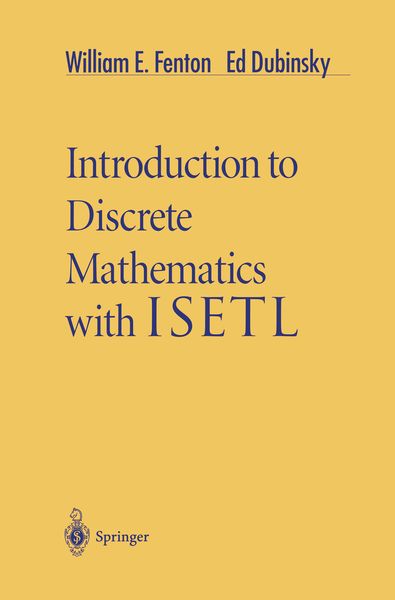
Introduction to Discrete Mathematics with ISETL

49,99 €

inkl. gesetzl. MwSt., Versandkostenfrei


Beschreibung

Produktdetails

Einband

Taschenbuch

Erscheinungsdatum

01.10.2011

Verlag

Springer Us

Seitenzahl

196

Maße (L/B/H)

23,5/15,5/1,2 cm

Gewicht

330 g

Auflage

Softcover reprint of the original 1st ed. 1996

Sprache

Englisch

ISBN

978-1-4612-8480-2

Beschreibung

Produktdetails

Einband

Taschenbuch

Erscheinungsdatum

01.10.2011

Verlag

Springer Us

Seitenzahl

196

Maße (L/B/H)

23,5/15,5/1,2 cm

Gewicht

330 g

Auflage

Softcover reprint of the original 1st ed. 1996

Sprache

Englisch

ISBN

978-1-4612-8480-2

Herstelleradresse

Springer-Verlag GmbH
Tiergartenstr. 17
69121 Heidelberg
DE

Email: ProductSafety@springernature.com

Ein neues Kapitel für Ihre Bücher

Ein neues Kapitel für Ihre Bücher

Schenken Sie Ihren alten Schätzen ein zweites Leben: Einfach Barcode scannen, Versandetikett ausdrucken, Bücher verschicken und Thalia Geschenkkarte erhalten.

Jetzt verkaufen
Jetzt verkaufen

Kundinnen und Kunden meinen

0 Bewertungen

Informationen zu Bewertungen

Zur Abgabe einer Bewertung ist eine Anmeldung im Konto notwendig. Die Authentizität der Bewertungen wird von uns nicht überprüft. Wir behalten uns vor, Bewertungstexte, die unseren Richtlinien widersprechen, entsprechend zu kürzen oder zu löschen.

Die Bewertungen sind nach Format, Anzahl Sterne und Datum sortiert.

Verfassen Sie die erste Bewertung zu diesem Artikel

Helfen Sie anderen Kund*innen durch Ihre Meinung

Kundinnen und Kunden meinen

0 Bewertungen filtern

  • Produktbild: Introduction to Discrete Mathematics with ISETL
  • Produktbild: Introduction to Discrete Mathematics with ISETL
  • 1 Numbers and Programs.- 1.1 The Basics of ISETL.- Activities.- Discussion.- Beginning with ISETL.- Some Syntax.- Familiar Sets of Numbers.- Decimal Representation.- Binary Representation.- Sequences.- Exercises.- 1.2 Divisibility.- Activities.- Discussion.- ISETL funcs—Functions.- ISETL smaps—Functions.- Sources of Functions.- Recursive Functions.- Modular Arithmetic.- Prime Numbers.- Common Divisors.- Common Multiples.- Exercises.- Overview of Chapter 1.- 2 Propositional Calculus.- 2.1 Boolean Expressions.- Activities.- Discussion.- Constants and Variables.- Basic Operations.- Functions Using Boolean Values.- Exercises.- 2.2 Implication and Proof.- Activities.- Discussion.- Conditional Statements.- Variations of Conditional Statements.- Direct Proof.- Indirect Proof.- Proof by Contradiction.- Exercises.- Overview of Chapter 2.- 3 Sets and Tuples.- 3.1 Defining Sets and Tuples.- Activities.- Discussion.- Sets and their Elements.- Tuples and their Elements.- Forming Sets and Tuples.- Sequences.- Recursive Sequences.- Exercises.- 3.2 Operations on Sets.- Activities.- Discussion.- Cardinality.- Subsets.- Basic Combinations of Sets.- De Morgan’s Laws.- Cartesian Products.- Inclusion-Exclusion.- Exercises.- 3.3 Counting Methods.- Activities.- Discussion.- The Multiplication Principle.- Permutations.- Combinations.- The Pigeonhole Principle.- Exercises.- Overview of Chapter 3.- 4 Predicate Calculus.- 4.1 Quantified Expressions.- Activities.- Discussion.- Existential and Universal Quantifiers.- Quantifying over Proposition Valued Functions—Existential.- Quantifying over Proposition Valued Functions—Universal.- Negations.- Reasoning about Quantified Expressions.- Exercises.- 4.2 Multi-Level Quantification.- Activities.- Discussion.- Quantified Statements that Depend on a Variable.- Two-Level Quantification.- Negating Two-Level Quantifications.- Reasoning about Two-Level Quantifications.- Three-Level Quantification.- Exercises.- Overview of Chapter 4.- 5 Relations and Graphs.- 5.1 Relations and their Graphs.- Activities.- Discussion.- Relations.- Representing a Relation.- Properties of Relations.- More about Graphs.- Exercises.- 5.2 Equivalence Relations and Graph Theory.- Activities.- Discussion.- Equivalence Relations.- Types of Graphs.- Subgraphs.- Planarity.- Exercises.- Overview of Chapter 5.- 6 Functions.- 6.1 Representing Functions.- Activities.- Discussion.- Constructing Functions.- Functions as Expressions.- Functions as Sequences.- Functions as Tables.- Functions as Graphs.- The Process of a Function.- Two Definitions.- Exercises.- 6.2 Properties of Functions.- Activities.- Discussion.- Basic Properties.- One-to-One Functions.- Combinations of Functions.- Inverse Functions.- Rate of Growth for Functions.- Exercises.- Overview of Chapter 6.- 7 Mathematical Induction.- 7.1 Understanding the Method.- Activities.- Discussion.- Proposition-Valued Functions.- Eventually Constant Proposition-Valued Functions.- Implication-Valued Functions.- Modus Ponens.- Coordinating the Steps.- Exercises.- 7.2 Using Mathematical Induction.- Activities.- Discussion.- Making Induction Proofs.- The Induction Principle.- Complete Induction.- The Binomial theorem.- Exercises.- Overview of Chapter 7.- 8 Partial Orders.- Activities.- Discussion.- Order on a Set.- Diagrams of Posets.- Topological Sorting.- Sperner’s Theorem.- Exercises.- Overview of Chapter 8.- 9 Infinite Sets.- Discussion.- Sets of Equal Cardinality.- Infinite Sets.- Countable Sets.- Uncountable Sets.- Ordering of Infinite Sets.- Exercises.- Appendix 1: Getting Started With Isetl.- A. Working in the Execution Window.- B. Working with Files.- C. Using Directives.- D. Graphing in ISETL.- Appendix 2: Some Special Code.- Index of Frequently Used Sets and Functions.