• Produktbild: Hardware Evolution
  • Produktbild: Hardware Evolution
- 13%

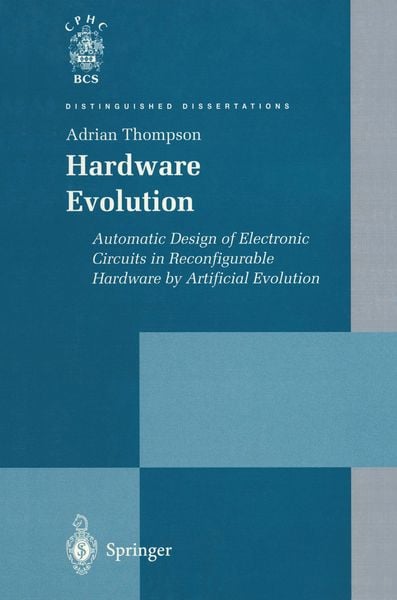
Hardware Evolution Automatic Design of Electronic Circuits in Reconfigurable Hardware by Artificial Evolution

13% sparen

92,99 € UVP 106,99 €

inkl. gesetzl. MwSt., Versandkostenfrei


Beschreibung

Produktdetails

Einband

Taschenbuch

Erscheinungsdatum

13.02.2012

Verlag

Springer London

Seitenzahl

117

Maße (L/B/H)

23,5/15,5/0,8 cm

Gewicht

219 g

Auflage

Softcover reprint of the original 1st ed. 1998

Sprache

Englisch

ISBN

978-1-4471-3416-9

Beschreibung

Produktdetails

Einband

Taschenbuch

Erscheinungsdatum

13.02.2012

Verlag

Springer London

Seitenzahl

117

Maße (L/B/H)

23,5/15,5/0,8 cm

Gewicht

219 g

Auflage

Softcover reprint of the original 1st ed. 1998

Sprache

Englisch

ISBN

978-1-4471-3416-9

Herstelleradresse

Springer-Verlag KG
Sachsenplatz 4-6
1201 Wien
AT

Email: GPSR Kontakt

Ein neues Kapitel für Ihre Bücher

Ein neues Kapitel für Ihre Bücher

Schenken Sie Ihren alten Schätzen ein zweites Leben: Einfach Barcode scannen, Versandetikett ausdrucken, Bücher verschicken und Thalia Geschenkkarte erhalten.

Jetzt verkaufen
Jetzt verkaufen

Noch keine Bewertungen vorhanden

Verfassen Sie die erste Bewertung zu diesem Artikel

Helfen Sie anderen Kundinnen und Kunden durch Ihre Meinung.

Kundinnen und Kunden meinen

Bewertungen (0)

  • Produktbild: Hardware Evolution
  • Produktbild: Hardware Evolution
  • 1. Introduction.- 1.1 Topic.- 1.2 Hardware Evolution.- 1.2.1 An Example of Reconfigurable Hardware.- 1.2.2 Evolving the Circuit Configuration.- 1.2.3 Intrinsic/Extrinsic.- 1.3 Motivation.- 1.4 The Thesis.- 2. Context.- 2.1 Inspiration.- 2.1.1 Mead et al.: Analog neural VLSI.- 2.1.2 Pulse-stream Neural Networks.- 2.1.3 Other Neural Hardware.- 2.1.4 Reconfigurable Hardware.- 2.1.5 Self-Timed Digital Design.- 2.1.6 Analogies with Software: Ray’s Tierra.- 2.1.7 A Dynamical Systems Perspective.- 2.2 Evolutionary Algorithms for Electronic Design: Other approaches.- 2.2.1 ETL.- 2.2.2 deGaris.- 2.2.3 EPFL & CSEM: ‘Embryonics’.- 2.2.4 A Sophisticated Extrinsic Approach: Hemmi et al.- 2.2.5 Evolving Analogue Circuits.- 2.2.6 A Silicon Neuromorph — The First Intrinsic Hardware Evolution?.- 2.2.7 Loosely Related Evolutionary Hardware Projects.- 2.3 Multi-Criteria EAs: Area, Power, Speed and Testability.- 2.4 A Philosophy of Artificial Evolutionx.- 2.4.1 Domain Knowledge, Morphogenesis, Encoding Schemes and Evolvability.- 2.4.2 Species Adaptation Genetic Algorithms (SAGA).- 2.5 The Position of this Book Within the Field.- 3. Unconstrained Structure and Dynamics.- 3.1 The Relationship Between Intrinsic Hardware Evolution and Conventional Design Techniques.- 3.2 Unconstrained Structure.- 3.3 Unconstrained Dynamics.- 3.3.1 Unconstrained Evolutionary Manipulation of Timescales I: Simulation study.- 3.3.2 II: Using a real FPGA.- 3.3.3 A Showpiece for Unconstrained Dynamics: An Evolved Hardware Sensorimotor Control Structure.- 3.4 The Relationship Between Intrinsic Hardware Evolution and Natural Evolution.- 4. Parsimony and Fault Tolerance.- 4.1 Insensitivity to Genetic Mutations.- 4.2 Engineering Consequences of Mutation-Insensitivity.- 4.3 Explicitly Specifying Fault-Tolerance Requirements.- 4.4 Adaptation to Faults.- 4.5 Fault Tolerance Through Redundancy.- 4.6 Summary.- 5. Demonstration.- 5.1 The Experiment.- 5.2 Results.- 5.3 Analysis.- 5.4 Interpretation.- 6. Future Work.- 6.1 Engineering Tolerances.- 6.2 Applications.- 7. Conclusion.- Appendix A. Circuit Diagram of the DSM Evolvable Hardware Robot Controller.- Appendix B. Details of the Simulations used in the ‘Mr Chips’ Robot Experiment.- B.1 The Motor Model.- B.2 The Movement Model.- B.3 The Sonar Model.- References.