
• Produktbild: Vegetables and Vegetable Products
  • Produktbild: Vegetables and Vegetable Products
Band 16

Vegetables and Vegetable Products

96,99 €

inkl. gesetzl. MwSt., Versandkostenfrei


Beschreibung

Produktdetails

Einband

Taschenbuch

Erscheinungsdatum

09.02.2012

Herausgeber

Hans F. Linskens + weitere

Verlag

Springer Berlin

Seitenzahl

187

Maße (L/B/H)

23,5/15,5/1,2 cm

Gewicht

324 g

Auflage

Softcover reprint of the original 1st ed. 1994

Sprache

Englisch

ISBN

978-3-642-84832-2

Beschreibung

Produktdetails

Einband

Taschenbuch

Erscheinungsdatum

09.02.2012

Herausgeber

Verlag

Springer Berlin

Seitenzahl

187

Maße (L/B/H)

23,5/15,5/1,2 cm

Gewicht

324 g

Auflage

Softcover reprint of the original 1st ed. 1994

Sprache

Englisch

ISBN

978-3-642-84832-2

Herstelleradresse

Springer-Verlag KG
Sachsenplatz 4-6
1201 Wien
AT

Email: GPSR Kontakt

Ein neues Kapitel für Ihre Bücher

Ein neues Kapitel für Ihre Bücher

Schenken Sie Ihren alten Schätzen ein zweites Leben und erhalten dafür eine Thalia Geschenkkarte.

Jetzt verkaufen
Jetzt verkaufen

Noch keine Bewertungen vorhanden

Verfassen Sie die erste Bewertung zu diesem Artikel

Helfen Sie anderen Kundinnen und Kunden durch Ihre Meinung.

Kundinnen und Kunden meinen

Bewertungen (0)

  • Produktbild: Vegetables and Vegetable Products
  • Produktbild: Vegetables and Vegetable Products
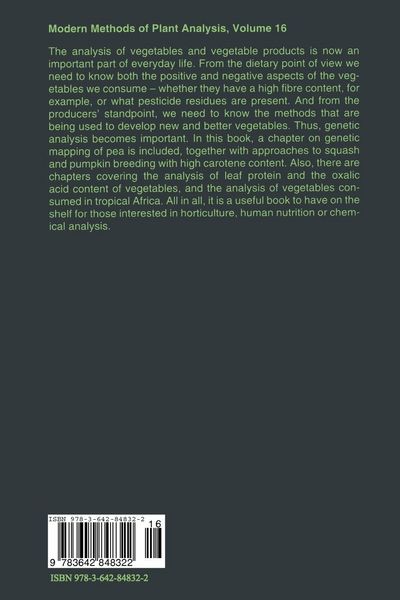
  • The Bulk Extraction and Quality of Leaf Protein.- 1 Introduction.- 2 Species.- 3 Technique of Extraction.- 4 Coagulation and Washing.- 5 Storage.- 6 Composition.- 6.1 Amino Acids.- 6.2 Lipids.- 6.3 Phenolic Substances.- 6.4 Miscellaneous Components.- 7 Fractionation.- 8 Nutritive Value.- References.- Physical and Chemical Analysis of Dietary Fibers in Sugar Beet and Vegetables (With 5 Figures).- 1 Introduction.- 2 Cell Walls of Vegetables.- 2.1 Cell Walls in Relation to Dietary Fibre in Sugar Beet and Vegetables.- 2.2 Structure of the Main Cell Wall Components.- 3 Determination of the Dietary Fibre Content.- 3.1 Enzymatic-Gravimetric Methods.- 3.2 Chemical Methods.- 3.3 Comments and Comparisons.- 3.3.1 Elimination of Starch.- 3.3.2 Elimination of Proteins.- 3.3.3 Determination of Total Dietary Fibre.- 3.3.4 Soluble and Insoluble Dietary Fibres.- 3.3.5 Preparation of Fibre for Its Characterization.- 4 Analysis of the Constituents of Dietary Fibre.- 4.1 Sugar Analysis.- 4.1.1 Acid Hydrolysis of Polysaccharides.- 4.1.2 Neutral Sugars.- 4.1.3 Acidic Sugars.- 4.1.4 Other Methods.- 4.2 Other Cell Wall Components.- 4.2.1 Methanol and Acetic Acid.- 4.2.2 Phenolic Acids.- 4.2.3 Lignin.- 4.2.4 Organic Acids.- 4.3 Chemical Structure of the Polysaccharides.- 4.3.1 Fractional Extractions of Cell Wall Polysaccharides.- 4.3.2 Methylation.- 5 Cation-Exchange Capacity.- 5.1 The Ionic Groups and the Measurement of CEC.- 5.2 Examples of CEC Values.- 6 Hydration Properties.- 6.1 Swelling.- 6.2 Water-Binding Capacity.- 6.2.1 Centrifugation.- 6.2.2 Suction Pressure.- 6.2.3 Filtration.- 6.3 Water-Holding Capacity.- 6.4 Examples of Hydration Values.- 7 Particle Size Determination.- 8 Conclusions.- References.- Texture of Plants (With 6 Figures).- 1 Introduction.- 2 Texture — The Background Materials Science.- 3 Mechanical Tests.- 3.1 Tensile Tests.- 3.2 Compressive Tests.- 3.3 Bending Tests.- 3.4 Fracture Tests.- 3.4.1 Tensile Fracture — Parenchyma.- 3.4.2 Tensile Fracture — Skin.- 3.4.3 Compressive Fracture.- 3.4.4 Wedging.- 3.4.5 Cutting.- 3.4.6 Beam Test.- 3.4.7 Impact Loading.- 4 Interactions of Material and Shape — Hierarchies.- References.- Analysis of Fungicide Residues in Vegetables and Vegetable Products.- 1 Introduction.- 2 Multiresidue Methods.- 3 Single Residue Methods.- 3.1 EBDC and Other Dithiocarbamates.- 3.2 Fosteyl-Al Aluminum Tris.- 3.3 Benomyl (as MBC) and 2-AB.- 3.4 Chlorothalonil, HCB, PCBN, SDS-3701 and SDS-46851.- 3.5 Triadimefon, KWG-0519, KWG-1342 and KWG-1323.- 3.6 Metalaxyl (Total Residues).- References.- Genetic Analysis and Breeding of Pumpkins and Squash for High Carotene Content.- 1 Introduction, Taxonomy, and Diversity.- 1.1 Etymology of Pumpkins and Squash.- 1.2 Geographic Origin.- 1.3 Wild vs Cultivated Cucurbita.- 1.4 Agricultural Importance.- 1.5 Fruit Diversity.- 1.6 Significance of Fruit-Fresh Color.- 2 Carotenoid Analysis and Vitamin A Value.- 2.1 Nature and Types of Carotenoids.- 2.2 Extraction and Separation of Carotenoids.- 2.3 Total Carotenoids.- 2.4 Total Carotenes.- 2.5 Percent Carotenes of Carotenoids.- 2.6 Individual Carotenes and Vitamin A Value.- 3 Genetics of Fruit Pigmentation.- 3.1 Fruit Coloration and Pigment Content.- 3.2 Genes Affecting Coloration and Total Carotenoid Content.- 3.3 Genes Affecting Carotene, Percent Carotene, and Beta-Carotene Contents.- 4 Breeding for High Carotene Content.- 4.1 Early History.- 4.2 Mode of Reproduction of Cucurbita.- 4.3 Difficulties in Breeding Improved Pumpkins and Winter Squash.- 4.4 Successes in Breeding Improved Pumpkins and Winter Squash.- 4.5 Gene B in Breeding for High Carotene Content.- 4.6 Strategies in Breeding for High Carotene Content.- 4.7 Other Characteristics to Consider in Breeding for High Carotene Content.- 4.8 Possibilities Offered by Interspecific Crosses.- References.- Approaches to the Genetic Mapping of Pea (With 8 Figures).- 1 Introduction.- 1.1 General Comments.- 1.2 Scope and Aims.- 2 Segregation Data.- 2.1 Population Structures.- 2.2 Classical Markers.- 2.3 Isozymes.- 2.4 Restriction Fragment Length Polymorphism Markers.- 2.4.1 Preparation of Pea Genomic DNA.- 2.4.1.1 Method A: Large-Scale Preparation of DNA from Fresh Tissue.- 2.4.1.2 Method B: Small-Scale Preparation of DNA from Fresh Tissue.- 2.4.2 Digestion of Pea Genomic DNA.- 2.4.3 Agarose Gels.- 2.4.3.1 Gel Size and Geometry.- 2.4.3.2 Gel Strength, Buffers and Voltage Gradients.- 2.4.3.3 Sizing of DNA Fragments, Systematic Investigations of Size-Dependent Resolution.- 2.4.4 Southern Blots.- 2.4.5 Choice and Preparation of Probes.- 2.4.5.1 Isolation of DNA Fragments from Agarose or Acrylamide Gels.- 2.4.5.2 Labelling Reactions.- 2.4.6 DNA-DNA Hybridization.- 2.4.6.1 Method C: Probe Preparation for Southern Blot Hybridization.- 2.4.6.2 Method D: Probe Preparation for Church and Gilbert Hybridization.- 2.4.6.3 Mismatch.- 2.4.7 Detection of Hybrids.- 2.5 Oligonucleotide Markers.- 2.6 Polymerase Chain Reaction Markers.- 2.6.1 Dispersed Repeated Sequences and PCR.- 2.6.2 RAPD Markers.- 2.6.3 Minisatellites.- 2.7 Quantitative Traits.- 3 Data Analysis.- 3.1 Data Format.- 3.2 Tests for Linkage.- 3.3 Determination of Marker Orders.- 3.3.1 Finding Markers Which Belong to a Group.- 3.3.2 When Minimization Is Not Appropriate.- 3.4 Presentation of Linkage Data.- 4 Final Comments.- References.- Determination of Oxalic Acid in Vegetables.- 1 Oxalic Acid in Crop Plants.- 2 Precipitation Methods for the Determination of Oxalic Acid in Vegetables.- 3 Modern Methods for the Determination of Oxalic Acid in Vegetables.- 3.1 Gas Chromatography.- 3.2 High-Pressure Liquid Chromatography.- 3.3 Enzymatic Method.- References.- Analysis of Vegetable Foods Consumed in Tropical Africa (With 2 Figures).- 1 Introduction.- 2 Analytical Methods.- 2.1 Moisture Content.- 2.1.1 General.- 2.1.2 Distillation.- 2.1.3 Oven Drying to a Constant Weight With or Without Vacuum.- 2.1.4 Drying in a Desiccator.- 2.1.5 Chemical Methods.- 2.1.6 Other Methods.- 2.2 Analysis of Nitrogen.- 2.2.1 General.- 2.2.2 Procedure.- 2.3 Amino Acids.- 2.3.1 General.- 2.3.2 Acid Hydrolysis.- 2.3.3 Cyst(e)ine.- 2.3.4 Tryptophan.- 2.4 Fat.- 2.5 Fatty Acids.- 2.6 Fat-Soluble Vitamins.- 2.6.1 General.- 2.6.2 Procedure.- 2.6.2.1 Preparation of Standards.- 2.6.2.2 Determination of Standard Purities.- 2.6.2.3 Extraction of the Vitamins.- 2.6.2.4 Apparatus.- 2.7 Analysis of Dietary Fiber.- 2.7.1 Crude Fiber.- 3 Applications: Food Analyses in the Sudan and Kenya.- References.