
• Produktbild: Nuclear Magnetic Resonance
  • Produktbild: Nuclear Magnetic Resonance
Band 2 - 10%

Nuclear Magnetic Resonance

10% sparen

95,99 € UVP 106,99 €

inkl. gesetzl. MwSt., Versandkostenfrei


Beschreibung

Produktdetails

Einband

Taschenbuch

Erscheinungsdatum

08.12.2011

Herausgeber

Hans-Ferdinand Linskens + weitere

Verlag

Springer Berlin

Seitenzahl

196

Maße (L/B/H)

24,4/17/1,2 cm

Gewicht

375 g

Auflage

Softcover reprint of the original 1st edition 1986

Sprache

Englisch

ISBN

978-3-642-82611-5

Beschreibung

Produktdetails

Einband

Taschenbuch

Erscheinungsdatum

08.12.2011

Herausgeber

Verlag

Springer Berlin

Seitenzahl

196

Maße (L/B/H)

24,4/17/1,2 cm

Gewicht

375 g

Auflage

Softcover reprint of the original 1st edition 1986

Sprache

Englisch

ISBN

978-3-642-82611-5

Herstelleradresse

Springer-Verlag KG
Sachsenplatz 4-6
1201 Wien
AT

Email: GPSR Kontakt

Ein neues Kapitel für Ihre Bücher

Ein neues Kapitel für Ihre Bücher

Schenken Sie Ihren alten Schätzen ein zweites Leben und erhalten dafür eine Thalia Geschenkkarte.

Jetzt verkaufen
Jetzt verkaufen

Noch keine Bewertungen vorhanden

Verfassen Sie die erste Bewertung zu diesem Artikel

Helfen Sie anderen Kundinnen und Kunden durch Ihre Meinung.

Kundinnen und Kunden meinen

Bewertungen (0)

  • Produktbild: Nuclear Magnetic Resonance
  • Produktbild: Nuclear Magnetic Resonance
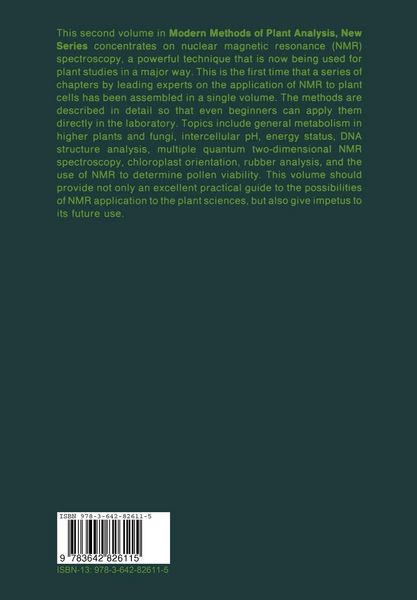
  • 13C-NMR in Metabolic Studies.- 1 Introduction.- 2 The Design and Interpretation of Labelling Experiments.- 3 Radioisotope Labelling.- 4 13C NMR Spectroscopy.- 4.1 Assignment of 13C NMR Spectra.- 4.1.1 Known Chemical Shifts and Substituent Chemical Shift Effects.- 4.1.2 Off-Resonance and Specific Proton Decoupling.- 4.1.3 Analysis of Long-Range 1H-13C Couplings.- 4.1.4 Polarisation Transfer and 2D NMR Methods.- 4.1.5 Lanthanide-Induced Shift Studies.- 4.1.6 Model and Derivative Studies.- 4.1.7 Synthesis of Isotopically Labelled Compounds.- 4.1.8 Incorporation Studies.- 5 Biosynthetic Methodology.- 5.1 Precursor Incorporation.- 6 13C Enrichment Studies.- 6.1 Single 13C-Labelling.- 6.1.1 Quantitative 13C Measurements.- 6.1.2 Single 13C-Labelling Studies in Plants.- 6.2 13C-13C Spin-Spin Coupling.- 6.2.1 Singly 13C-Labelled Precursors.- 6.2.2 Double 13C-Labelled Precursors.- 6.2.3 Non-Contiguous Double 13C-Labelling.- 6.2.3.1 Two-Bond 13C-13C Couplings from Contiguous 13C2-Labelled Precursors.- 6.2.3.2 One-Bond 13C-13C Couplings from Non-Contiguous 13C2-Labelled Precursors.- 6.2.3.3 Two-Bond Couplings from Non-Contiguous 13C2-Labelled Precursors.- 7 13C, 15N Doubly Labelled Precursors.- 8 Isotope-Induced Shifts in 13C NMR.- 8.1 The Deuterium Alpha-Shift Technique.- 8.2 The Deuterium Beta-Shift Technique.- 8.3 18O Isotope Induced Shifts in 13C NMR.- 9 Conclusion.- References.- Determination of the Energy Status of Plant Cells by 31P-Nuclear Magnetic Resonance Spectroscopy.- 1 Introduction.- 2 Principles.- 3 Experimental Considerations.- 4 Quantitation of Metabolite Concentrations of vivo by NMR.- 5 Measurement of Nucleoside Di- and Triphosphate Levels by 31P-NMR.- 6 Estimation of the Extent of Magnesium Ion Binding to Nucleoside Triphosphates in vivo by 31P-NMR.- 7 Measurement of the Gibbs’ Free Energy for Hydrolysis of ATP.- 8 Relationship of in vivo 31P-NMR Measurements to What Is Seen by Other Methods.- 9 Conclusions.- References.- The Use of NMR Spectroscopy to Follow Deuterium in Studies of Fungal Metabolism.- 1 Introduction.- 2 Deuterium NMR Spectroscopy.- 2.1 Background and Techniques.- 2.1.1 The Nuclear Magnetic Properties of Deuterium.- 2.1.2 The Deuterium NMR Spectrum.- 2.1.3 Recording a Deuterium NMR Spectrum.- 2.2 Applications of Deuterium NMR Spectroscopy to Fungal Metabolism.- 2.2.1 Administering the Precursor.- 2.2.2 Establishing the Retention or Loss of a Hydrogen.- 2.2.3 Establishing Precursor-Product Relationships.- 2.2.4 Mechanistic Studies.- 2.2.4.1 Displacement Reactions.- 2.2.4.2 Incorporation of Deuterium Atoms from the Medium.- 2.2.4.3 Following Hydride Shifts.- 2.2.5 The Use of [2-2H3]-Acetate as a Polyketide Precursor..- 2.3 Kinetic Isotope Effects.- 2.4 The Use of Shift Reagents.- 3 Detection of Deuterium Indirectly in the 13C-NMR Spectrum.- 3.1 Background and Techniques.- 3.1.1 Detecting Deuterium Directly Attached to a Carbon Reporter Nucleus (the ?-Shift Technique).- 3.1.2 Detecting Deuterium on a Carbon Adjacent to the Reporter Nucleus (the ?-Shift Technique).- 3.2 Applications to the Study of Biosynthesis in Fungi.- 3.2.1 Quantitative Measurements of Deuterium Retention.- 3.2.2 Determining the Multiplicity of Labelling.- 3.2.3 Labelling a Bond.- 4 Conclusions.- References.- Proton NMR Studies on DNA Structure.- 1 Introduction.- 2 Theoretical Background.- 2.1 Chemical Shifts.- 2.2 Coupling Constants.- 2.3 NOE.- 2.4 Assignments.- 3 Examples.- 4 Summary.- References.- NMR Methods for Determination of Intracellular pH.- 1 Introduction.- 2 Some Principles.- 3 Determinants of Chemical Shift.- 4 Measurement of Chemical Shifts.- 5 Estimating Intracellular pH from Chemical Shifts: Titration Curves.- 6 Other Factors Contributing to Potential Errors in Intracellular pH Measurements Using NMR.- 7 Observation of pH Heterogeneity in Cell Populations and Tissues by NMR.- 8 NMR Signals That Have Been Used as Intracellular pH Indicators.- 9 Assignment of Resonances.- 10 Can the pH in Compartments Other Than Cytoplasm and Vacuole be Measured in Vivo by NMR Methods?.- 11 Conclusions.- References.- Orientation of Chloroplasts in Leaves by 1H NMR Spectroscopy.- 1 Introduction.- 1.1 What is NMR?.- 1.2 NMR Spectra of Plant Leaves.- 2 Experimental Technique.- 2.1 Choosing an NMR Spectrometer.- 2.2 Sample Holders.- 2.3 Sample Preparation.- 2.4 Operating the Spectrometer.- 3 Data Analysis.- 3.1 The Need for a Theory.- 3.2 Review of Leaf Anatomy and Physiology.- 3.3 The Theory.- 3.4 The Model.- 3.5 Calculations.- 4 Examples of Interpreted Spectra.- 4.1 Orientation Dependence.- 4.2 Species Dependence.- 4.3 Effects of Drying.- 4.4 Effects of Freezing.- 5 Future Directions.- References.- 13C-NMR Determination of Rubber Content in Guayule Bushes.- 1 Introduction.- 1.1 Background.- 1.2 Analytical Methods.- 2 Experimental.- 2.1 13C-NMR Spectra.- 2.2 Sample Preparation.- 2.2.1 Guayule Material.- 2.2.2 Sample Geometry.- 2.3 Calibration Curve.- 3 Results and Discussion.- 3.1 13C-NMR Spectra.- 3.2 Sample Preparation.- 3.2.1 Guayule Sample.- 3.2.2 Sample Geometry.- 3.2.2.1 Calibration Plot.- 3.3 Quantitative Results.- 3.3.1 Milled Bush.- 3.3.1.1 Precision of the Method.- 3.3.2 Guayule Branches.- 3.3.3 Branches of Different Sizes; Bark.- 3.3.4 Branches, Trunk, Roots.- 3.3.4.1 Extraction Options.- 4 Conclusions.- Appendix A 13C-NMR Method.- References.- Nuclear Magnetic Resonance and Pollen Quality.- 1 What is the Pollen Grain?.- 1.1 Organization and Role.- 1.2 Water Content, Membrane Organization and Pollen Viability.- 2 1H-NMR — Water Content.- 2.1 Method.- 2.2 General.- 2.3 Water Content Evolution.- 2.4 Water State Evolution.- 2.4.1 Relaxation Time.- 2.4.2 Hydric Compartmentation.- 2.5 Dehydration Control and Cryptobiotic Organisms.- 3 31P, 13C-NMR and Membrane State.- 3.1 Structural Polymorphism.- 3.2 Functional Aspects of Membrane Polymorphism.- 3.2.1 Hexagonal Configuration: HII.- 3.2.2 Vesicular, Micellar or Inverted Micellar Configuration..- 3.2.3 Application to Water Stress.- 3.3 13C-NMR and Membrane State.- 4 Conclusions.- References.