• Produktbild: Engineering Databases
  • Produktbild: Engineering Databases

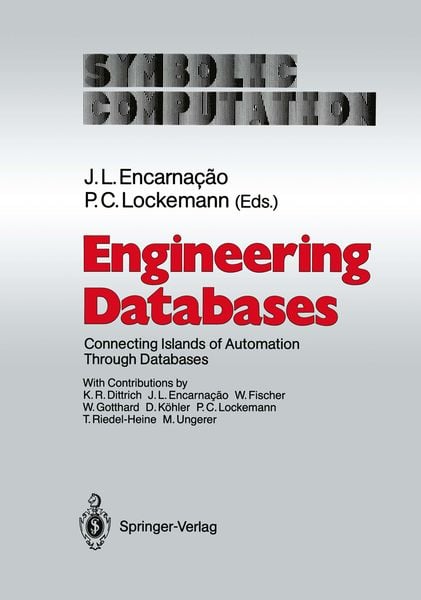
Engineering Databases Connecting Islands of Automation Through Databases

97,99 €

inkl. gesetzl. MwSt., Versandkostenfrei


Beschreibung

Produktdetails

Einband

Taschenbuch

Erscheinungsdatum

01.10.2011

Herausgeber

Jose L. Encarnacao + weitere

Verlag

Springer Berlin

Seitenzahl

229

Maße (L/B/H)

24,2/17/1,4 cm

Gewicht

425 g

Auflage

Softcover reprint of the original 1st ed. 1990

Sprache

Englisch

ISBN

978-3-642-64859-5

Beschreibung

Produktdetails

Einband

Taschenbuch

Erscheinungsdatum

01.10.2011

Herausgeber

Verlag

Springer Berlin

Seitenzahl

229

Maße (L/B/H)

24,2/17/1,4 cm

Gewicht

425 g

Auflage

Softcover reprint of the original 1st ed. 1990

Sprache

Englisch

ISBN

978-3-642-64859-5

Herstelleradresse

Springer-Verlag KG
Sachsenplatz 4-6
1201 Wien
AT

Email: ProductSafety@springernature.com

Ein neues Kapitel für Ihre Bücher

Ein neues Kapitel für Ihre Bücher

Schenken Sie Ihren alten Schätzen ein zweites Leben: Einfach Barcode scannen, Versandetikett ausdrucken, Bücher verschicken und Thalia Geschenkkarte erhalten.

Jetzt verkaufen
Jetzt verkaufen

Kundinnen und Kunden meinen

0 Bewertungen

Informationen zu Bewertungen

Zur Abgabe einer Bewertung ist eine Anmeldung im Konto notwendig. Die Authentizität der Bewertungen wird von uns nicht überprüft. Wir behalten uns vor, Bewertungstexte, die unseren Richtlinien widersprechen, entsprechend zu kürzen oder zu löschen.

Die Bewertungen sind nach Format, Anzahl Sterne und Datum sortiert.

Verfassen Sie die erste Bewertung zu diesem Artikel

Helfen Sie anderen Kund*innen durch Ihre Meinung

Kundinnen und Kunden meinen

0 Bewertungen filtern

  • Produktbild: Engineering Databases
  • Produktbild: Engineering Databases
  • 1 Significance of Engineering Databases.- 1.1 The Situation.- 1.1.1 Evolution of Engineering/Scientific Data Processing (CAx).- 1.1.2 Oceans of Information.- 1.1.3 Bridging the Islands.- 1.2 The Solution.- 1.2.1 Integration Through Databases.- 1.2.2 CIE: Computer Integrated Enterprise.- 1.3 The Architecture of an Engineering Database System.- 1.3.1 Conceptual Aspects.- 1.3.2 Hybrid Solutions.- 1.4 Organizational Procedures.- 1.4.1 Information Engineering.- 1.4.2 Management Aspects.- 1.5 Further Reading.- 2 Database Technology.- 2.1 Concepts and Terminology.- 2.1.1 Characteristics of Database Systems.- 2.1.2 Operation of Database Systems.- 2.1.3 Outline of the Chapter.- 2.1.4 A Running Example.- 2.2 Data Organization and Manipulation: Current Status.- 2.2.1 The Classical Data Models.- 2.2.1.1 The Hierarchical Data Model.- 2.2.1.2 The Network Data Model.- 2.2.1.3 The Relational Data Model.- 2.2.2 Database System Interfaces.- 2.2.2.1 Database Languages and Standards.- 2.2.2.2 The Hierarchical Data Model.- 2.2.2.3 The Network Data Model.- 2.2.2.4 The Relational Data Model.- 2.2.3 Database Consistency.- 2.2.3.1 Consistency Control.- 2.2.3.2 Expressing Consistency Constraints.- 2.2.4 Concurrency.- 2.2.5 Database Recovery.- 2.2.6 Transaction Management.- 2.2.7 Miscellaneous Services.- 2.2.7.1 Protection.- 2.2.7.2 Mass Data Input and Output.- 2.2.7.3 Data Dictionary.- 2.2.8 System Organization and Environment.- 2.2.8.1 Distribution Aspects.- 2.2.8.2 Hardware and Operating System Aspects.- 2.2.9 Performance Control.- 2.2.10 Further Reading.- 2.3 Database Systems for Engineering Applications: A New Focus.- 2.3.1 Perspectives.- 2.3.2 Data Model.- 2.3.3 Database System Interface.- 2.3.4 Database Consistency.- 2.3.5 Concurrency.- 2.3.6 Database Recovery.- 2.3.7 Transaction Management.- 2.3.8 Miscellaneous Services.- 2.3.9 System Organization.- 2.3.10 Performance Control.- 2.4 Data Organization and Manipulation: Taking Care of the New Focus.- 2.4.1 Trends and Objectives.- 2.4.2 Data Models.- 2.4.2.1 Semantic Concepts.- 2.4.2.2 Object Identification.- 2.4.2.3 Objects and Relationships.- 2.4.2.4 Attributes.- 2.4.2.5 Object-Oriented Database Systems.- 2.4.3 Other Issues.- 2.4.4 Further Reading.- 3 Utilization of Engineering Databases.- 3.1 Motivation.- 3.2 Database Schema Design.- 3.2.1 Principles of Schema Definition.- 3.2.2 Typical Situations.- 3.2.3 Objects and Interdependencies.- 3.2.3.1 Object Representations.- 3.2.3.2 Object Interdependencies.- 3.2.3.3 Library and Object Overlapping Information.- 3.3 Version Management.- 3.3.1 Version Generation in the Course of a Design Process.- 3.3.2 Modeling of Version Interrelations.- 3.3.3 Configuration Modeling Based on Version Management.- 3.3.4 Support of Design Control.- 3.3.5 Version and Configuration Management Based on DAMOKLES.- 3.4 Generating and Entering Data.- 3.4.1 Criteria for Characterizing the Generation Process.- 3.4.2 Commercial Applications.- 3.4.3 Engineering Applications.- 3.4.4 Example.- 3.5 Archiving Database Objects.- 3.5.1 General Requirements for an Archiving Mechanism in a Database System.- 3.5.2 Archiving Objects.- 3.5.3 Archiving Versions.- 3.5.4 Archiving Configurations.- 3.6 Data Interchange.- 3.6.1 Importance of Data Interchange in Engineering Applications.- 3.6.2 Data Interchange in Different Levels of System Integration.- 3.6.3 Kind and Structure of Interchange Data.- 3.6.4 Requirements for Data Interchange in New Comprehensive Applications.- 3.6.5 Example of a New Format for VLSI-Design: EDIF.- 3.7 Application Programming.- 3.7.1 Application Programming in Different Levels of System Integration.- 3.7.2 Use of Database Functions for Application Programming.- 3.8 Further Reading.- 4 Case Studies.- 4.1 VLSI Design.- 4.1.1 The E.I.S. Project — Conception of an Integrated Open VLSI Design System.- 4.1.2 Representation of Design Information in Relational Databases.- 4.1.2.1 Modeling of Design Objects for Extensions of Relational Databases.- 4.1.2.2 Implementing an Operational Interface on Top of the Relational Database System ORACLE.- 4.1.3 EDIF-Oriented Design Systems.- 4.1.3.1 EDIF-Oriented Database Schemes.- 4.1.3.2 The EDIF System — Support Tools for Checking and Previewing EDIF.- 4.2 Software Engineering.- 4.2.1 Software Engineering Environments.- 4.2.1.1 Requirements of Software Engineering.- 4.2.1.2 A System Engineering Environment.- 4.2.2 The PRODAT Object Model.- 4.2.2.1 Simple Objects.- 4.2.2.2 Structured Objects and Relationships.- 4.2.2.3 Completeness of Objects.- 4.2.2.4 Standard Relationships in Software Engineering.- 4.2.2.5 Versions.- 4.2.2.6 Configurations.- 4.2.3 Tool Using PRODAT — The Object Editor.- 4.2.4 PRODAT as Interface to DAMOKLES in Software Engineering.- 4.3 Further Reading.